Humanoid robots: Tesla's bet on the next industrial revolution
The market for humanoid robots could grow to up to 200 billion US dollars by 2035. Tesla is positioning itself as a pioneer in this new industry with its Optimus robot. However, competitors from the USA and China are also investing heavily in the technology.


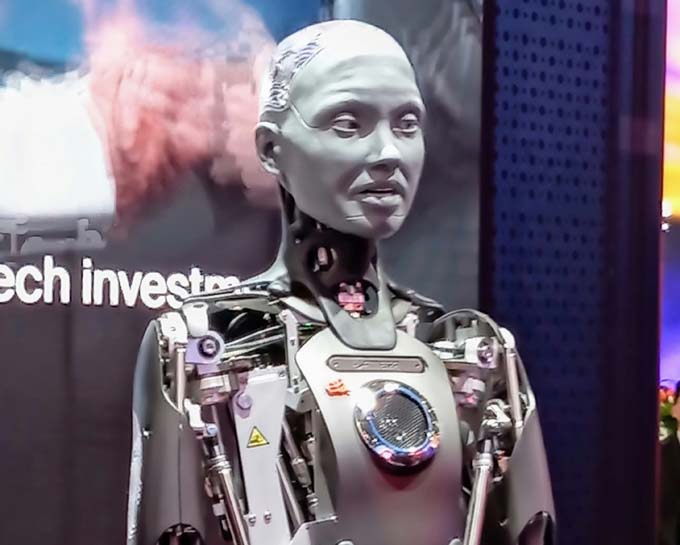
From car manufacturer to robotics company? What has long sounded like a vision of CEO Elon Musk at Tesla is now taking concrete shape. Humanoid robots - machines with a human-like shape, sensors and autonomy - are developing from a research project into an industry potentially worth billions. For investors, the question is: is this the next big platform on the verge of a breakthrough?
A market with enormous leverage
The global market for humanoid robots is still in its infancy, but the growth expectations are extraordinary. Analysts at Goldman Sachs estimate that the market could reach a volume of 150 to 200 billion US dollars by 2035, with annual growth rates of over 40 percent. By 2030, more than one million humanoid robots could be in use worldwide - initially in industry, logistics and care, and later in the service sector.
By comparison, the current market for industrial robots is worth around 16 billion US dollars a year. Humanoid robots would structurally expand this category. Not replacing, but complementing.

Tesla Optimus: The most ambitious approach
Tesla is at the center of attention. With its humanoid robot Optimus, the company is taking a radically different approach to traditional robotics manufacturers. While competitors focus on specialized tasks, Tesla wants to develop a universally deployable worker.
Optimus is around 1.73 meters tall, weighs around 70 kilograms, can carry up to 20 kilograms according to Tesla and is controlled by the same AI systems as Tesla's vehicles. At its heart is the self-developed Full Self-Driving (FSD) AI system, supplemented by neural networks for gripping, walking and object recognition.
Elon Musk puts the long-term production costs per unit at less than 20,000 US dollars - a figure that would have a disruptive effect if industrial scaling were achieved. By comparison, humanoid prototypes today often cost over 100,000 US dollars.
The strategic advantage: data, software, scaling
Tesla's decisive advantage lies less in its mechanics than in its software and data basis. No other provider has comparable experience with real-time sensor fusion, visual AI in complex environments and series production in the millions.
Musk argues that Optimus could become more valuable than the car business in the long term. With several hundred million jobs worldwide in simple, repetitive activities, the addressable market is enormous. Crucially for investors, even low market penetration would have a massive impact on Tesla's valuation.
Strong competition from the USA and China
However, Tesla is not alone. In the US, Boston Dynamics (Hyundai Group as shareholder) is driving development with its humanoid Atlas, which today works autonomously alongside humans in Hyundai factories. Figure AI, backed by Microsoft, OpenAI and Nvidia, has reached a valuation of around 40 billion US dollars in 2025 and is already testing humanoid robots in factories such as UPS and BMW.
In China, companies such as Xiaomi, Unitree Robotics and state-funded research institutions are investing heavily in humanoid systems. China sees robotics as a key strategic industry, especially against the backdrop of demographic change.
The silent beneficiaries: chips, actuators, AI
As with previous technology cycles, attractive opportunities arise beyond the end products. With its AI accelerators, Nvidia provides the computing power for training and simulating humanoid movements. Qualcomm is working on energy-efficient edge chips for autonomous robotics. Manufacturers of electric motors, actuators and sensors - such as Harmonic Drive, Nabtesco and Bosch - are benefiting from the increasing demand for precision and reliability.
Despite all the euphoria, caution is still required. Humanoid robots are technically extremely complex. Autonomy, safety, energy efficiency and regulatory issues remain unresolved. In the short term, humanoid robots will not replace human workers, but will initially provide support - for example in factories, warehouses or care facilities.
For Tesla, this means that Optimus will not generate any significant sales in the coming year. The valuation is still primarily based on the automotive business. But in the long term, an asymmetric option opens up: if the project fails, the damage will be limited; if the breakthrough succeeds, Tesla could dominate an entirely new industry, which could be the largest industry ever created.
Outlook: The next big platform?
Humanoid robots could become what the smartphone was for the digital world: a universal interface between humans and technology. For investors, it is crucial to distinguish between vision and feasibility. Tesla brings both, but also considerable risks.
One thing is certain: The race for humanoid robots has begun. And as is so often the case with technology: Whoever controls the platform controls the market.
Source and further information: DNB Asset Management