M&A Succession Forum celebrates premiere in Zurich
On May 7, 2026, the Swiss M&A Succession Forum took place for the first time at Volkshaus Zurich. Initiated by the Swiss umbrella organization for corporate succession - CHDU and held jointly with Dealcircle GmbH as co-organizer, the conference focused on one of the most pressing economic issues of the coming years: the successful handover of companies.


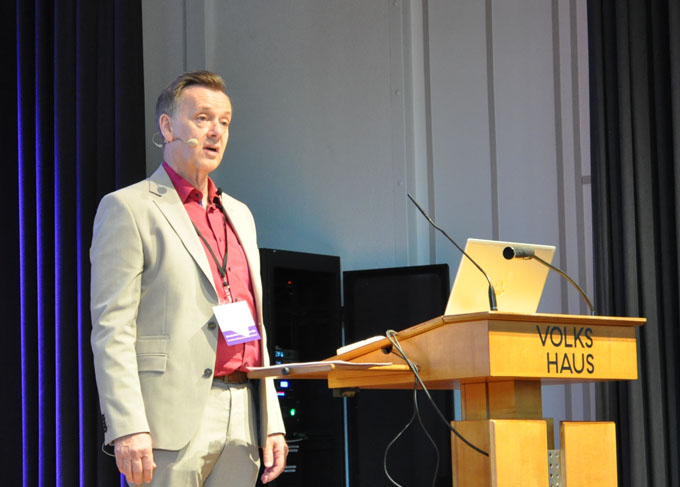
Company succession is an economic focal point: over 90,000 companies are about to be handed over to the next generation in the next few years. Thousands of jobs are at stake. In his keynote speech, Hans Jürg Domenig, President of the Swiss umbrella organization for company succession - CHDU, emphasized that the question posed as the conference motto ’Who will save prosperity« was therefore anything but rhetorical. Fabian Streiff, Head of the Office of Economic Affairs of the Canton of Zurich, also emphasized the importance of the topic, especially since a clear majority of the population - 81% according to a recent survey - considers SMEs to be economically important, i.e. more important than start-ups or large companies. »You don't just have to think about start-ups or innovations, but also about company transfers,« said Fabian Streiff.
How AI is used in follow-up processes
There are various forms of succession solutions: Change of ownership within a family, management buyout, resale to another company or mixed forms of these. The aim of the M&A Succession Forum was to create a concentrated meeting place for networking between entrepreneurs, buyers and sellers, advisors, investors, academia, business and politics. «Matchmaking» was therefore a frequently heard term at the event. Identifying the ideal buyer is also one of the biggest challenges when transferring a company. Digitizing this process is one of Dealcircle GmbH's goals. Graig Gröbli, Co-Founder and Managing Partner of this company, explained the growing number of AI applications in M&A processes, for example for contract analysis, due diligence or correspondence by AI agents. However, an explicit single AI tool for M&A does not yet exist. «The M&A process cannot yet be fully digitalized,» says Gröbli. Decision-making remains human, and the «gut feeling» or chemistry between seller and buyer cannot be controlled by software.
However, we know that AI is making huge progress when it comes to quasi-human interactions. According to Prof. Dr.-Ing. Andreas Lorenz from the University of Applied Sciences and Arts Northwestern Switzerland, so-called «AI doubles», i.e. digital twins of decision-makers, are a major trend. The fact that such «virtual bosses» will decide on a successor themselves is certainly still a dream of the future. But they can be a means of making entrepreneurial decision-making knowledge accessible to successors. After all, the transfer and preservation of know-how plays a decisive role in every company handover. When AI comes into play here, the following four aspects must remain fulfilled, according to Andreas Lorenz: Trust, credibility, discretion and empathy.
Different M&A cultures
What was striking: Quite a few participants at the M&A Succession Forum also came from Germany. It was therefore interesting to take a comparative look at the topic of succession between Switzerland and its northern neighbor. The differences are of course most clearly visible in the figures: While around 90,000 companies in Switzerland are facing succession by 2030, the figure in Germany is around 570,000, 88 percent of which are in the small-cap sector. Another major difference between the two countries: In Switzerland, the proportion of successions within the family is significantly higher (41 percent). There are also differences in the advisory landscape: In Germany, this is more standardized, while in Switzerland it is more relationship-oriented.
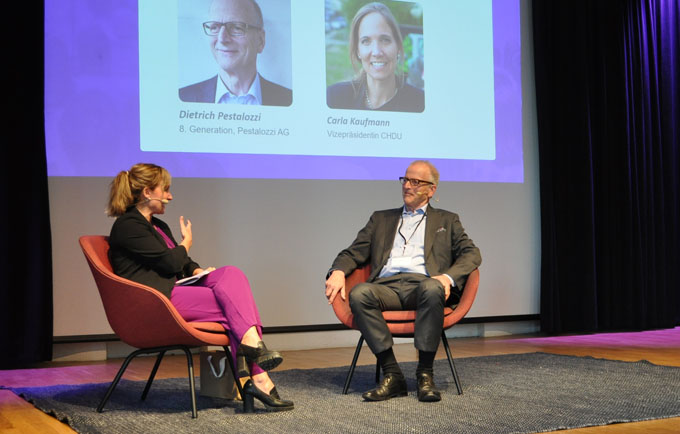
The best practice example of the steel and building materials trading company Pestalozzi AG also showed that successful company successions can hardly be achieved without external advice. Dietrich Pestalozzi, representative of the 8th generation, described anecdotally in conversation with Carla Kaufmann, Vice President CHDU, how the handover to the ninth generation was successful. External coaches and lawyers were selected after «family assessments». According to Dietrich Pestalozzi, however, it is always important to give the descendants confidence and to uphold responsibility towards the family.
In a second practical example, René Spielmann, Delegate of the Board of Directors and co-owner of Rüetschi AG, a company that can look back on more than 650 years of history, addressed organizational challenges. He showed how a company can remain «viable» in the long term by constantly adapting to new circumstances. This includes not only ensuring that the company always earns enough money to be able to pay salaries, but also taking care of a successor in good time.
Company succession: A topic that has arrived in politics
Dr. Simone Häberli, Head of SME Policy at SECO, first addressed the political component of the succession issue. She also emphasized the economic relevance of successful company successions. «A succession is generally more successful than a start-up,» she said, referring to the fact that many young companies survive for around five years. Promoting succession is therefore also a concern of the federal government, which is pursuing the following approaches: Providing information and raising awareness (via its own SME platform), seeking cooperation and dialog and facilitating financing. In this respect, the four guarantee cooperatives BGOst, BGMitte, Cautionnement Romand and BG Saffa (explicitly for female entrepreneurs) provide access to secure financing by guaranteeing loans of up to CHF 1 million from the banks.
The need for constant dialog between politics and business was finally demonstrated in the concluding panel discussion. One of the topics discussed was the motion by National Councillor and panelist Dominik Blunschy, which calls for the removal of barriers to company succession. This motion was adopted in April and calls on the Federal Council to eliminate existing disadvantages compared to start-ups. While all the conservative parliamentary groups supported this request, the SP voted against it. The fact that the M&A Succession Forum was held in the Volkshaus of all places - for some a symbol of socialist Zurich - is probably an irony of history...
Note: The next M&A Succession Forum will take place on May 13, 2027. Further information: www.nachfolgeforum.ch and www.chdu.ch