Battery storage systems are becoming increasingly important for the energy system
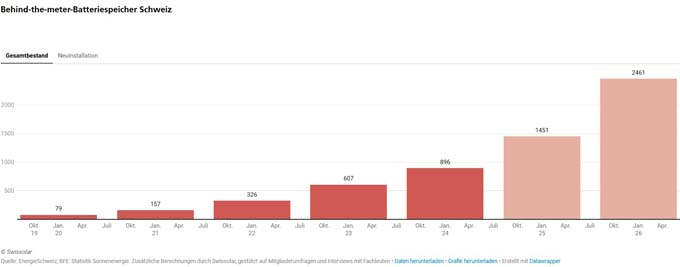
The new Battery Monitor Switzerland 2026 from Swissolar shows: The market for battery storage is developing rapidly and new installations have almost doubled within a year. Nevertheless, better framework conditions are needed so that their potential for the energy system can be fully utilized in the future.





With the expansion of photovoltaics, a large proportion of electricity production takes place during daylight hours. Battery storage systems make it possible to use this electricity more flexibly in terms of time: they store solar power and make it available again later for self-consumption. This increases the use of locally produced electricity, power peaks are smoothed out, local grid loads are reduced and buildings can even be self-sufficiently supplied with electricity in emergencies. «Battery storage systems make an important contribution to an electricity system with a high proportion of renewable energies,» says Matthias Egli, Managing Director of Swissolar, the solar industry association. «They help to use solar power efficiently, reduce the load on the electricity grids and lower overall costs.»
Market growing rapidly
The Battery Monitor 2026 shows that the market for battery storage in Switzerland is growing strongly. Behind-the-meter storage systems in particular, which are installed directly at households, agricultural or commercial enterprises, are increasing significantly. By the end of 2026, the storage capacity installed behind the grid connection point in Switzerland will grow from 1.5 to 2.5 GWh within a year, with new installations almost doubling.
At the same time, larger battery storage systems in the electricity grid (front-of-the-meter storage) are becoming increasingly important. Various companies from the electricity sector have announced the construction of over 4 GWh of additional storage capacity by 2030. That is 30 times the capacity installed today. In addition to energy storage, these large-scale storage facilities can also take on tasks for the stability of the electricity system, for example by providing balancing energy or other system services.
The market is also growing strongly internationally: around 27.1 GWh of new battery storage capacity was installed in the European Union in 2025, an increase of 45% compared to the previous year.
Falling costs increase attractiveness
In parallel with market growth, the cost of battery storage systems is falling significantly. A typical home storage system with a capacity of 15 kWh now costs around CHF 8,800 in Switzerland, including installation, which is around a quarter less than in the previous year. Battery storage systems are therefore becoming increasingly economically attractive, especially in combination with photovoltaic systems.
With the further expansion of photovoltaics, the importance of energy storage systems will also continue to increase. In addition to stationary battery storage systems, electric cars could also provide additional flexibility in the electricity system in future through bidirectional charging.
Better tariff incentives and a national storage strategy are needed
Swissolar points out that battery storage systems can develop their full potential if the right framework conditions are in place. First and foremost, energy suppliers must consistently offer dynamic, grid- and system-friendly tariffs in order to reduce system costs, according to the industry association. The Battery Monitor also recommends that the national storage strategy should define clear and simple rules for the use of battery storage in the electricity system as well as a better data basis for the development of the storage market.
Source: Swissolar