PFAS Forward Action Summit: Act instead of wait and see
The PFAS Forward Action Summit took place in Zurich on March 25, 2026. Representatives from science, industry, regulation and technology discussed how concrete progress can already be made in containing PFAS despite dynamic developments.





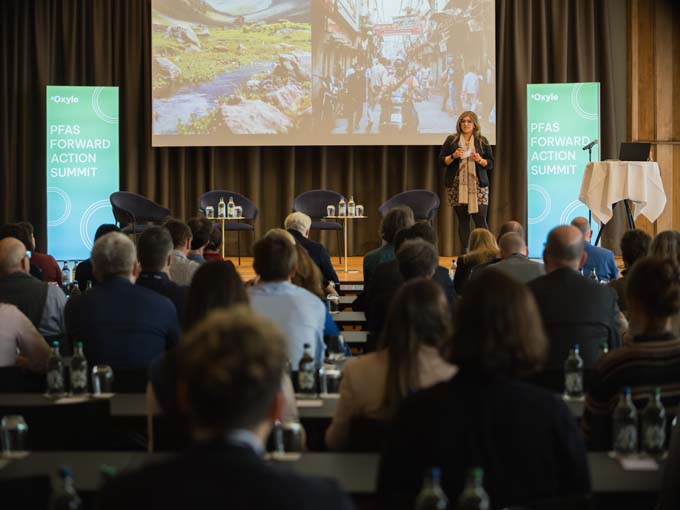
When dealing with PFAS, waiting is no longer an option. Instead of waiting for complete scientific or regulatory clarity, solutions must be implemented with the means available today. This conclusion was the focus of the «PFAS Forward Action Summit», which was organized by the Swiss cleantech company Oxyls (here our Interview with co-founder Dr. Fajer Mushtaq, paid articles) recently brought together around 100 experts from all over Europe.
PFAS: Eight million different chemical compounds
A key topic was the growing importance of substances that have received little attention to date. Dr. Hans Peter Arp (Norwegian Geotechnical Institute / NTNU) presented current research on trifluoroacetic acid (TFA) - an ultra-short-chain PFAS compound that is increasingly becoming the focus of research and practice due to its high mobility and persistence.
Dr. Emma Schymanski (University of Luxembourg) illustrated just how big the challenge really is: "Based on the OECD definition, more than eight million potential PFAS can be identified in chemical databases such as PubChem - significantly more than the individual substances frequently discussed to date.
The regulatory picture also remains complex. Stefan Voorspoels (VITO) and Eléonore Mullier (Steptoe) described a European regulation that is gaining momentum but remains fragmented. Although the REACH restriction process provides orientation, it also increases the complexity for companies that already have to make investment and technology decisions today. This tension between political ambition and practical implementation is characteristic of the current PFAS debate in Europe.
Regulation and traceability necessary
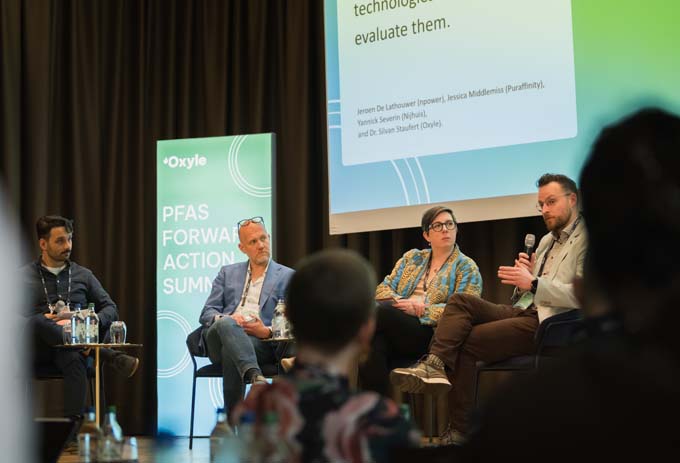
In the midst of all these developments - advancing science, new substances, changing regulation - the question arises: how can informed treatment decisions be made today? A panel discussion with Jeroen De Lathouwer (npower), Jessica Middlemiss (Puraffinity), Yannick Severin (Nijhuis Saur Industries) and Silvan Staufert (Oxyle) addressed this very issue: how to define site-specific requirements, what criteria to consider when selecting treatment approaches and how to make robust decisions in a field where options continue to proliferate. According to Kelly Thompson (Global Water Intelligence), there is also a significant acceleration of investment on the horizon, making such structured assessment more important than ever.
Zachary Neigh (AECOM) showed how PFAS chemometrics is increasingly becoming a powerful tool for identifying and tracing sources of contamination. Practical examples from Dr. Marcel Riegel (TZW DVGW-Technologiezentrum Wasser) and Frédéric Rondeau (Swiss Federal Roads Office FEDRO) illustrated how greatly contamination scenarios can differ - and that no site can be treated according to a uniform approach.
In a concluding discussion between Dirk Nuyens (ERM) and Dr. Fajer Mushtaq (CEO and co-founder of Oxyle), the key finding of the day was reaffirmed: Waiting does not reduce risks, in many cases it actually increases them. «Everyone comes at the topic of PFAS from different perspectives - but what unites everyone in this room is the clear will to solve the problem. There is a special power in bringing all parts of this ecosystem together, learning from each other and building on each other. This is exactly what we wanted to create space for - and this is exactly why we will continue to drive this dialog forward,» said Fajer Mushtaq, summing up the conference.
Source and further information: Oxyls