Sustainable funds: awareness of social issues is increasing
Sustainable funds are still popular. However, the majority of such funds are "green". Social aspects are still given little weight. This is also because implementation is very challenging. This is shown by a new study by Lucerne University of Applied Sciences and Arts.
The post Sustainable funds: awareness of social issues is increasing appeared first on Organizer.


Sustainable mutual funds are continuing to grow. Last year, the number of funds on offer in Switzerland increased by 15% to 2,155 - five times more than five years ago. Despite this growth, however, "sustainable" funds remain a niche market and only account for 22% of all mutual funds on the Swiss market. However, the latest capital flows show that eco-social investments are very popular with investors: Investors invested more than 90 percent of all newly allocated funds in corresponding vehicles last year. However, not all sustainability dimensions are given equal consideration in the funds. This is shown by the new edition of the Sustainable Investments Study by Lucerne University of Applied Sciences and Arts (HSLU).
Review of social sustainability criteria difficult
94% of sustainable funds meet the minimum standards of the Swiss Asset Managers Association (AMAS). However, the majority of the 2,155 sustainable funds in Switzerland focus on environmental issues such as climate risks. Social criteria are still rarely taken into account across the board. Only the review of companies for compliance with minimum social standards such as human and labor rights has become established: Sustainable funds check their investments for compliance with established standards of the United Nations or OECD countries much more frequently than conventional funds.

"Checking companies for breaches of social norms is extremely challenging, however, and the assessment is subjective," says co-author of the study and Professor Manfred Stüttgen. Even specialized rating agencies do not always agree on the assessment. However, such discrepancies are not surprising and can be explained by differences in methodology. For the clear majority of sustainable funds, established rating agencies come to the conclusion that they are not invested in companies that violate international social standards.
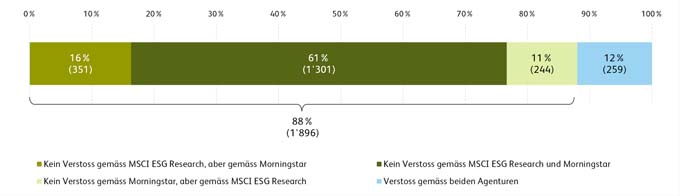
In contrast, these agencies unanimously identified breaches of standards in twelve percent of the funds. Co-study author Brian Mattmann comments: "It is important to understand the rating agencies' models in order to correctly classify breaches of international standards by companies." Investors would address such violations with different approaches. According to Mattmann, exclusions are not always the ideal solution. Active shareholder engagement can be more effective in reducing dubious practices at companies. "In the current debate, however, such violations can easily lead to unjustified accusations of greenwashing," says the HSLU lecturer.
Social issues as an investment opportunity?
A niche segment of around 50 funds selects its investments according to social themes. These funds see social issues such as population ageing, education, social progress or diversity as investment opportunities. Such thematic funds are often oriented towards the 17 goals of the United Nations to achieve a more sustainable global economy. However, social issues are difficult to tap into as a growth theme, as it is not possible to simply invest in a technology or product, as is the case with climate and environmental funds.
Banks must talk about sustainable investments in future
The trend towards more sustainable investments is likely to develop a new dynamic from 2024: In future, banks will have to survey the sustainability preferences of their private clientele and offer suitable investment solutions. This is required by the new self-regulation of the Swiss Bankers Association. The banks are currently implementing this requirement and training their employees in sustainability skills. Stüttgen is certain: "This major change in the Swiss banking system will further increase the range of sustainable funds on offer."
Source: www.hslu.ch
The post Sustainable funds: awareness of social issues is increasing appeared first on Organizer.