Coca-Cola: from Detroit to a Swiss icon
90 years ago, a car importer from Bern brought Coca-Cola from Detroit to Switzerland. Today, the brand is part of everyday life, pop culture and Swiss value creation. The anniversary celebration in Zurich's Schiffbau building, complete with its own orchestra, told a story that was as palatable as it was remarkable about how an American icon became a piece of Switzerland.


On this May evening, Zurich's Schiffbau is aglow in Coca-Cola red. A more fitting backdrop could hardly have been chosen: When the halls were built in 1891 for the construction of steamships, Coca-Cola was five years old. It was the time of the great inventors, Bertha Benz's first car ride, the virgin view over Paris from the Eiffel Tower and other technological breakthroughs. And somewhere in Atlanta, pharmacist John Pemberton was experimenting with the recipe that would later become the most famous beverage brand in the world. Almost 140 years later, two children of the industrial age meet again in shipbuilding. The anniversary becomes a short journey through economic history, advertising history and pop culture.
The discovery of Detroit
The Swiss history of Coca-Cola does not begin in Atlanta or Zurich. It begins in Detroit. In the hot summer of 1934, Max Stooss, a car importer from Bern, is sitting there negotiating for American vehicles. During the breaks, he is served ice-cold Coca-Cola. The taste impressed him so much that he decided to bring the drink to Switzerland.

This encounter gives rise to a success story that now spans three centuries. Invented in the 19th century, arrived in Switzerland in the 20th century and still amazingly alive in the 21st century. What began back then with a cold bottle is now a Coca-Cola system with local production, Swiss suppliers, thousands of jobs and a brand that has long been part of everyday life.
More than a recipe
Naturally, the question of the famous secret formula comes up at some point during an anniversary evening. Constance Courtois-Delanoë, Marketing Director Switzerland at The Coca-Cola Company, smiles. Of course, nothing is revealed. But her answer leads to the heart of the story. «John Pemberton really wanted to create a product that was highly refreshing, but at the same time had this invigorating effect - both emotionally and physically.»

It describes more than just a recipe. It describes a brand effect. Coca-Cola is one of those rare products that you can recognize practically blind. Color, lettering, bottle, sound, taste: everything interlocks. «The secret formula that everyone has tried to copy, but no one has really succeeded in the last 140 years,» says Courtois-Delanoë. This is where the real magic begins. Coca-Cola is not just a drink with a history. Coca-Cola is a brand that has created its own code.
The brand that always remained Coca-Cola
Many brands try to stay relevant by constantly reinventing themselves. Coca-Cola did something more difficult: the brand kept changing without losing its core. New packaging, new products, new channels, new target groups, new cultural stages - and yet to this day, a certain shade of red is enough to make the world immediately think of Coca-Cola.

This is brand management at the highest level. Not because everything has remained the same, but because everything is based on the same inner core: optimism, refreshment, community, recognizability. Fabio Cella, Country Manager of Coca-Cola Switzerland, puts this dimension in a nutshell: «Our history was written by the consumers.» This is not a nice anniversary phrase. It describes the difference between advertising and cultural anchoring. Advertising can buy attention. A brand like Coca-Cola deserves to be remembered.
The naturalized American
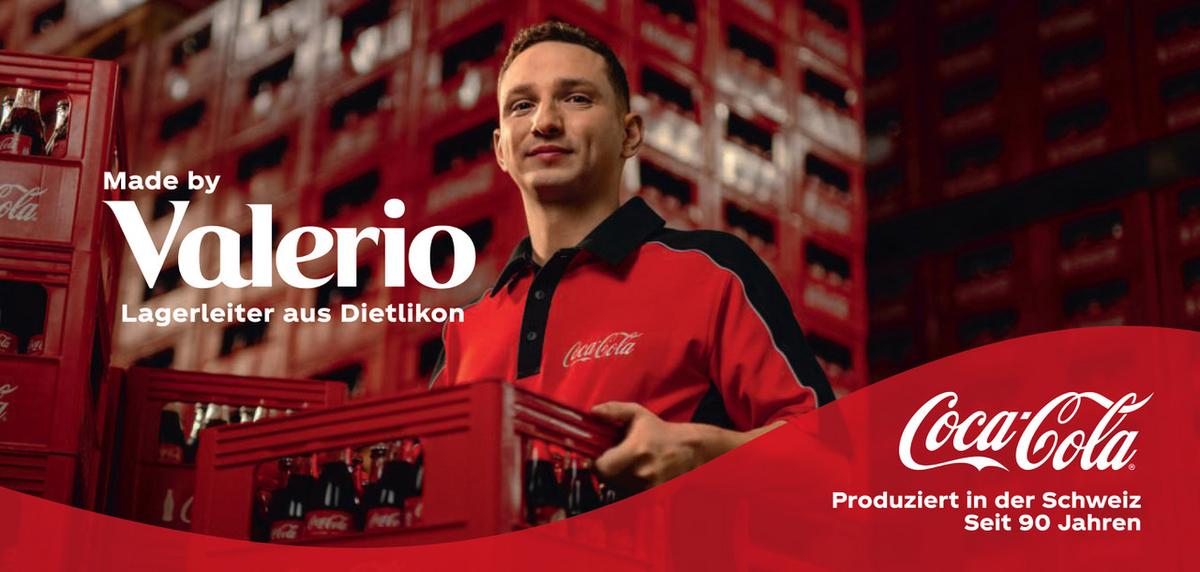
Anyone who views Coca-Cola exclusively as an American brand is overlooking an important part of its history. Around 80 percent of the drinks sold in Switzerland are produced here. 95 percent of the ingredients come from Swiss suppliers. The Coca-Cola system directly employs around 800 people and generates several thousand jobs along its value chain.
For Carmen Walker Späh, President of the Cantonal Government of Zurich, this is precisely what matters. «For me, a company is Swiss if it is anchored in Switzerland. If the employees live and work here. If production takes place here and added value is created.» Her conclusion is correspondingly clear: «Coca-Cola Switzerland is local. And how.». The Coca-Cola people nodded happily in agreement.
This is the best punchline of the evening. One of the most American brands in the world celebrates its Swiss birthday in Zurich's Schiffbau - and doesn't look like a guest, but like a naturalized icon.
Where life plays
Numbers do not explain why Coca-Cola is still relevant after 90 years. The brand's real strength lies in its ability to appear where people experience emotions. In music. In sport. At festivals. During the vacations. At Christmas. Or simply in those moments when people come together.
«One of the secrets is to be there in a meaningful way when it matters,» says Constance Courtois-Delanoë. In fact, this principle runs like a red thread through the history of the brand. Coca-Cola was never simply a drinks manufacturer. Early on, Coca-Cola saw itself as part of pop culture. As a companion to experiences. As an amplifier of emotions.
Switzerland is a good example of this. Today, over 40 music festivals are supported by Coca-Cola. Manuel Akanji, one of Switzerland's best-known footballers, is at the center of the current FIFA campaign. At the same time, the brand remains just as present in swimming pools, at open airs and concert venues as it is in the retail trade. «We have a global DNA of optimism and joy,» says Courtois-Delanoë. «But we have a lot of local freedom to tell our own stories.»

The soundtrack of memories
Some brands are remembered. Coca-Cola is heard. When the familiar Christmas melodies are heard from the orchestra room in the shipbuilding, just a few bars are enough to trigger images. The legendary trucks. Winter evenings. The start of the Christmas season. «Holidays are Coming» has long been more than just an advertising song. It is an acoustic marker in the calendar.

Later, historical advertising films are shown on the screen. These include «I'd Like to Buy the World a Coke» from 1971, a commercial that has long been more than just an advertisement. People from different backgrounds sing together on a hill. Decades before diversity and inclusion became an integral part of many corporate strategies.
Presenter Zoe Torinesi also recalls personal Coca-Cola stories: Shakira as a brand ambassador, collectors, fan clubs, memories that almost everyone associates with this brand. Coca-Cola sells drinks. But the brand collects memories. That is precisely why its strongest campaigns do not remain in the advertising archives, but are remembered by entire generations.
Switzerland as an experimental laboratory
90 years in Switzerland and over 140 years worldwide raise a simple question: How does a brand stay relevant for so long? Fabio Cella provides a remarkably clear answer. «Our success over the past 90 years is primarily due to the fact that we have remained very close to our consumers and really listen to them.»
Switzerland plays more than just the role of a sales market. It is a production location, innovation area and cultural testing ground. Cella points to the openness of Swiss consumers to innovation, particularly in the areas of well-being and health. Zoran Bogdanovic, CEO of the Coca-Cola HBC Group headquartered in Zug, also looks back on formative innovations: the launch of Coca-Cola Zero, developments at Valser and projects that received international attention from Switzerland. «Switzerland plays a major and important role for us as a company,» he says.

This role is also reflected in investments. A new high-bay warehouse is being built in Dietlikon, logistics are being gradually electrified and Coca-Cola is focusing on a circular economy for PET. This sounds less romantic than red trucks and iconic bottles, but it is part of the modern continuation of the same story: a brand only remains strong if the system behind it works.
The original
There will be a lot of talk about sustainability this evening. About the circular economy. About electromobility. About new products. About Zero. About Zero Zero. About the next 90 years. And that's the right thing to do. Brands that stand still will eventually disappear from the present.
Coca-Cola has reinvented itself time and again. New packaging. New products. New target groups. New channels. The brand has moved without losing its core. This is precisely what distinguishes it from many brands that have become prisoners of their time.
At the same time, this evening also tells a story about consistency. Less sugar, fewer calories or less caffeine are answers to real needs. But not everything that is less in tune with the zeitgeist is therefore outdated. After all, sugar only tastes really sweet as sugar. And caffeine still provides that little kick that sometimes makes all the difference.

The taste of the original has lasted for generations. Lifestyle trends have come and gone. Today, the buzzwords are longevity, sugar reduction and zero zero. Tomorrow, other terms will dominate the discussion. Coca-Cola will respond, as it has done for decades. But the original will remain the point of reference against which everything is measured.
Pharmacist John Pemberton would probably have smiled at this. His recipe was supplemented, expanded and varied over the decades. But it has never been replaced. In other words: pharmacist, stick to your formula.
Jürg Burkhalter sums it up in his own way that evening: «For me, Coca-Cola is simply the greatest drink that mankind has ever invented.» A sentence that triggers laughter and applause in the Schiffbau. And one that explains why, after 90 years in Switzerland, Coca-Cola doesn't seem like a jubilarian, but like a brand whose story is far from finished.