Renewable energies as a geopolitical shield
When energy prices rise, the effects are felt far beyond the gas pump. In many countries, higher energy prices have a negative impact on the entire economy, from the balance of trade to inflation and national budgets. This is why renewable energies - and in some countries nuclear energy - are increasingly becoming more than just a climate issue.


A recent analysis of the investable universe by Loomis Sayles (a subsidiary of Natixis IM) found that 56 out of 90 sovereign issuers are net importers of energy. This means they rely on other countries for the fuel that keeps the lights on and the factories running. The more dependent these countries are on imports, the more vulnerable they are when geopolitical tensions or supply disruptions shake up global oil and gas markets.
Energy security
If oil or gas prices rise, import bills usually increase as well. This can widen trade deficits, drive inflation and increase pressure on governments to subsidize households and businesses. Over time, these pressures can worsen the overall economic picture that investors look at - especially in countries with limited fiscal space.
Renewable energies and nuclear energy can act as a shock absorber here. If a large proportion of a country's energy supply comes from domestic sources such as solar, wind, hydro or geothermal energy or nuclear power, it generally requires fewer imported barrels of oil or gas supplies to keep the economy running. This does not make a country immune to global energy fluctuations, but it can cushion the impact.
This improves the economic framework conditions for renewable energies. Firstly, renewable energies have become more competitive in many places. Secondly, solar and onshore wind projects can often be realized faster than traditional fossil energy projects. Thirdly, producing electricity domestically reduces the logistical and geopolitical risks associated with dependence on global fuel supply chains.
Which countries are favorably positioned - and why
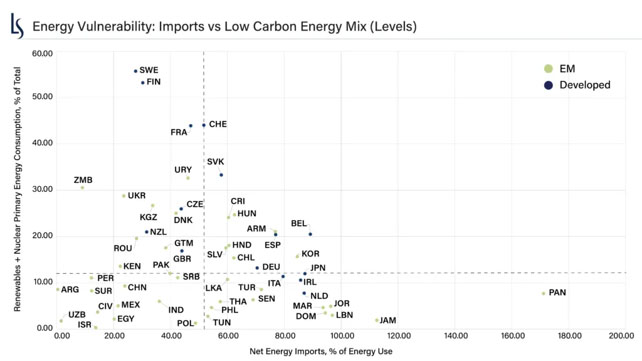
Within this framework, those countries that combine a lower dependency on energy imports with a high and growing share of clean energy stand out positively. Parts of Latin America - excluding the Caribbean - perform well, particularly Chile, Costa Rica and Uruguay, as they already have significant renewable energy buffers. Some frontier markets are also well positioned. These include Kyrgyzstan and Zambia, where clean energy accounts for a significant share of primary energy consumption and net import dependency is comparatively lower.
Europe also has many of the right long-term prerequisites. Renewable energies have been rapidly expanded and several countries cover a large part of their energy needs from renewable and nuclear sources. The catch, however, lies in the timing. In the short term, Europe's reliance on imported liquefied natural gas may continue to cause disruption when supply is tight. If the energy stress continues, countries such as France and the Scandinavian states, which already cover more than half of their primary energy needs from renewable and nuclear sources, could reap the benefits sooner.
Weak points
At the other end of the spectrum are large net energy importers with low clean energy penetration. There, a fuel shock can quickly become visible in the form of higher inflation, weaker trade balances and strained public finances. An analysis identifies parts of the Asia-Pacific region, the Caribbean and the non-Gulf countries of the Middle East and North Africa as being more exposed. The risk is particularly high if clean energies barely grow over time, as the respective country then remains tied to the same volatile import pattern.
If current trends continue, the greatest structural improvements are likely to be seen in the emerging markets, where the expansion of renewable energies is progressing the fastest - albeit from a low starting point.
How much energy does an economy need?
One factor that is often overlooked is energy intensity. It measures how much energy is required to generate one unit of economic output. Two countries can import the same proportion of their energy. However, the more efficient country is usually less vulnerable to price shocks because it simply needs less fuel to maintain GDP growth. Globally, energy intensity has improved since 2019, although fast-growing emerging markets may be exceptions.
Looking ahead does not guarantee further progress. It is therefore helpful to observe three factors together: how much energy a country imports, how quickly clean energies are growing and how efficiently the economy uses energy.
Conclusion
Energy may be political - but it does not necessarily have to have a destabilizing effect. Countries that develop reliable, indigenous clean energy effectively create a buffer between their economy and the next oil or gas shock. For investors, this can have very real implications: more stable inflation, fewer fiscal emergency measures and potentially greater resilience.
Author:
Alex Schober is Sustainability Analyst at Loomis Sayles.