AI Investment Cycle: Peak Not Yet Reached
Are we facing a bubble or a new technology supercycle? Tim Safarov, an equity analyst at Gonet & Cie, analyzes the signals from the AI investment cycle—and reaches a surprisingly clear conclusion. The rise of Agentic AI could structurally elevate demand for computing power to a new level.






Bubble or supercycle?
Few investment themes have sparked as much enthusiasm—but also skepticism—as artificial intelligence (AI). In recent months, numerous commentators have once again warned that the market is showing typical signs of a bubble. The timing of SpaceX’s recent mega-IPO, as well as the prospect of upcoming IPOs by companies such as OpenAI and Anthropic, reinforce comparisons to the dot-com era —given the sharp rise in hardware and semiconductor stocks and the increasing concentration of stock market performance on just a few AI-related companies.
Alphabet’s decision to raise $84.7 billion in equity—its first public capital raise since its 2004 initial public offering—has heightened another concern: the AI investment cycle could require significantly more capital than previously assumed. The rising number of outstanding shares, combined with higher depreciation and amortization expenses, would weigh on return on equity (ROE), which has been a key factor in the valuations of the so-called hyperscalers—the major cloud providers. Some investment strategists even warned that, if current trends continue, the AI boom could ultimately result in one of the greatest destruction of shareholder value in history.
Nevertheless, it is hard to deny that today’s AI ecosystem—unlike many companies from the dot-com era—is already driven by real revenue, profits, and real money. The exceptional performance of semiconductor stocks has been accompanied by strong earnings growth, which has not significantly driven up valuations based on future earnings expectations. However, there is another interpretation: The current AI boom could represent the early stages of a technology supercycle—comparable to the electrification of the economy, the rise of the internet, or the smartphone revolution.
Strong Signs of Demand
The source of demand differs fundamentally from previous technology booms. Semiconductor manufacturers sell primarily to hyperscalers—some of the largest and most profitable companies in the world. These companies are investing unprecedented amounts of capital in AI infrastructure because they believe the technology will yield significant economic returns. A strong signal of demand recently came from companies like Dell and HPE, which are reporting robust order intake for server capacity. Interestingly, Dell and HPE primarily serve the next tier—neoclouds, cloud service providers, and large enterprises—which traditionally have less capital to deploy than hyperscalers but are now also willing to spend more on expanding their own AI infrastructure.
Ultimately, the sustainability of the AI investment cycle depends on end-user demand. According to recent reports from the Wall Street Journal and CNBC, Anthropic’s revenue is set to rise from $4.8 billion in the first quarter of 2026 to $10.9 billion in the second quarter—a growth of over 120 percent in just one quarter. The current growth curve thus provides a strong indication of accelerated AI adoption. This raises a key question for investors: Are the rising AI capital expenditure plans a warning sign of overheating—or evidence that demand for computing power is structurally stronger than previously assumed?
From GenAI to Agent-Based AI: A Fundamental Shift
The current AI investment cycle may be far from reaching its peak—fueled by the rise of agentic AI. The difference from previous AI applications is fundamental: Generative AI (GenAI) is mostly passive—it takes an input and provides a response. Agentic AI, on the other hand, is active. It remembers previous requests, knows preferences, works across digital tools, plans workflows, and adapts to changing circumstances. It’s less of a co-pilot for a single task and more of an autopilot for multi-step workflows.
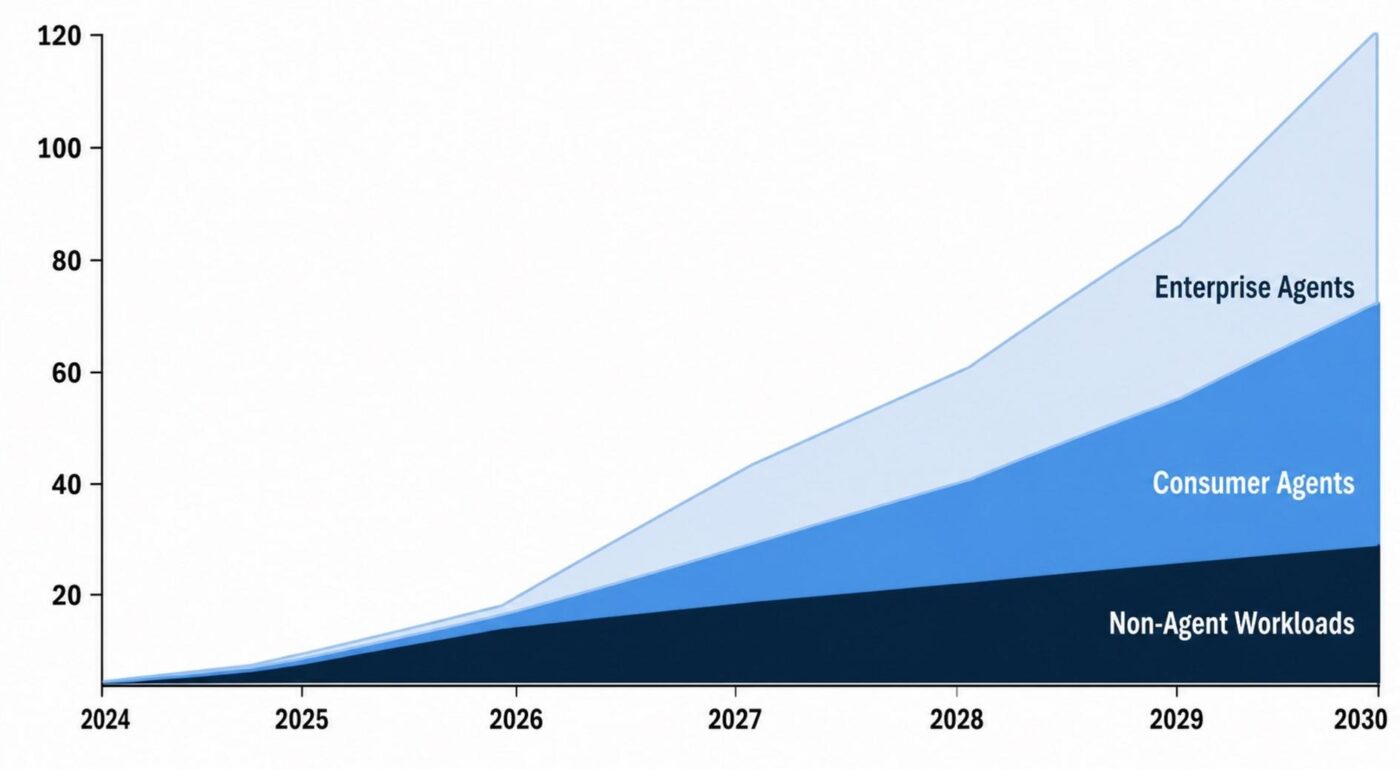
This distinction is crucial because it fundamentally changes the computational requirements. According to Goldman Sachs, agentic AI could dramatically increase token consumption—to around 120 quadrillion tokens per month by 2030. A token is the basic unit of information processed by an AI model: a word, a part of a word, a punctuation mark, or a code snippet. While a standard chat session requires a certain number of tokens, a simulated travel booking agent requires ten times as many—and an email monitoring agent that interprets intent, drafts replies, and coordinates meetings requires as many as a hundred times that amount per day.
Token Intensity and Corporate Agents
Although consumer agents likely have a larger user base today, enterprise agents will be significantly more token-intensive per user. This is because enterprise workflows require more complex and precise actions: task monitoring, context retrieval, exception handling, result validation, system updates, and escalations. Enterprise agents must also process multimodal inputs—speech, images, documents, screen activity, application data, logs, and structured system data. The key difference lies in accuracy: While a consumer agent is often satisfied with a «good enough» answer, an enterprise agent requires multiple iterations to deliver accurate, verifiable results that can be used in real-world business processes.
The token has now also become the basic unit of the AI economy. For companies, AI adoption depends not only on productivity but also on cost-effectiveness. Not all corporate agents are currently cost-effective: A call center agent using real-time voice automation can be more expensive and complex than outsourced human labor. A coding agent, on the other hand, works within a valuable, mostly text-based workflow with a comparatively mature tool ecosystem—which explains why software development has so far been quicker to adopt agents.
Opportunities and Risks for Hyperscalers
For hyperscalers, the math is different. Their profitability depends on the difference between what customers pay for AI workloads and the internal costs of delivering them. According to Goldman Sachs, leading semiconductor companies are reducing the cost per token for hyperscalers by 60 to 70 percent annually, while customer token prices are stabilizing after years of sharp declines. This marks a turning point: companies are gaining more cost-effective AI workflows, while hyperscalers can convert rising token volumes into better margins. This makes the current Capex cycle easier to understand—AI Capex should not be viewed solely as a cost factor.
Risks remain, however. Cheaper Chinese models could increase price pressure on leading providers of large language models. Reviewing a 50-page legal contract could cost about $0.11 with Claude Sonnet, and less than $0.02 with DeepSeek R1. With hundreds or thousands of such tasks per month, the price difference becomes significant. At the same time, more affordable models could promote broader adoption of the technology by reducing the costs of many use cases—which could increase the demand for cloud computing and continue to benefit the hyperscalers. Agentic AI will likely evolve into a tiered model architecture: simpler models will handle repetitive tasks, while the most advanced models will tackle complex, multi-step tasks.