Industry 4.0: China extends its lead, DACH region falls behind
A new study shows: While China and the USA are consistently digitizing their production, the DACH region is stagnating in the use of Industry 4.0 technologies. There is a lot of catching up to do, particularly when it comes to digital twins and software-defined manufacturing. The eighth edition of the Industry 4.0 Barometer by MHP and LMU Munich also analyzes India and Mexico for the first time.





China is shaping the factory of the future, while Europe, especially the DACH region, is struggling with the past. Grown IT and OT landscapes as well as fragmented data structures are slowing down progress. Meanwhile, China is taking the lead in the areas of supply chain transparency, digital twin, automation and AI. These are the key findings of the Industry 4.0 Barometer 2026, published by management and IT consultancy MHP in cooperation with Prof. Dr. Johann Kranz from Ludwig Maximilian University in Munich.
For the Industry 4.0 Barometer 2026, more than 1,200 people from industrial companies in the DACH region, the UK, the USA, China and, for the first time, India and Mexico were asked about their assessment of the status quo of Industry 4.0 in their own company. The study highlights successes, but also reveals gaps in the areas surveyed.
Degree of digitization increases to 68 percent worldwide
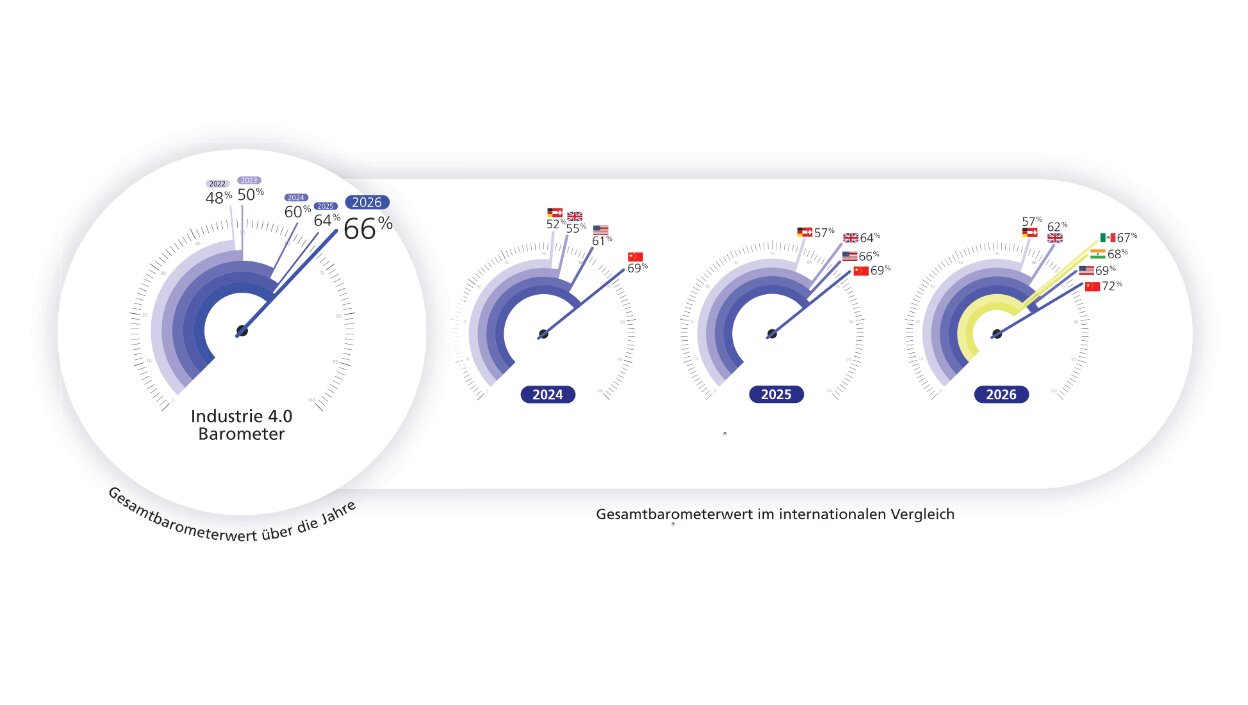
Internationally, the degree of digitalization in the industry continues to increase: the overall barometer value has risen from 48% in 2022 to 68% in all areas today. However, two regions have clearly fallen behind: DACH stagnates at 57 percent, while the United Kingdom drops to 62 percent. Meanwhile, China reaches 72%, the USA 69%, India 68% and Mexico 67%.
«The degree of digitalization in industry is increasing worldwide, and Europe is also making progress,» says Dr. Johann Kranz, Professor of Digital Services and Sustainability at LMU Munich. «However, when comparing countries, the USA and China are implementing digital production technologies faster, more integrated and more scalable than European companies. India and Mexico, which we are analyzing for the first time, also show better results in some cases.»
Technical debt is slowing down the transformation
When digital transformation is slowed down, it is usually due to technical debt: Heterogeneous legacy systems, fragmented data landscapes and limited interoperability make it difficult to introduce new technologies. For example, 42% of the DACH companies surveyed rated their data silos as an obstacle and 52% their historically grown IT systems. However, these classic obstacles are being overcome at different speeds.
Digital twin: DACH region brings up the rear
The differences for digital twins are particularly noteworthy: The barometer value for use in plants and machines has risen from 54% to the current 62%, and from 61% to 67% in the logistics application area. This means that the digital twin is establishing itself faster than any other of the technologies surveyed.
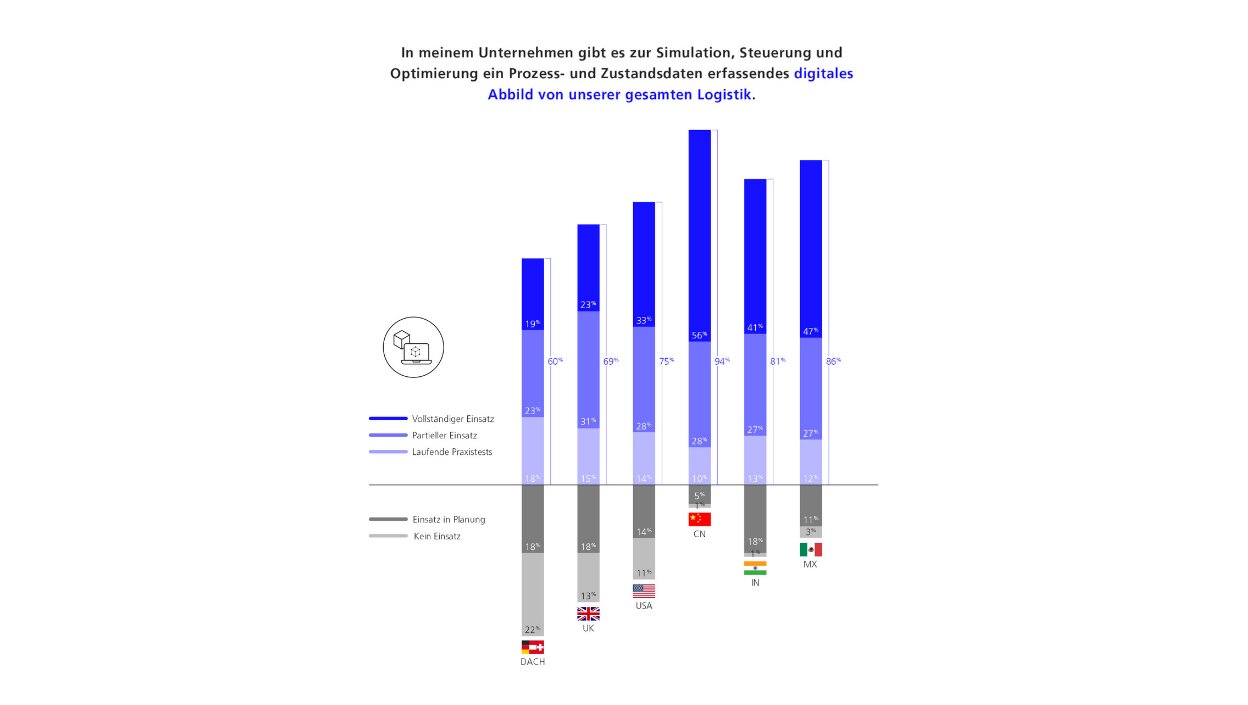
Across all fields of application, China is a clear leader when it comes to digital twins. The logistics context is particularly pronounced: 84% of the Chinese companies surveyed use this technology partially or completely. This is followed by Mexico with 74%, India with 68%, the USA with 61% and the UK with 54%. The DACH region brings up the rear with 42%.
DACH stuck in the AI hype gap
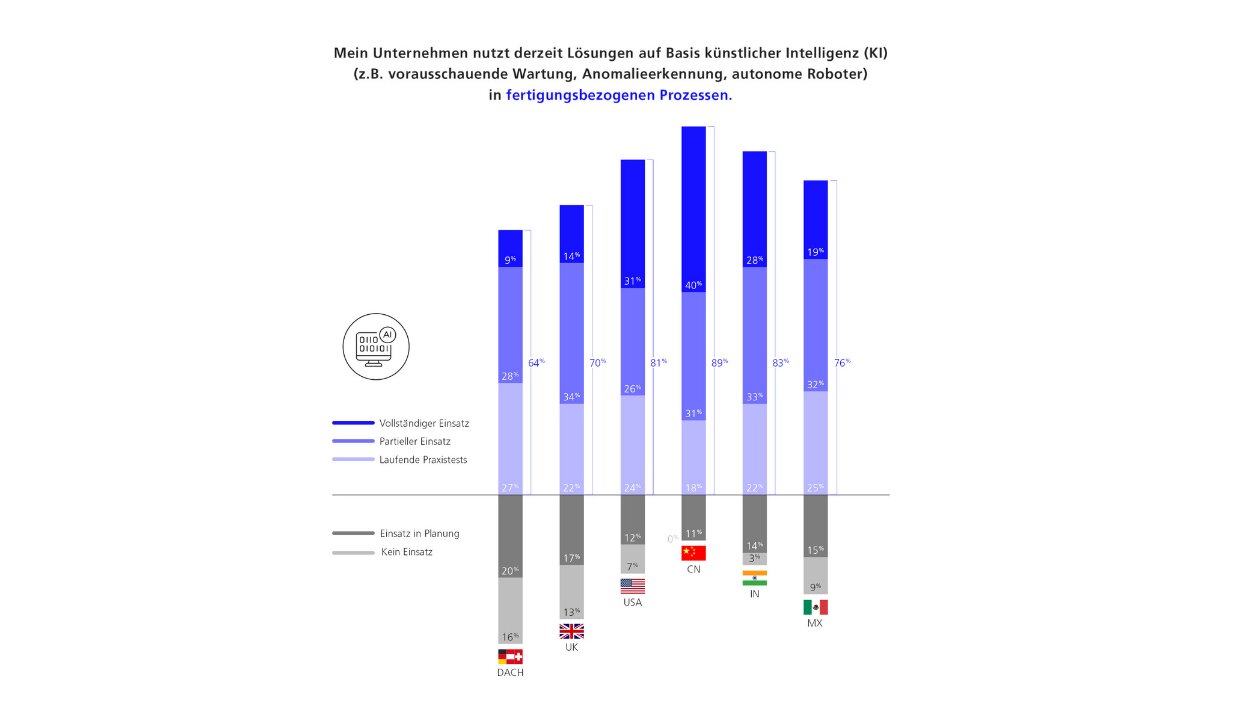
China and the USA also play a pioneering role in the use of artificial intelligence in the production environment: In terms of partial or full AI use, the Chinese participants are ahead with 71 percent, followed by India with 61 percent and the USA with 57 percent. Mexico and the United Kingdom form the midfield with 51% and 48% respectively, while the DACH region lags behind with 37%.
The results show that many European companies are taking a rather cautious approach here. So far, they have only used AI as a pilot, and there is a lack of deep integration into production processes. At the same time, the future influence of AI is estimated to be high. This gap makes it clear that smart algorithms cannot work productively without solid foundations in data infrastructures, sensor technology and digital twins. AI therefore remains a promise for the future in industrial practice, but will not become an effective productivity lever.
Software-defined manufacturing as a new key competence
Software-defined manufacturing (SDM) decouples production control from physical hardware and creates a central software layer that makes production flexible, scalable and cross-location. CIOs play a key role here: they become the architects of the digital factory, responsible for IT/OT integration, data expertise and investment prioritization.
When comparing familiarity with the still young SDM concept, India and China are the pioneers: 30% of respondents in each country attest to a «very high» level of familiarity. In the DACH region, the figure is only 3 percent, in the UK 6 percent. The USA and Mexico are in the middle of the field with 14% and 18% respectively.
Markus Wambach, Group COO at MHP: «Our data clearly shows that while China and the USA are consistently transforming their production to be software and data-driven, the DACH region is not generating any momentum. Only 3 percent of companies in this country are very familiar with software-defined manufacturing - in China and India, the figure is 30 percent. Those who do not strategically combine production control, data and software are risking their competitiveness.»
Readiness to invest as a key factor
A high willingness to invest is a prerequisite for digitalization: 71% of respondents from India state that their companies are prepared to make significant investments in new digital technologies. Mexico follows with 65% and the USA with 59%. The result for the DACH region is shocking: there, the willingness to invest is only 29%.
«The DACH region focuses strongly on efficiency and cost optimization, which means that strategic potential for growth, flexibility and innovation often remains untapped,» comments Prof. Dr. Christina S. Reich from the FOM University of Applied Sciences for Economics & Management and Manager at MHP. «Meanwhile, emerging markets such as India, China and Mexico are pursuing more differentiated strategic goals.»
Overall, the results make it clear that Europe is facing a massive modernization task. The key lever for international competitiveness lies in the reduction of technical debt, the standardization of IT/OT structures and the consistent orientation of production towards software-based, scalable architectures. SDM is becoming the yardstick for industrial sustainability - and a critical success factor in the context of Industry 4.0.
The complete study is available at MHP Newsroom available.