US customs ruling: Switzerland and emerging markets benefit from new uncertainty
The US Supreme Court has overturned key tariffs, but the customs system remains in place. Alongside Brazil, China and other countries, Switzerland could benefit from a time window in the new customs regime. For companies, however, the ruling means further uncertainty and a new round of hoarding.


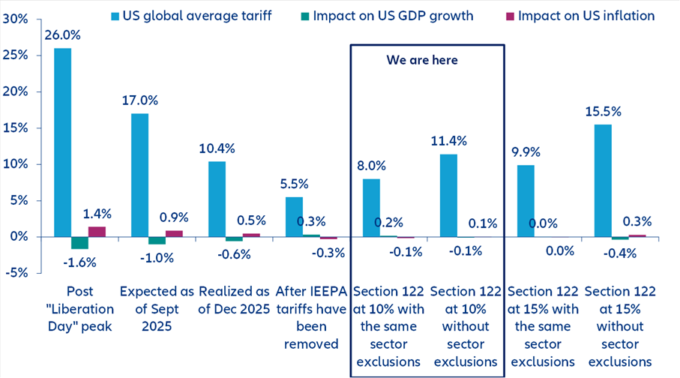
The US Supreme Court has declared part of the US tariffs unconstitutional - but not the new tariff system as a whole. In a 6-to-3 decision, the court ruled on February 20 that the International Emergency Economic Powers Act (IEEPA) does not provide a legal basis for the reciprocity tariffs announced on Liberation Day. The tariffs put on hold represent around 60 percent of US customs revenue since April 2025. The ruling invalidates tariffs worth around 60 billion US dollars as well as the emergency fentanyl tariffs on China, Mexico and Canada amounting to a further 40 billion dollars.
Halving the tariff - but only temporarily
The court ruling halves the effective US tariff rate to around five percent. However, significant parts of the tariff regime remain in place: Section 301 of the Trade Act, with 25 percent tariffs on industrial machinery, electrical equipment and other products from China, and Section 232 on steel and aluminum. President Trump has already confirmed his plans for a universal minimum tariff of ten percent. Section 122 of the Trade Act of 1974, which allows tariffs of up to 15 percent for 150 days, is expected to serve as a replacement instrument.
The respite is likely to be short-lived. «The tariff ruling does give some countries more breathing space, probably for a slightly longer period of time,» says Ana Boata, Head of Economic Research at Allianz Trade. «But the US has already launched new tariffs, with Section 122 of the Trade Act replacing the invalidated tariffs.»
Winners and losers of the reorganization
Bangladesh (minus 20 percentage points) and Pakistan (minus 19 percentage points) as well as major emerging exporters such as Indonesia (minus 18 percentage points), Brazil (minus 17 percentage points), China (minus 15 percentage points) and Vietnam (minus 15 percentage points) are currently experiencing the greatest tariff reductions as a result of the ruling. South Africa (minus 15 percentage points), Turkey and India (minus 12 percentage points each) also benefit from lower tariffs.
Under a Section 122 regime with industry exemptions, Brazil, Bangladesh, India, China, Pakistan, Switzerland, South Africa, Vietnam and Indonesia in particular would benefit. Exporters from these markets could benefit from a reduction in the average US tariff rate by at least ten percentage points compared to the previous level. In contrast, Saudi Arabia, Mexico and Ecuador as well as Taiwan, Norway, South Korea or the European Union could face higher tariffs if no sectoral exemptions are granted.
Uncertainty for Swiss companies
«The ruling comes at an inopportune time for Switzerland,» says Jan Möllmann, CEO of Allianz Trade in Switzerland. «The envisaged trade agreement should finally create more predictability for local companies. Thanks to the stop-and-go policy, they are now still up in the air.» In a new customs system, exceptions for certain sectors, such as pharmaceuticals, are crucial for Switzerland in particular.
The time window in Section 122 is limited by definition: Congressional approval is required after 150 days. This is likely to lead to deliveries from favored markets being brought forward before there are further tariff increases under other sections.
New round of warehousing in the USA
The customs chaos is leading to a new wave of hoarding in the USA. «By 2025, warehouses were already full and pull-forward effects ahead of new tariff levels were the new normal,» explains Boata. «Manufacturers of cars and household appliances in particular have filled their warehouses, but the retail and chemical industries have also made provisions for longer procurement cycles with more goods.»
Working capital requirements (WCR) in the US rose by more than 35 days to over 60 days in the third quarter of 2025. Automotive manufacturers and producers of household appliances - the two sectors with the highest exposure to tariff increases - were particularly affected. A renewed precautionary inventory cycle is likely to keep US WCRs at their 2025 highs.
Fiscal and inflationary effects
So far (until December 2025), only half of the higher customs costs have been passed on to consumers. The greatest impact is not expected to be felt until well after the first quarter of 2027, with an additional inflation contribution of one percentage point at an average tariff rate of ten percent.
Since Liberation Day, US customs revenue has risen to 240 billion dollars - 180 billion dollars more than in the same period last year. IEEPA-related measures accounted for almost 60 percent of the additional customs revenue. If the tariffs are found to be retroactively illegal, refund liabilities could reach 120 billion dollars (0.5 percent of GDP) and widen the budget deficit to 7.5 percent of GDP.
Markets react cautiously
The reactions on the financial markets were measured. The S&P 500 rose by 0.7%, while the markets in Europe rose by around 0.9%. Analysts expect that the short-term upward effects could be dampened by uncertainty. A growth impulse of 0.5% could increase corporate profits by around 1% - modest compared to the 16% profit growth expected for the S&P 500 in 2026.
«It will continue to be a back and forth in the coming weeks and months,» predicts Boata. «Ultimately, we expect an average tariff rate of ten percent in accordance with Section 122 with sectoral exceptions. Overall, therefore, little is likely to change in the medium term despite the overturned tariffs. However, for some countries and sectors, there may well be a ripple effect if the cards are reshuffled now.»
More information: www.allianz-trade.ch