Study by the University of Zurich: Gold as a safe asset for wealth accumulation
A financial analysis conducted by the Department of Finance at the University of Zurich on behalf of Bank von Roll shows that precious metals play an essential role in long-term wealth accumulation. Swiss investors should invest 20 to 30 percent of their portfolio in precious metals - a clear contrast to the prevailing doctrine.





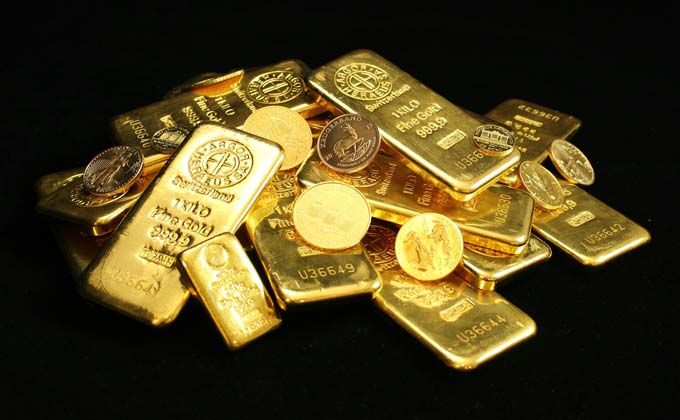
The prevailing financial doctrine takes a sober, data-based view of precious metals. In asset allocation, they are regarded as unproductive assets that are at best suitable for risk diversification. However, a recent study by the Department of Finance at the University of Zurich shows that this doctrine needs to be reconsidered: Precious metals, in combination with equities, play an essential role in long-term wealth accumulation.
Prof. Dr. Thorsten Hens and MA Alvin Amstein were commissioned by Bank von Roll to investigate the extent to which precious metals are suitable for long-term wealth accumulation. The analysis is based on data since 1972 and takes into account both the perspective of an investor with the reference currency CHF and that with USD. In addition, the optimal asset allocation was calculated with and without taxes.
Gold outperforms the world equity index
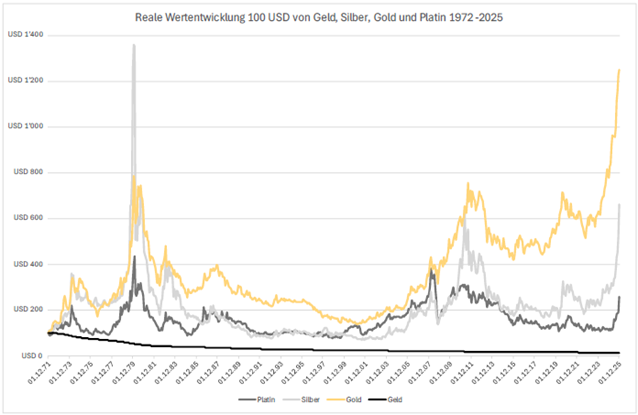
The key findings of the second study - the first was presented in February 2025 - show significant deviations from common assumptions. A comparison between gold and an investment in the world equity index (MSCI World) in the period from 1972 to today, without taking inflation into account, shows that an investment of USD 100 in gold would be worth around USD 6,000 today, while the same investment in the MSCI World would only be worth around USD 3,400.
If the dividends were reinvested, however, an investment in the MSCI World would have achieved a value of around USD 14,800. However, this advantage is significantly reduced if the taxation of dividends is taken into account. As an investment, gold also offers protection against inflation, as the price of gold tends to rise during periods of rising inflation.
20 to 30 percent precious metals recommended
The study concludes that a Swiss investor should hold 20 to 30 percent precious metals in their portfolio. A portfolio with a weighting of 85% equities and 15% precious metals achieves a higher long-term return than a pure equity portfolio. On average, a precious metals portfolio should consist of two-thirds gold and one-third silver.
Depending on the model, strategy and currency, the proportion of gold and silver that an investor should hold in his asset allocation varies between 1 and 30 percent. If all scenarios since 1972 are taken into account, a CHF investor who rebalances monthly should hold an average of 10 percent gold and 10 percent silver across all three allocation models (GOP - Growth Optimal Portfolio, MVA - Minimum Variance Portfolio, PT - Prospect Theory).
If he invests only in Swiss equities, the proportion changes to 9% silver and 11% gold. Taking into account income tax on interest from bonds and dividends from shares, the ratio changes to 25 percent precious metals, or even 30 percent for an internationally diversified investor.
Insurance for volatile market phases
Precious metals, especially gold, play an important role in long-term wealth accumulation and preservation - contrary to the prevailing doctrine. Silver supports gold in a portfolio that is rebalanced monthly. Platinum, on the other hand, does not play a significant role.
The researchers conclude that precious metals are not primarily a driver of portfolio returns compared to equities, but rather serve as insurance. They enable investors to remain capable of acting even in phases of highly volatile share prices and to emerge stronger from such periods.
Precious metals are used today both as raw materials for industry and high technology and as investments. While gold is primarily used as a store of value, silver and the metals of the platinum group are widely used in electronics, medicine, catalysis and energy technologies. Silver in particular is likely to benefit from the energy transition.
As capital gains are tax-free in Switzerland, but dividends and interest are subject to income tax, gold may have a structural advantage. The inflation rates for Switzerland are taken from the website of the Federal Statistical Office, for the USA from the online data of Robert Shiller, the equity data from Bloomberg.
Bank von Roll, based in Zurich, was founded in 2009 as a public limited company and is regulated by FINMA. The main shareholder August François von Finck guarantees the independence of the bank, which focuses on the traditional asset management business for wealthy private individuals, family offices and selective institutional investors. The bank operates exclusively in Switzerland for a select national and international clientele.