gfm Trend Conference 2026: Between AI fog and brand clarity
At the gfm Trend Conference 2026 in Zurich, it became clear just how much AI is already changing marketing. At the same time, the industry gathering also showed that brand, trust, creativity and clear use cases remain more important than ever, especially in the midst of the biggest tech noise.


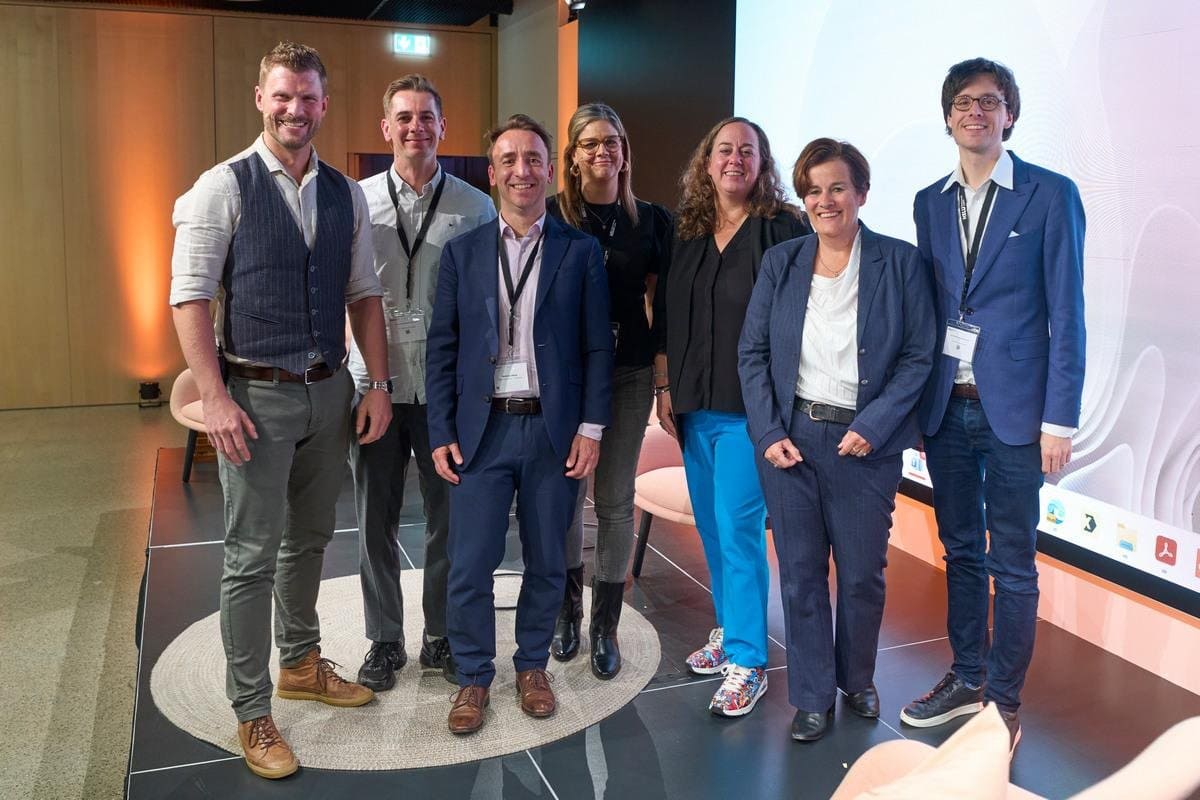
The 35th gfm Trend Conference at the AURA in Zurich marked a new beginning in several respects. For the first time, the event was hosted by the new gfm President, Prof. Marcus Schögel, who welcomed around 300 guests from marketing, advertising, agencies and academia and also provided a kind of conclusion at the end of the day. Many things are accelerating, many things are becoming more complex, said Schögel - but nothing simply disappears. This was precisely one of the strongest insights of this packed industry day: the new is coming with force, but this does not automatically make the old worthless.
Under the motto «The New Marketing Playbook», the conference posed the question of which disciplines count in marketing today - and how a CMO can survive in this mixed situation. The answers varied, but a common thread was unmistakable. AI is changing search behavior, production logic, decision-making processes and customer relationships. At the same time, however, it also became clear that classic strengths such as brand management, creativity, trust and genuine proximity are gaining new focus in the age of AI.
High tech, high touch: Marcus Schögel opens a new phase
Right from the start, Marcus Schögel gave the conference a tone that was neither alarmist nor nostalgic. Rather, he set the scene. Yes, technology is developing exponentially. Yes, new methods and new use cases are essential. But no, that doesn't mean you have to throw what you've learned overboard. On the contrary: precisely because everything is accelerating, we need orientation, methodology and a clear view of what remains.

His concluding remarks summed up this attitude succinctly. More will remain, more will be added and more will have to be dealt with at the same time. This is precisely why different methods and clearer priorities are needed. The term «use case», which Schögel explicitly emphasized at the end, almost became the leitmotif of the entire event: away from mere fascination with technology and towards concrete applicability.
Why real experiences are suddenly gaining value again
Stephan Balzer made it clear that the counter-movement to total digitalization was also visible on a day so strongly influenced by AI. The founder of TEDxBerlin spoke about trends in live communication - and hit a nerve. The more AI-generated content floods the market, the greater the longing for the real thing, for presence, for community, for experiences that cannot be replicated.

Balzer argued that live communication not only transports content, but also builds trust, creates emotional depth and gives brands the chance to present themselves authentically. With such formats, people don't just buy content, but the moment, the community and the memory of really being there. This also matched the atmosphere at AURA. From the moment coffee was served at 8.15 a.m., it was clear that this event wanted to be more than just an update day. It was a knowledge platform, meeting place and sounding board all in one.

Culture marketing instead of marketing bullshit
Sebastian Kemmler delivered one of the most pointed contributions. His title «Who Wants to Have Sex with a Robot? Why Culture eats AI Marketing for Breakfast» was provocative, but by no means just for effect. Kemmler took aim at a discomfort that many associate with AI marketing: It can be produced quickly, cleanly and efficiently - and yet often comes across as cool, distant and surprisingly remote from people.

His thesis was that today's marketing must be thought of in three pillars: Product marketing, brand marketing and now culture marketing. The latter in particular is becoming increasingly important because the younger generation is increasingly decoding classic marketing as «marketing bullshit», but at the same time is responding very well to brands that are culturally relevant, docking in communities and becoming part of real conversations.
Culture marketing therefore does not stand for decorative zeitgeist gymnastics, but for a central area between attention and buying interest. It is about values, relevance, collaboration, creator culture and the question of what a brand actually stands for. Those who only explain products or claim brand values remain too shallow. Those who become culturally legible gain radiance.

Swisscom shows why trust remains the toughest brand value
The presentation by Olaf Geuer, Group Head of Brand at Swisscom, was particularly practical. He spoke about brand management in the field of tension between technology and people - and impressively demonstrated why strong brands are not losing importance in the age of AI, but rather gaining it.
In recent months, Swisscom has worked intensively on its strategy, positioning and brand image, said Geuer. One of the starting points was an «emotional survey of Switzerland». The result: even in a country with a high level of stability and quality of life, uncertainty and the need for trust, proximity and confidence are on the rise. This is precisely where Swisscom sees its role as a tech and trust brand.

What was particularly interesting was how openly Geuer addressed the ambivalences of AI. On the one hand, a company like Swisscom has to embrace technological developments and make them productive. On the other hand, an AI children's book project, of all things, showed how quickly you can get into social debates about creative work, illustration professions and cultural sensitivity. The lesson from this was not to do without technology, but to put «human first». In other words: technology as an instrument, humanity as a point of reference.
Geuer also made it clear that the value of a brand lies not just in beautiful images, but in the trust it has built up. How else would it be possible to explain why Swisscom's price increases attract criticism but do not immediately lead to a massive loss of market share? The brand acts as a buffer here. And that is precisely why it remains king.
Philipp Skrabal and the comeback of the big idea
If one contribution defended the primacy of creativity against the uniformity of machine output, it was that of Philipp Skrabal, Partner and Chief Creative Officer at Farner Switzerland. His title «Creativity is a survival skill» was deliberately pointed - and therefore apt.
Skrabal did not advocate creative romanticism, but hard work to make a difference. Creativity does not arise incidentally, but from friction, feeding, discipline and the willingness to struggle. This is precisely where its relevance lies in the age of AI. Because machines mix patterns. Humans can break patterns.

That was one of the strongest thoughts of the day. If everyone feeds the same tools with similar prompts, there is an increased risk of more and more of the same. But brands thrive on differentiation. Agencies do too. And people in their professions no less. The good old idea is therefore not a nostalgic accessory, but a survival strategy.

Skrabal demonstrated this with examples that have stuck: with the legendary Blendtec case, in which a blender crushes golf balls, with KitKat as proof of how far a strong basic idea carries over decades, and with campaigns that precisely combine zeitgeist, humor and product truth. His message was clear: it is not the machine that overshadows creativity - but a good idea that still outshines almost everything else.
Doubt and imagination as a new discipline of thought
Mikael Krogerus and Roman Tschäppeler brought a different color to the day. Their contribution on rethinking seemed almost like an intellectual deceleration in the midst of tools, models and AI scenarios. At the same time, they got to the heart of many discussions with astonishing accuracy.
Her thesis: If you really want to rethink, you need imagination and doubt. In other words, the childlike courage to imagine the impossible and the scientific ability to question your own ideas. This dual movement - «What if?» and «Maybe I'm wrong» - proved to be highly relevant for marketing, which should not be seduced too quickly by the machine's first answers.

Especially in times of generative systems, the opposite threatens: the first solution is there immediately, the imagination atrophies and so does doubt. Krogerus and Tschäppeler reminded us that new ideas not only have to be new, but also useful - and that great ideas are often initially reflexively rejected. It was a contribution about mindset, not tactics. That is precisely why it had a lasting effect.
Revenue instead of turf war
Guntram Friede from Celonis drew attention to an area that continues to cause friction in many companies: the relationship between marketing and sales. His message was unmistakable. If marketing has no place at the sales table, it ultimately lacks a strategic basis for existence.
Friede argued from a B2B and SaaS perspective, but his thoughts extended beyond this world. Classic lead generation alone is damaged as a playbook, he said. Instead, orchestration is needed along the entire bowtie funnel - from awareness and opportunity to renewal and anti-churn. Marketing must be measured against the same KPIs as sales and make it clear what contribution it makes to sales.

It was remarkable that Friede nevertheless placed a strong emphasis on emotion. His point was that experiences, relevance and urgency remain central, especially in B2B. The examples from Street Parade to FC Bayern showed that even complex tech brands thrive on creating experiences that people talk about for a long time to come. The «B» in B2B does not stand for boring.
A look into the age of customer agents
One of the most far-reaching presentations was given by Dennis Herhausen, who will soon take on an important role at the University of St. Gallen. His topic was Agentic AI - and thus a development that goes far beyond the usual AI buzzwording.
Herhausen drew a differentiated picture. Agentic AI is neither just hype nor already productive across the board. In companies, complexity, security issues and susceptibility to errors are still considerable. At the same time, consumers are increasingly willing to use AI for shopping, pre-selection and even autonomous purchasing decisions.

It was precisely from this that Herhausen derived a striking change in perspective. Companies may be confronted with their customers' agents sooner than they themselves are fully organized as agents. This results in new rules of the game: Who buys is changing. How you are found is changing. How decisions are made, how trust is built and where competition takes place - all of this is shifting.
His summary was particularly memorable: «AI agents buy, humans use.» It forces us to rethink the customer journey. When agents compare offers, prefer structured information and react to verifiable results, flowery brand promises are no longer enough. Machine-readable data, proof assets, open interfaces and strategies that not only work direct to consumer but also direct to agents will be needed.
Herhausen was therefore one of the speakers who dared to look the furthest ahead. And that is precisely why his contribution was one of the most relevant of the day.
More than networking, more than a warm-up
The gfm Trend Conference was not only a strong event in terms of content, but also a remarkably well-attended and mixed industry get-together. The 300 or so guests formed an exciting mix of advertising clients, agencies and the university environment. It was precisely this mix that gave the day the productive friction that is crucial at such events.
The networking qualities of the format were more than just a pleasant accessory. During the breaks and at the drinks reception, it became clear how valuable such spaces are right now. The industry is under great pressure to change, and it needs places where practice, strategy, teaching and creative perspectives can meet.
In this sense, the gfm Trend Conference was more than just a warm-up for the SWA Summit 2026 next week. Rather, it is a strong signal for the Swiss marketing and advertising industry to have two high-caliber platforms for exchange, positioning and future issues in the first quarter. With the «Advertiser of the Year» also on the horizon, the pace continues to quicken. This is not too much for the industry, but a good sign.
See clearly in the AI fog
What remains from this day is less a new master formula than a condensed attitude. AI is here, and it is already fundamentally changing marketing. It is speeding up processes, creating new forms of search, shifting purchasing decisions and demanding new tools and skills. But it is no substitute for knowledge of human nature, creativity, cultural intuition or trust.
This is precisely why the 35th gfm Trend Conference came across as a plea for clarity. If you don't want to be blinded by the AI fog, you need to do more than just test new tools. They need precise brand management, a clear understanding of target groups, a culture of creativity, resilient use cases and the ability to combine technological possibilities with human relevance.
Or, to put it more bluntly: if machines can do more and more, what makes brands really strong becomes all the more visible. Trust. Differentiation. Idea. Attitude in craftsmanship. And the ability not to simply run along at the right moment, but to see clearly.