AXA Cybersecurity Monitor 2026: AI exacerbates the threat situation
The second AXA Cybersecurity Monitor shows that 87% of the Swiss population expect an increase in cyber fraud cases as a result of AI. At the same time, almost seven out of ten respondents reject personalized algorithms - and a good half want less private screen time.






The Swiss population is increasingly concerned about the digital world: cyber fraud, uncontrolled use of AI and excessive screen time are worrying people of all ages. These are the findings of the second AXA Cyber Worry Monitor, which was conducted in collaboration with the Sotomo research institute. For the representative survey, a total of 1,490 people from German-speaking and French-speaking Switzerland were interviewed between February 16 and March 1, 2026.
Cybercrime remains one of the biggest challenges
Digital security and cybercrime are still among the most strongly perceived social challenges in Switzerland in 2026. With an average score of 4.2 on a scale of 1 (no challenge) to 5 (major challenge), the topic ranks behind health insurance premiums (4.4) and the housing market (4.3) - but ahead of retirement provision (4.1) and the international security situation (3.9).
People are particularly worried about specific cybercrimes: 77% of respondents fear falling victim to a hacking attack, while 64% are concerned about phishing. Fake stores (54 %) and social engineering fraud (52 %) also worry many people.
The respondents attribute the greatest influence on the threat situation to artificial intelligence: 87% expect AI to increase the frequency of cyber fraud cases, while 77% also assume that the financial loss per case will increase. «On the Internet, there is no longer any inhibition threshold for the spread of counterfeits,» says Katrin Sprenger, Head of AXA Cyber Prevention Services. «Whether for clicks, for cyber fraud or for the targeted manipulation of opinions: Anyone can now use AI to produce realistic imitations and publish them largely uncontrolled.»
AI content: Skepticism instead of enthusiasm
AI-generated media content meets with little enthusiasm among the Swiss population. Around 43% state that they do not specifically consume such content at all. Those who do use AI content do so primarily for learning (25 %) or out of curiosity (25 %). Only 15% and 17% respectively consciously use AI-generated content for entertainment or information on current topics.
There is a clear age gap in terms of usage behavior: While 29% of 18 to 35-year-olds state that they never specifically consume AI content, this figure is over half for the over 55s. In addition, around 40% of respondents believe that the growing presence of AI content is making social media less attractive - only a third see an increase. So-called AI slop - obviously AI-generated images or videos with visual distortions - is not popular with around two thirds.
The perceived threat to the credibility of information is particularly serious: 61% rate this as a major challenge (scale value 5). The formation of political opinion (51 %) and transparency in the creation of AI content (51 %) are also considered to be major problems by a majority. A considerable proportion of respondents also state that they have difficulty recognizing AI-generated texts (65 %), AI images (53 %) or AI audio content (49 %) as such.
«The technologies are constantly improving. Learning to recognize AI-generated content can therefore not be the goal,» says Sprenger. «We should always check the truthfulness of digital content before we trust it.»
Clear vote for mandatory labeling and platform responsibility
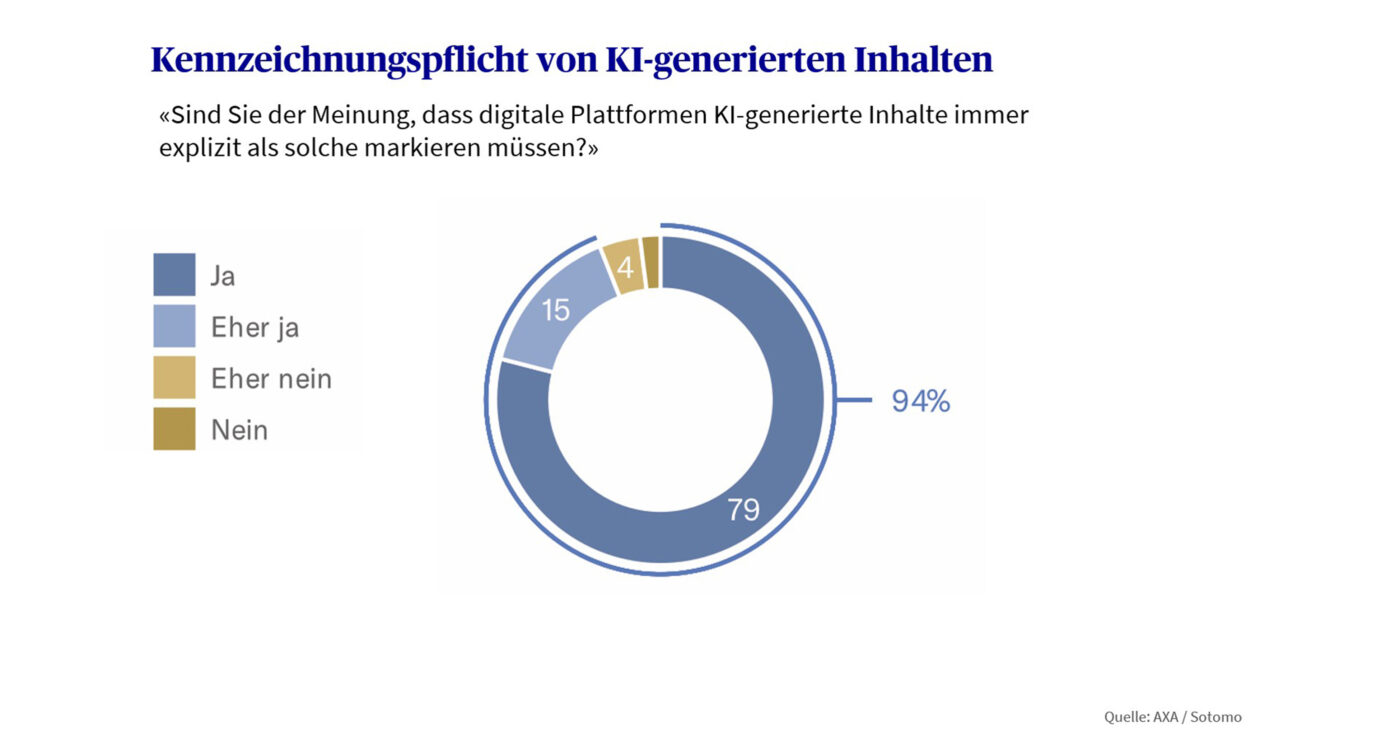
The demand for more regulation is clear: 94% of respondents are in favor of an obligation for digital platforms to explicitly label AI-generated content as such. From August 2026, the EU AI Act will oblige large platforms to take precisely this measure.
It is also clear who the population believes should bear responsibility: 70% see the operators of digital platforms - i.e. companies such as Google or Meta - as having the main responsibility for the safe handling of AI content. 55 percent also see the developers of AI models as having a duty, while 44 percent expect measures to be taken by national authorities and politicians. Michael Hermann, Head of Sotomo, comments: «People have moved away from the idea of dealing with digital platforms on their own responsibility.»
Personalized algorithms meet with rejection
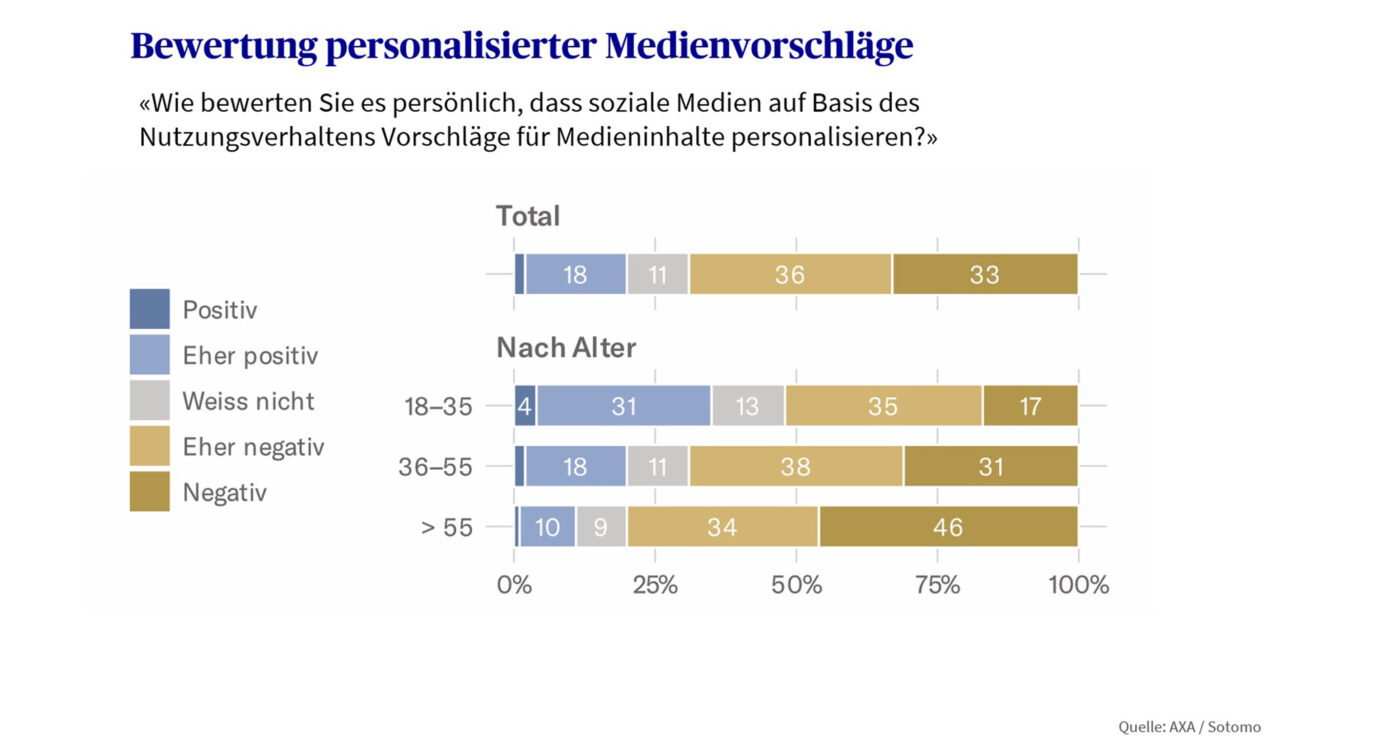
Not only AI content itself, but also the algorithmic mechanisms behind it are met with disapproval. 69% of respondents have a negative opinion of social media personalizing content based on user behaviour. This disapproval is particularly pronounced among the over 55s, 80% of whom rate personalization as negative. «Many digital platforms are deliberately designed to capture our attention for as long as possible,» says Katrin Sprenger. «One example of this is personalized algorithms that analyse our usage behaviour and display content that matches our interests.»
Nevertheless, the adaptation of content does not lead to consistently positive user experiences: Just under a fifth (19 %) of respondents say they feel bad more often than good after using social media. 49 percent feel good and bad equally often. Only when streaming audio content such as music or podcasts do the positive feelings clearly outweigh the negative ones: 80% say they feel good more often afterwards.
Screen time: desire for reduction is growing
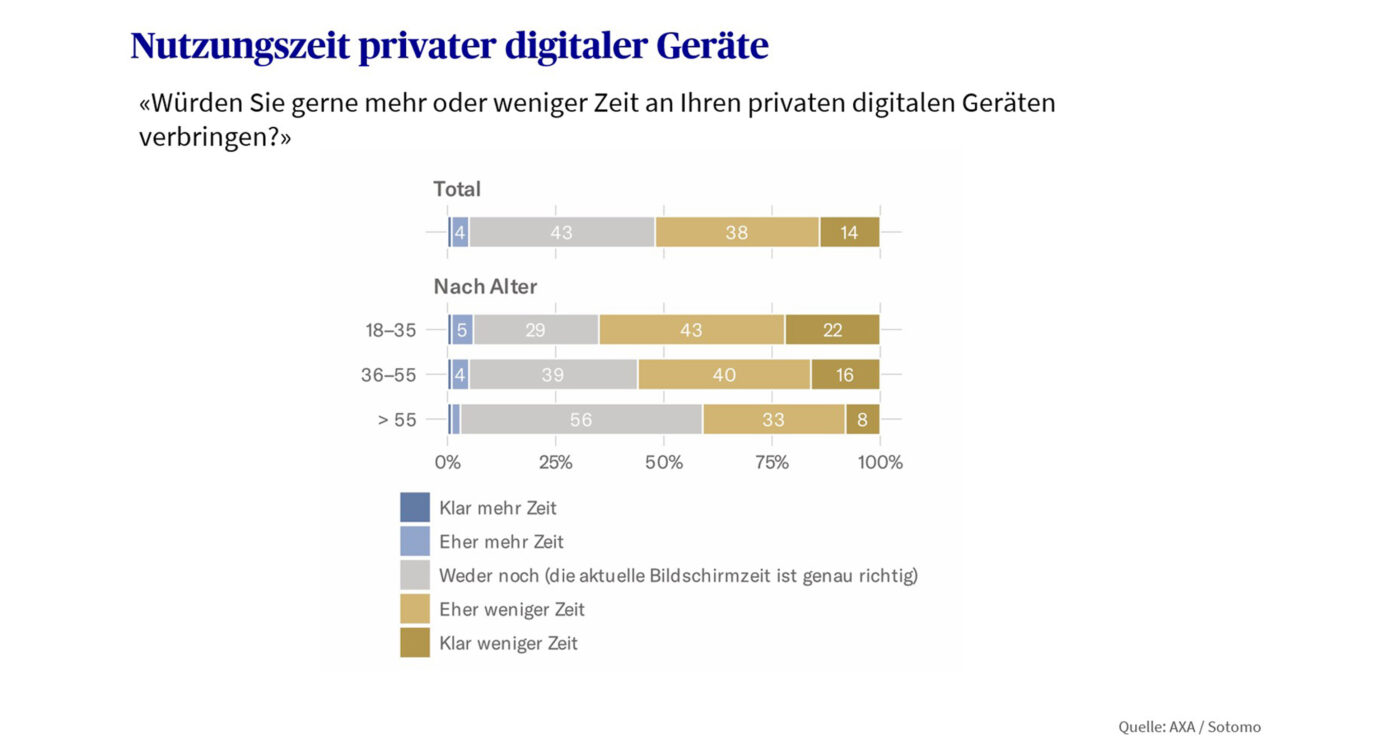
A good half of the Swiss population (52 %) would like to spend less time on private digital devices - six percentage points more than in the previous year (46 %). This desire is particularly clear among 18 to 35-year-olds: Two thirds of them would like to reduce their private screen time, and one in five young people even «clearly less». In contrast, only 5% of all respondents said they wanted to spend more time on their devices.
Two thirds of the population (68 %) frequently use their private cell phone without a specific reason - simply to pass the time or out of habit. Among the under-36s, the figure is as high as 84%. A large proportion actively take measures to regulate their own usage time: 46% consciously avoid certain apps or platforms, 27% limit notifications, 26% replace digital activities with analog ones.
However, not everyone finds it equally easy to implement these self-imposed rules: 34% say they have difficulties doing so. Among 18 to 35-year-olds, just under half (49 %) state that they find it difficult to stick to their own resolutions. This result is part of a consistent picture: The first generation of «digital natives» have significantly more trouble controlling their screen time than older people who grew up without a smartphone.
Source: www.axa.ch
Speaking of AI content: This article was created by the editorial team with AI support.