Swiss Cyber Security Days 2026: Embracing digital sovereignty
The Swiss Cyber Security Days (SCSD) will take place for the seventh time on February 17 and 18, 2026. On the main and tech stages of the congress area, leading national and international speakers will spend two days highlighting the opportunities and challenges of cyberspace and new technologies such as AI and quantum computing. Various exhibitors will also be on site.
Editorial - December 19, 2025
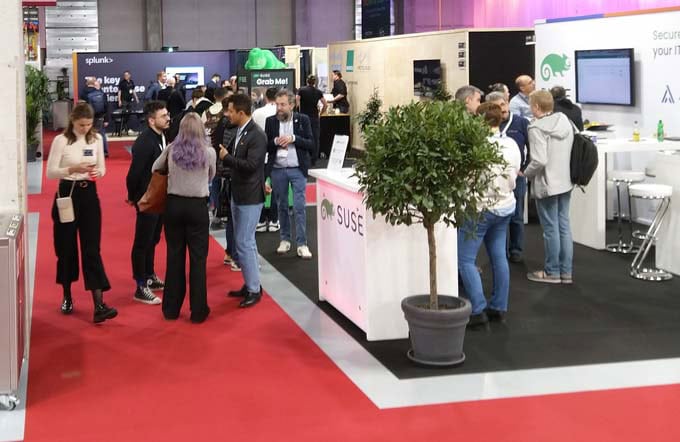
Impressions from the Swiss Cyber Security Days 2025. On February 17–18, 2026, various exhibitors will once again be showcasing their cybersecurity services and products. (Image: Thomas Berner)
Data, code, and digital infrastructures are the new building blocks of power, freedom, and self-determination. «Digital Sovereignty – The New Frontier» means that we ourselves determine and actively control our digital infrastructures. This is not about isolation, but about real choices, autonomy, transparency, and freedom. The motto of SCSD 2026 extends an invitation to the frontier of digital self-determination.
Digital sovereignty means self-determination and freedom
This goes hand in hand with a call to actively shape developments. «Digital sovereignty is not a question of isolation, but of self-determination. We must not delegate this responsibility, but actively exercise it,» says Nik Gugger, National Council member and President of the SCSD.
The audience can look forward to two days of high-caliber content: Federal Chancellor Viktor Rossi will give the opening speech. In addition, Florian Schütz, Director of the Federal Office for Cybersecurity, will give a keynote speech on how Switzerland's cyber resilience can be increased collectively. At the heart of SCSD 2026 is a three-hour focus on digital sovereignty, led by one of Europe's clearest and most courageous voices, Dr. Cristina Caffarra. Together with Nextcloud, Eurostack, and European and Swiss partners, we will unfold a compelling vision of why digital sovereignty is not only necessary, but also attractive and forward-looking. Also participating are NATO, Dr. Jean-Marc Rickli from the Geneva Center for Security Policy (GCSP), the FBI, Prof. Dr. Touradj Ebrahimi from EPFL, and the latest findings from the fields of e-ID, AI security, and quantum computing. Another highlight will be the contribution by Prof. Dr. Dr. Oliver Hoffmann. His research focuses intensively on the psychological conditions for sustainable work and the effects of artificial intelligence on our self-image.
New SME Zone and renowned exhibitors
The backbone of the Swiss economy—SMEs—is also particularly exposed. Those who understand and control their own IT infrastructure not only protect their business, but also gain freedom: the freedom to choose, change, and combine technologies. For SMEs, digital sovereignty is becoming a beacon that guides them through the fog of risk, dependency, and growing pressure. The new SME Zone, created specifically for this purpose, takes this into account and connects SMEs with relevant IT service providers. Here, decision-makers meet experienced IT and security specialists who present practical tools, solutions, and best practices. The zone offers guidance, inspires new partnerships, and accompanies companies on their way to a secure digital future.
In the Start-up Zone, young companies showcase their innovative cyber security solutions and engage in direct exchange with potential partners, investors, and trade visitors. Together with over 90 exhibitors such as Hornetsecurity, ELCA, Keepit, Sophos, Cloudflare, Redhat, and Axpo, a versatile platform for practical solutions, technological innovations, and direct knowledge transfer is created.
Tickets and formats – access to knowledge, exchange, and inspiration
Swiss Cyber Security Days 2026 offers the right ticket format for every interest – from EXPO Access to CONGRESS Access to the exclusive VIP ticket. Visitors can still take advantage of the early bird offer until December 31, 2025. EXPO Access now also includes access to the Tech Stage, which offers practical short presentations and technical insights.
AI and robotics at Phänomena: Learning as an adventure
The Phänomena science exhibition is returning after more than 40 years and will be traveling from place to place. Natural phenomena will be brought to life for young and old alike. AI and robotics are central themes.
Editorial - December 18, 2025
Sketch of the exhibition environment. (Image: zvg)
Digitization you can touch, climate you can feel, energy you can see: Phänomena turns science into an experience. The first edition in 1984 was a crowd-puller because it made research interactive and tangible for the first time. In 2026, Phänomena On Tour will revive the fascination of that time and consistently carry it into the future.
Mobile world of experience
Urs Müller, General Manager of Phänomena
Phänomena On Tour creates a mobile world of experiences at various locations. The exhibition will open in Dietikon on March 14, 2026. Further locations are yet to be announced. Through interactive stations, immersive installations, and digital tools, curious visitors discover natural phenomena by exploring them. Because when you experience knowledge, you remember things for a long time. «As a child, Phänomena taught me that the world is full of wonders,» says Urs Müller, general manager of Phänomena and son of founder Georg Müller. «For me, continuing this legacy means passing on the fascination of my own childhood to the future.»
How AI and robots are changing the world
In its 2026 exhibition, Phänomena is deliberately focusing on the topic of artificial intelligence. Instead of concentrating on language models such as ChatGPT, the focus is on making AI an experience. It deals with ethical questions and how AI and robots can relieve humans of dangerous jobs with drones or other technologies, what responsibilities programmers have, and whether machines also have feelings.
Cybersecurity and digital sovereignty: Can Europe regain control?
Awareness of the importance of digital sovereignty is growing rapidly in European organizations. In the cybersecurity environment, choosing a sovereign solution means greater resilience against cyberattacks as well as secure data integrity, trust, and decision-making autonomy.
Editorial - December 18, 2025
Cybersecurity and digital sovereignty are becoming critical factors for businesses and public authorities. (Image: AI-generated by Chat GPT / Stormshield)
According to the Digital Sovereignty Barometer 2025 According to EY, four out of five companies already consider sovereignty to be a key criterion that will become even more important in the future. This trend highlights a fundamental shift in understanding how control over data, infrastructure, and digital technologies can be regained.
Digital sovereignty is increasingly coming into focus, not least due to growing concerns about cybersecurity, data protection, and geopolitical tensions. Companies are now systematically incorporating this strategic factor into their technology decisions—whether for cloud solutions, software, or partnerships—in order to secure control and independence and reduce systemic exposure to foreign providers. This development will have a lasting impact on the technology market and give a boost to those providers who meet the increasing demands for sovereignty.
Building trust through digital autonomy
True digital sovereignty requires solutions that are designed from the outset to comply with local standards and fit seamlessly into regulatory frameworks such as the NIS2 Directive or the Cyber Resilience Act. The following applies: Sovereignty and performance are not mutually exclusive. Those who rely on European cybersecurity solutions that are certified by independent authorities such as France's ANSSI or Germany's BSI have been tested or certified, receive technologies that are reliable, effective, and secure—without having to accept a loss of control over data or infrastructure. Such solutions must be easy to implement and offer a high level of protection without compromising productivity.
Choosing a sovereign solution means greater resilience against cyberattacks, as well as secure data integrity, trust, and decision-making autonomy. It is not enough to simply certify products, i.e., have them evaluated according to technical safety criteria. They must also be approved by European authorities. qualified This qualification goes beyond certification: it confirms that a solution is reliable in the long term, meets operational requirements, and is suitable for sensitive environments. If source codes are also independently tested, both unintended vulnerabilities and potential backdoors can be identified. This strengthens trust and contributes directly to the goals of digital sovereignty.
Bringing key players together – for confident cybersecurity
Digital sovereignty requires the commitment of all stakeholders. From public institutions to companies of all sizes, everyone faces the same challenges: protecting employee and citizen data as well as business-critical and sensitive information. This requires a shared commitment to trustworthy cybersecurity solutions that enable a sovereign, resilient digital ecosystem. Equally necessary is a consensus among states whose political systems or geopolitical interests do not always align with those of the European Union.
In a market that continues to be dominated by non-European players, the decision in favor of local alternatives is an important step. It not only enables the regaining of technological and data control, but also strengthens Europe's strategic autonomy in security and digital issues.
This technological shift has an impact on security and at the same time strengthens the economy. The development and deployment of European solutions will boost the digital and cybersecurity industry across the continent and create skilled jobs. Conversely, the continuing massive import of American technologies, for example, means indirect financing of the US digital economy – at the expense of European capacities.
To achieve these economic goals and strengthen digital sovereignty, organizations already have numerous tools at their disposal: research funding, cooperation and information exchange between relevant actors, the creation and use of common standards, and a robust regulatory framework. All these elements contribute to building a resilient European digital ecosystem that fulfills the demand for sovereignty as well as the need for collective innovation.
Reducing technological dependencies also means protecting oneself against extraterritorial legislation. The US Cloud Act, for example, allows US authorities to access data even if it is stored outside the US. This example clearly illustrates the risks associated with a lack of sovereignty: it allows third parties to access sensitive information, possibly even without the owner's knowledge.
A shared path towards an independent digital Europe
The most important task is to achieve broad collective solidarity between all relevant forces in the public and private sectors. Only by working together can we create an independent, secure, and sustainable digital Europe. Sovereignty cannot be based on the decisions of individuals, but requires broad-based, coordinated, and ambitious collective action.
The change has already begun. Public institutions are driving forward initiatives in this area, and in practice, companies and their customers are increasingly expressing a desire for technological independence. If these impulses are combined, digital sovereignty can become a real, tangible strength—to the benefit of security, the economy, and the future of Europe.
Author:
Source: Stormshield
Pierre-Yves Hentzen is Chairman and CEO of Stormshield, a provider of cybersecurity solutions for businesses, government institutions, and defense agencies. www.stormshield.com
Managers ignore the power guzzler in the data center
AI data centers consume ever-increasing amounts of energy and water. However, many European executives are ignoring this development. In German companies, for example, the associated environmental risks have so far caused little concern. This is the finding of a recent AI survey.
Editorial - December 17, 2025
A clear majority currently assesses the environmental impact of AI as a low risk. (Graphic: Expleo)
Every month, technology consulting firm Expleo publishes its AI sentiment barometer, «Expleo AI Pulse.» This is based on a survey conducted in Germany, the United Kingdom, and France. It provides representative snapshots of sentiment regarding the use of artificial intelligence in companies.
«Artificial intelligence requires a lot of resources, »The impact on the environment is often ignored,« says Dr. Yusuf Erdogan, Country Lead Digital & Technology at Expleo Germany. »Our survey reveals this discrepancy: although the ecological footprint is growing, awareness of this is not yet reaching many boardrooms."
The main question in the latest Expleo AI Pulse survey focuses on the environmental impact of AI technologies. Only 13 percent of executives said they were «very concerned,» while another 29 percent were «somewhat concerned.» This shows that a clear majority currently consider the environmental impact of AI to be a low risk. German managers are particularly relaxed about this issue: only 30 percent of them are concerned, which is the lowest figure in the comparison. In France, the proportion of those concerned is 44 percent, and in the UK it is as high as 55 percent.
The advantages of using AI outweigh the disadvantages
At the same time, the survey shows that German executives overwhelmingly view the benefits of AI for their own companies in a positive light. 70 percent see primarily advantages for their business, while only 14 percent place greater emphasis on the risks. France is more cautious, with 61 percent, while British managers are particularly optimistic (75 percent).
According to Yusuf Erdogan, many companies are currently in a transitional phase: «There are often numerous pilot projects already in place, but there is still a lack of clear standards behind them. With increasing practical experience, it will become clear where AI creates sustainable added value. Traditionally, British companies tend to be more experimental in this area.»
Stable general sentiment toward AI
Despite differing perceptions, the general mood toward AI remains consistently positive. At 67 points, the European AI Pulse Sentiment Score in November is virtually unchanged from the previous month. The United Kingdom leads the ranking with 70 points, followed by Germany with 67 points and France with 64 points.
According to Expleo manager Erdogan, a strong commitment to AI technology is essential for a successful business future. However, the industry must also take sustainability into account: «Responsible AI means combining environmental, regulatory, and ethical responsibility with clear business models. This balancing act will determine success or failure in the market in the future.»
Price-performance ratio and regionality will determine tomorrow's energy suppliers
The EVU Atlas from YouGov Switzerland provides an overview of perceptions, market mechanisms, and expectations in the energy sector. Price increases, geopolitical tensions, and the ongoing debate about complete market liberalization have increased attention on the sector and changed the expectations of the population, according to one conclusion.
Editorial - December 17, 2025
How is the Swiss electricity market changing? The EVU Atlas from YouGov shows the perspective of electricity customers. (Image: Unsplash.com)
The new EVU Market Atlas from YouGov Switzerland (formerly known as LINK Marketing Services AG), based on over 18,000 respondents from 2021, 2023, and 2025, examines how the population perceives Switzerland's 29 largest energy suppliers and what would be important when choosing a provider.
Media visibility among the big players – local roots among small energy suppliers
The results show remarkable stability in terms of brand awareness: national providers such as Axpo and Alpiq remain top of mind even though they do not supply private customers, while large regional energy suppliers such as BKW, EKZ, IWB, and CKW also enjoy high visibility. Smaller providers remain locally anchored, while targeted communication has led to noticeable increases for several EVUs.
Perceptions of regionality remain an emotionally important factor and clearly show how strongly many Swiss people identify with their local provider. Energy suppliers such as SAK, Elektra Baselland, and EKS Schaffhausen receive particularly high scores in this area. Western Switzerland shows significantly higher volatility, indicating a stronger reaction by the population to political and price-related debates. The perception of price-performance is developing even more dynamically, with several energy suppliers showing significant improvement between 2023 and 2025, while national providers continue to lag clearly behind.
Value for money and regional roots are the biggest drivers of consideration
A key finding of the statistical model developed by YouGov Switzerland is that, among the characteristics surveyed, two factors in particular increase the likelihood of an energy supplier being shortlisted: perceived value for money and regional roots. Both show a clear and statistically robust correlation with consideration. If a provider is perceived as attractively priced, the probability of consideration increases significantly; if it is perceived as regionally anchored, this further increases trust and willingness to choose. At the same time, there has been a slight negative trend over the years: the population is becoming more cautious overall in its assessment of potential energy suppliers – a possible consequence of the energy policy uncertainty of recent years.
Dissatisfaction higher in French-speaking Switzerland, willingness to switch higher in German-speaking Switzerland
Satisfaction with one's own electricity supplier fell noticeably in 2023, but recovered slightly in 2025. Western Switzerland is particularly striking, where the proportion of clearly dissatisfied customers is three times higher than in German-speaking Switzerland. Nevertheless, it is precisely there that the proportion of people with a very low risk of switching is highest. This paradoxical pattern is typical of regulated markets: attitudes change even without freedom of choice, but they only translate into behavior when real alternatives exist. Hypothetical willingness to switch has been rising significantly since 2021 and stands at around 17 percent in 2025. This means that one in six people today would definitely be willing to switch if they could.
The study shows a clear correlation between the factors of price-performance and regionality and the likelihood that an electricity supplier will be shortlisted. At the same time, there are significant differences between regions: while willingness to switch is higher in German-speaking Switzerland and active loyalty management is required, a sudden and strong impulse to switch could arise in French-speaking Switzerland in the event of market liberalization. Overall, it is becoming apparent that tomorrow's electricity customers will be more informed, more demanding, and more selective than yesterday's customers. Who they choose will not be determined by historical structures, but by transparency, fair pricing, and genuine proximity to the population.
What happens when bosses ban AI? Stéphanie Kioutsoukis in the podcast
When managers ban AI, they weaken the very areas that are fighting hardest for attention: marketing and communication. Biel-based AI strategy expert Stéphanie Kioutrsoukis discusses this in the podcast by the Text Academy Foundation.
Editorial - December 15, 2025
Stéphanie Kioutsoukis is an entrepreneur and innovation expert from Biel. She specializes in artificial intelligence, organizational development, and strategic innovation. As the founder and CEO of two companies—Fresh Strategy and Fresh Solutions AI—she has established herself as an influential voice in the Swiss and international AI and innovation landscape.
Stéphanie Kioutsoukis is a guest on the latest episode of the AI podcast from the Text Academy Foundation. The Biel-based entrepreneur and innovation expert has observed a paradoxical pattern. The pressure to produce more content in less time is increasing. At the same time, bans are blocking the structured use of AI tools that could provide relief in this very area. Employees are responding with shadow IT, using private accounts, and testing campaign ideas outside of any control.
The podcast on YouTube:
The potential is particularly evident in marketing. Many teams use ChatGPT to create posts or newsletter ideas. Kioutsoukis sees this as just the beginning. Communication will only become truly «AI-native» when entire content process chains are rethought. Her team has opinion leaders analyze and cluster topics and generate post suggestions from them. People curate, refine the tone, and adapt examples, while AI takes care of the preliminary work and producing variants.
Responding with bans here damages your brand twice over. Campaigns take longer, reactions to trends come later, and testing remains sporadic. At the same time, the company is missing out on the opportunity to learn systematically from data. AI can identify response patterns, reveal target group preferences, and refine strategies. Without these signals, communication remains based on gut feeling.
Kioutsoukis advocates clear guidelines rather than bans. Marketing and communications teams should be encouraged to experiment with AI—on defined systems, with guidelines on data and content. Mistakes are inevitable, but instructive. It is crucial that managers protect these learning processes rather than penalizing them.
Swiss SMEs in particular are facing a turning point. Their visibility is increasingly dependent on digital communication, while budgets remain limited. AI can help to produce content more frequently and in a more targeted manner – from topic research to personalized messages. Those who reject this option risk falling behind in terms of communication.
In this way, AI in marketing becomes neither a promise of salvation nor a threat, but rather a standard set of tools. Prohibitions cement old structures and drive usage underground. Clear guidelines, training, and the courage to experiment turn AI into an amplifier for brands, messages, and dialogue.
The podcast episode on Spotify:
The video podcast «AI and Society - Paths into the New World» is produced by the Text Academy Foundation. Two episodes are published monthly, on Spotify, Youtube and other podcast platforms. Biel-based AI strategy expert Stéphanie Kioutrsoukis discusses this in the Text Academy Foundation podcast.
Fire protection planning meets engineering: Conference on March 10, 2026
Important changes are on the horizon with the upcoming fire safety regulations (BSV 2026). New legal frameworks, technical developments, and increasing cost pressures call for smart solutions that balance safety, usability, and innovation. The conference «Fire Safety Planning Meets Engineering» on March 10, 2026, will provide a concise overview and demonstrate in a practical manner the direction in which fire safety is moving.
Editorial - December 15, 2025
Various speakers will talk about changes to fire safety regulations on March 10, 2026. (Image: zVg / SAVE)
The focus is on current issues such as: How do risk-based performance assessments help to avoid overfitting in fire protection? What expectations does the intervention have of planning and engineering for more effective deployment? How does the fire protection authority use the performance-based approach, for example in smoke and heat management?
Another focus is on natural fire simulations, which reveal new possibilities in the design of structures—for example, for high-rise buildings with unprotected steel or composite construction. In addition, the most important innovations in BSV 2026 will be presented: feedback from the consultation process, contents of the new Model Code, and organizational approaches by the authorities for demanding verifications. Concrete examples will be used to illustrate how the Model Code is applied in practice.
The distinction between escape routes and evacuation, as well as the use of artificial intelligence in dealing with regulations and certifications, are also key topics. AI makes complex regulations easier to understand and opens up new opportunities for experts.
The conference provides concise inspiration, well-founded insights, and clear perspectives for the future of fire protection.
What YouTube reveals as a benchmark for brand management at AI speed
YouTube is not the message, but the mirror: if you want to survive the video overload, you need a fast workflow, creativity combined with craftsmanship, trust instead of vanity—and measurement that doesn't ruin the brand.
Editorial - December 14, 2025
(Image: Nano Banana)
Five seconds. Then the skip button appears—and with it, a simple, brutal market test: Is an idea even relevant in the present? This is not “YouTube logic.” It is modern logic. YouTube just makes it more visible than other places—because there, decisions about what sticks and what disappears are made faster, more publicly, and more ruthlessly.
This is precisely why the platform serves as a benchmark for adaptation. As a blueprint for principles that determine survivability everywhere today. This m&k learning comes from numerous reports on video, creativity, brand management, marketing, AI, and platforms. We have condensed it into seven drivers for advertising and marketing-based business success.
1) Speed is not a virtue, but the new strategic level
The real shift is not “more video.” It's more iteration. Audiences consume content at feed speed, competitors respond in real time, and trends shift in days rather than quarters. Those who still think in terms of traditional campaign cycles don't come across as “solid,” but rather slow. And in digital markets, slow is not neutral – slow becomes a weakness.
Speed does not mean hecticness, but rather systematicity: short loops, clear responsibilities, fast versions, early learning. The brand remains stable, but the execution becomes agile. This is precisely where the new form of competitiveness arises: not through volume, but through timing.
Adaptable:
Creation as an iteration machine (testing, learning, refining)
Production logic: less “masterpiece at the end,” more “versions at the start”
Fast feedback loops between creation, media, data, and community
2) Creativity requires craftsmanship: The ABCD principle as a transfer model
When attention is scarce, craftsmanship becomes a lifeline. Creativity alone is not enough—it has to work under pressure: in the first few seconds, in different formats, on different screens, with changing contexts. That's exactly why the ABCD principle is so valuable: it translates “good idea” into a structure that holds up in reality.
ABCD is not the creative idea itself. It is the framework that prevents an idea from fizzling out due to poor timing, a false start, or a lack of clear guidance. In short, it is storytelling as a discipline—not as a gut feeling.
A – Attention: The introduction is the pitch. No preamble, no “first some context.”.
B – Branding: Mark early as a cue, not late as a sender stamp.
C – Connection: Emotion as a driver of impact, not as decoration.
D – Direction: Clear next step, otherwise it remains entertainment.
Adaptable:
ABCD is a universal briefing and quality grid for moving images—whether CTV, social media, pre-roll, DOOH screens, or product films.
3) Culture as a competitive advantage: The cultural delta
The hardest currency in the market is not reach, but meaning. Products can be copied, features too, and prices anyway. What remains difficult to copy is cultural relevance: the feeling that a brand “knows what's going on” – and not just “has something to say about it.” YouTube is a particularly clear benchmark for how culture is created: through friction, remixing, commentary, counter-arguments, and repetition. Those who recognize cultural signals early on and translate them accurately build a cultural delta: a lead that does not come from “trend hopping” but from genuine understanding. The attitude behind it is important: not artificially inventing trends, but picking up on existing energies – and credibly translating them into brand actions, tonality, and storytelling.
Adaptable:
Don't treat culture as a trend deck, but as input for positioning
“Repurposing as the supreme discipline: absorbing existing cultural energies, not artificially inventing them
Storytelling not only as a sales tool, but as status workBrands build cultural status by creating meaning, not just messages.
4) Trust beats attention: Creators as operating systems, not as package inserts
Attention is available. Trust is scarce. This is precisely where the core of creator logic lies: creators are not “reach providers,” but rather trust architects. Their audience follows them not because they have to, but because they want to—and because they know the codes: tone, rhythm, attitude, recurring formats, a feeling of closeness. This has consequences for brands: those who treat creators as interchangeable media spaces often get interchangeable results. Those who think of creators as partners with their own system—format, community, editorial, production—can scale authenticity instead of crushing it. And that's exactly where the game shifts from short-term peaks to long-term preference.
Adaptable:
Think of partnerships like media projects (format logic, continuity, autonomy)
Treat creators not as an extension of the brand, but as independent publishers
Measure success not by likes, but by sustainable signals (return visits, searches, brand preference, recommendations)
Mateo Price, Chief Strategy Officer at MrBeast, in the GML 2025 stage talk in Dublin with Aarthi Scott, Managing Director at Google.
5) Premium is a context, not a channel: the living room as a new seal of quality
“Premium” is no longer what is shown on linear TV. Premium is what is consumed in the right mode: sound on, big screen, lean-back, shared attention. The living room is not just another screen – it is a different mental state. And this state is worth its weight in gold for brands because it allows storytelling again: longer, denser, more emotional, less fleeting. The strategic lesson: CTV is not a format building block, but a funnel building block. At the top, it builds trust and memory; at the bottom, other devices translate this into action. Those who separate the two are wasting their impact. Those who integrate it are building a modern full-funnel dramaturgy.
Adaptable:
CTV as an upper funnel engine for storytelling and brand building
Mobile/desktop as a lower funnel engine for action and conversion
Build the creation in such a way that the transition between screens is taken into account (e.g., clear action guidance, QR, search prompts).
YouTube EMEA Press Event in Zurich: Dyana Najdi, Managing Director, Google Advertising UKI (Images: Beat Hürlimann)
6) Measurement without brand loss: Brand lift instead of click fetishism
Many organizations optimize performance until their brand evaporates—often not out of stupidity, but because of measurement pressure. What can be neatly counted in the short term wins internally. What has a long-term effect but is more indirect becomes a “soft” metric. The result is well known: short-term efficiency, long-term erosion.
The benchmark lesson is therefore: measurement must protect the brand, not replace it. Brand lift logic, clean control groups, midflight learnings—none of this is particularly glamorous, but it forms the basis for legitimizing branding investments in the company without neglecting performance. The key is a common language: full funnel as a system, not as a team war.
Enable mid-flight learning (not just “post-funeral reporting”)
Full funnel as a shared goal, not as trench warfare between teams
7) AI is not a tool, but a pacemaker
AI is not only changing production. It is changing expectations: more variants, faster adaptation, shorter half-lives. This makes AI the new timing level—those who ignore it are not being “cautious,” but are at an operational disadvantage.
At the same time, AI does not replace what makes brands distinctive. It accelerates what needs to be done anyway: prototyping, testing, adaptations. The real bottleneck remains human: tonality, truth, courage to come up with ideas, cultural understanding, quality filters. The winners are not those with the most tools, but those with the clearest interplay between speed and brand.
Adaptable:
GenAI as a prototyping layer (speed)
Human craftsmanship as a quality filter (brand, tone, ethics, differentiation)
Governance that allows creative momentum rather than blocking it
Conclusion: The benchmark that hurts—and helps precisely because of that
YouTube is the ultimate test. It shows what applies everywhere in a video-first reality: Speed + craftsmanship + cultural understanding + trust + premium context + measurement = brand management. Everything else is “playing games.” And playing games is the easiest way to slowly fade away these days.
Transfer checklist for agencies and brands
Workflow: Iteration capable? (Versions, quick feedback, short paths)
Creation: ABCD-ready? (Entry, early branding, connection, direction)
Culture: Cultural delta active? (Reading signals, constructing meaning, translating credibly)
Screens: CTV + Mobile integrated? (Storytelling above, action below)
Measurement: Brand Lift + Full Funnel neatly linked?
AI: Prototyping accelerated, brand secured?
NZZ strengthens position at APG|SGA: stake to increase to 45 percent
The NZZ Group is consolidating its position in the Swiss outdoor advertising market and acquiring share packages from major shareholders JCDecaux and Pargesa. The deal is subject to certain conditions and heralds a change in leadership: NZZ CEO Felix Graf is set to take over as chairman.
Editorial - December 12, 2025
The NZZ wants to increase its stake in APG|SGA from 25 to 45 percent. As announced, the media company has agreed with JCDecaux and Pargesa to purchase a total of 20 percent of the shares at a price of CHF 220 each. The independent members of APG's board of directors support the move as a „market-friendly solution“ to stabilize the shareholder structure.
The hurdle of «opting up»
The implementation is subject to the general meeting approving an opting-up clause. This would exempt NZZ from the obligation to make a public takeover bid up to a threshold of 49 percent. The decision will be made at an extraordinary General Meeting on January 23, 2026, with the final say resting solely with the public shareholders („majority of the minority“).
Confident brand management – when reduction becomes a leadership quality
Today, brand management is not determined by more messages, but by the ability to distinguish what is relevant from background noise. The louder the communication environment becomes, the more valuable it is to leave things out. Reduction is not a weakness, but an act of sovereignty—and a leadership quality that stabilizes trust.
Editorial - December 11, 2025
The new art of omission
For years, presence was power. But in a communication space that never falls silent, constant presence is no longer an advantage—it becomes a risk. The Edelman Trust Barometer 2025 shows that brands that carefully measure their messages achieve significantly higher trust ratings than those that broadcast constantly. 71 percent of respondents find overly staged brand appearances «intrusive.».
Today, confidence is no longer demonstrated by volume, but by control over one's own tone. Brands that know when to speak—and when not to—gain depth.
Swiss brands with attitude rather than volume
In Switzerland, a surprising number of traditional companies are succeeding in this. Geberit talks about precision, not pathos. Ricola talks about origin, not reach. Bühler Group and NZZ cultivate consistency in an age that demands a new tone every week.
Others also show that restraint is not renunciation, but an expression of strength:
Caran d'Ache stands for craftsmanship and timelessness in a culture of speed. Victorinox remains committed to simple functionality—and that is precisely what makes it so sought after worldwide. – La Prairie talks about quality and origin, not exclusivity.
They all demonstrate the same thing: credibility does not come from reinforcement, but from consistency.
Reduction as an economic and communicative strength
An Interbrand analysis (2024) shows that brand value is created where clarity, recognizability, and scale come together. A GfK study in Switzerland also confirms that trust is the most important purchasing motive—ahead of price, speed, and innovation.
Those who consciously reduce their communication increase its impact. Reduction is not absence, but a form of precision: it only allows through what is essential. This requires attitude—and leadership.
By the way ...
Nowadays, trust rarely comes from what brands add—but often from what they wisely leave out.
Laura Colledani and Klaus Ammon have more than 40 years of combined experience in consumer research and marketing research. Over the years, they have developed a keen sense of what moves people - even beyond the numbers. Both authors advocate a communication culture that listens before it broadcasts. With the new approach of consumer listening management tools, they want to support marketing managers in not only questioning consumers in the traditional way, but also entering into a genuine relationship with them.
Cloud solutions are on the rise, but hybrid scenarios dominate the landscape
Cloud solutions are becoming increasingly prevalent in SAP landscapes, but the standard remains hybrid for the time being: most companies combine on-premises systems with private and public cloud offerings.
Editorial - December 11, 2025
Hybrid cloud solutions dominate the system landscapes of SAP users. (Graphic: DSAG)
SAP user groups in North America, Germany, Austria, Switzerland, the United Kingdom, and Japan conducted a joint survey. A total of 274 participants from the DACH region registered for the survey. The main findings are as follows: More than two-thirds of SAP users surveyed worldwide already use cloud services for applications, workloads, or data storage. In the DACH region, the rate among DSAG members is 76 percent, driven by RISE and GROW offerings designed to accelerate the transition without replacing on-premises operations in the short term.
Hybrid landscapes dominate
According to survey results, 78 percent of DSAG companies combine on-premises and cloud systems, while pure public cloud scenarios remain rare. The reasons for this are highly customized S/4HANA systems, investment protection, complex licensing models, and uncertainties regarding return on investment.
The reluctance to embrace the public cloud is primarily cultural and regulatory in nature. Many companies in Germany, Austria, and Switzerland fear dependence on individual providers, data access by foreign hyperscalers, and the loss of established customizations and functions.
Around 43 percent of DSAG members are also calling for more flexibility in deployment models and insist on genuine freedom of choice between on-premises, private, and public clouds. They are demanding standardized, open operating models, transparent licensing and cost structures, and clear migration paths.
Business Suite and Business Data Cloud
Only around a third of respondents are truly familiar with SAP's new Business Suite; many feel that clear roadmaps and support timeframes are lacking. The knowledge gaps are even greater when it comes to the Business Data Cloud: companies are seeking guidance on integration capabilities, licensing and pricing models, and how it differs from existing SAP data solutions.
The survey conducted in July and August 2025 confirms that the cloud is gaining ground, but the hybrid approach remains dominant for the foreseeable future. Whether Business Suite and Business Data Cloud will further accelerate this trend depends heavily on better communication, transparency, and reliable framework conditions on the part of SAP. «The DACH region is characterized by mature on-premises landscapes, high data protection requirements, and a strong awareness of investment security. This explains the more cautious but sustainable approach of many companies to cloud transformation,» says Jens Hungershausen, DSAG CEO.
YouGov survey: Seven out of ten donate, almost half volunteer
During the Christmas season, the topics of sharing and togetherness often come up. According to the new YouGov survey „Donations and Volunteer Work in Switzerland,“ 72 percent of Swiss people made some form of donation last year, with 64 percent donating money and 13 percent donating material goods.
Editorial - December 11, 2025
The most common cause for donations is humanitarian aid after crises (41 percent). Women support such humanitarian causes significantly more often than men (47 vs. 35 percent). In contrast, men donate above average to nature conservation and environmental protection (40 percent) (45 vs. 36 percent). Social causes (40 percent) and health organizations (36 percent) follow closely behind. There are regional differences: people in German-speaking Switzerland donate money more frequently (68 percent).
Personal values as the strongest motivator—but not the same for everyone
The most important motivation for donating is personal values or life experiences (65 percent). There are relevant age differences here: while personal values are clearly decisive for all respondents, this factor is less central for 18- to 29-year-olds (54 percent), but still important for around half of them. Emotional attachment (29 percent), proximity to the issue (24 percent), and visible, measurable results (25 percent) follow at a considerable distance. Regionally, the importance of proximity is particularly high in Ticino, where local ties are given greater weight when it comes to donations (40 percent).
Why some people don't donate
The most important reason for not donating is a lack of available budget (36 percent). This particularly affects younger people: in the 18 to 29 age group, the proportion of non-donors is significantly higher than in all older groups. Other common barriers are a lack of trust in charitable organizations (27 percent) and uncertainty about how the funds are used (26 percent).
There are regional differences in terms of trust in organizations. Only 11 percent of people in German-speaking Switzerland say they do not trust church organizations – in French-speaking Switzerland (23 percent) and Ticino (22 percent), this proportion is significantly higher.
Volunteering: Almost one in two people do volunteer work
Almost half of the Swiss population did volunteer work last year (47 percent). Among those who did, it was particularly common in sports clubs (31 percent). This was followed by social organizations (22 percent), community and neighborhood organizations (20 percent), churches, leisure clubs, and cultural associations (19 percent each).
In German-speaking Switzerland, volunteer work is carried out in church organizations at an above-average rate (22 percent compared to 11 and 9 percent in French-speaking Switzerland and Ticino, respectively).
Motivations for volunteering – community stronger than with donations
As with donations, personal values and life experiences are the most important motivators (65 percent). However, in contrast to donations, a sense of community plays a significantly greater role in volunteer work (45 percent vs. 24 percent for donations). Personal involvement (30 percent) is particularly important for people in French-speaking Switzerland (55 percent) and Ticino (62 percent), compared to 21 percent in German-speaking Switzerland. Measurable results (24 percent) follow behind.
Volunteering is often initiated by the immediate environment: through personal requests (48 percent) or contacts within one's own circle.










 The most common cause for donations is humanitarian aid after crises (41 percent). Women support such humanitarian causes significantly more often than men (47 vs. 35 percent). In contrast, men donate above average to nature conservation and environmental protection (40 percent) (45 vs. 36 percent). Social causes (40 percent) and health organizations (36 percent) follow closely behind. There are regional differences: people in German-speaking Switzerland donate money more frequently (68 percent).
