More digitally confident thanks to open source software
The term «digital sovereignty» is currently dominating the discussion in the ICT scene. Open source software is becoming an option for more and more organizations. One leading provider of an open source collaboration platform is Nextcloud. We spoke to founder and CEO Frank Karlitschek.
You need to be logged in to view this content. Please Log In. Not a Member? Subscribe now!
In the past, hierarchical positions and professional expertise were often combined in one person. This is different today. Why one person alone is no longer enough is discussed in the following sections.
You need to be logged in to view this content. Please Log In. Not a Member? Subscribe now!
Data centers require a lot of energy, indeed, they are even described as real «power guzzlers». And there are fears that developments in AI will even massively increase energy requirements. However, Yves Zischek from Digital Realty takes a more nuanced view.
You need to be logged in to view this content. Please Log In. Not a Member? Subscribe now!
The number of FinTech companies in Switzerland and Liechtenstein increased slightly in 2025. At the same time, the technological focus is shifting towards data- and AI-based solutions. This is the conclusion of the new IFZ FinTech Study 2026 by Lucerne University of Applied Sciences and Arts.
You need to be logged in to view this content. Please Log In. Not a Member? Subscribe now!
AXA Cybersecurity Monitor 2026: AI exacerbates the threat situation
The second AXA Cybersecurity Monitor shows that 87% of the Swiss population expect an increase in cyber fraud cases as a result of AI. At the same time, almost seven out of ten respondents reject personalized algorithms - and a good half want less private screen time.
Editorial - April 20, 2026
Two thirds of young people want less screen time. Source: zvg
The Swiss population is increasingly concerned about the digital world: cyber fraud, uncontrolled use of AI and excessive screen time are worrying people of all ages. These are the findings of the second AXA Cyber Worry Monitor, which was conducted in collaboration with the Sotomo research institute. For the representative survey, a total of 1,490 people from German-speaking and French-speaking Switzerland were interviewed between February 16 and March 1, 2026.
Cybercrime remains one of the biggest challenges
Digital security and cybercrime are still among the most strongly perceived social challenges in Switzerland in 2026. With an average score of 4.2 on a scale of 1 (no challenge) to 5 (major challenge), the topic ranks behind health insurance premiums (4.4) and the housing market (4.3) - but ahead of retirement provision (4.1) and the international security situation (3.9).
People are particularly worried about specific cybercrimes: 77% of respondents fear falling victim to a hacking attack, while 64% are concerned about phishing. Fake stores (54 %) and social engineering fraud (52 %) also worry many people.
The respondents attribute the greatest influence on the threat situation to artificial intelligence: 87% expect AI to increase the frequency of cyber fraud cases, while 77% also assume that the financial loss per case will increase. «On the Internet, there is no longer any inhibition threshold for the spread of counterfeits,» says Katrin Sprenger, Head of AXA Cyber Prevention Services. «Whether for clicks, for cyber fraud or for the targeted manipulation of opinions: Anyone can now use AI to produce realistic imitations and publish them largely uncontrolled.»
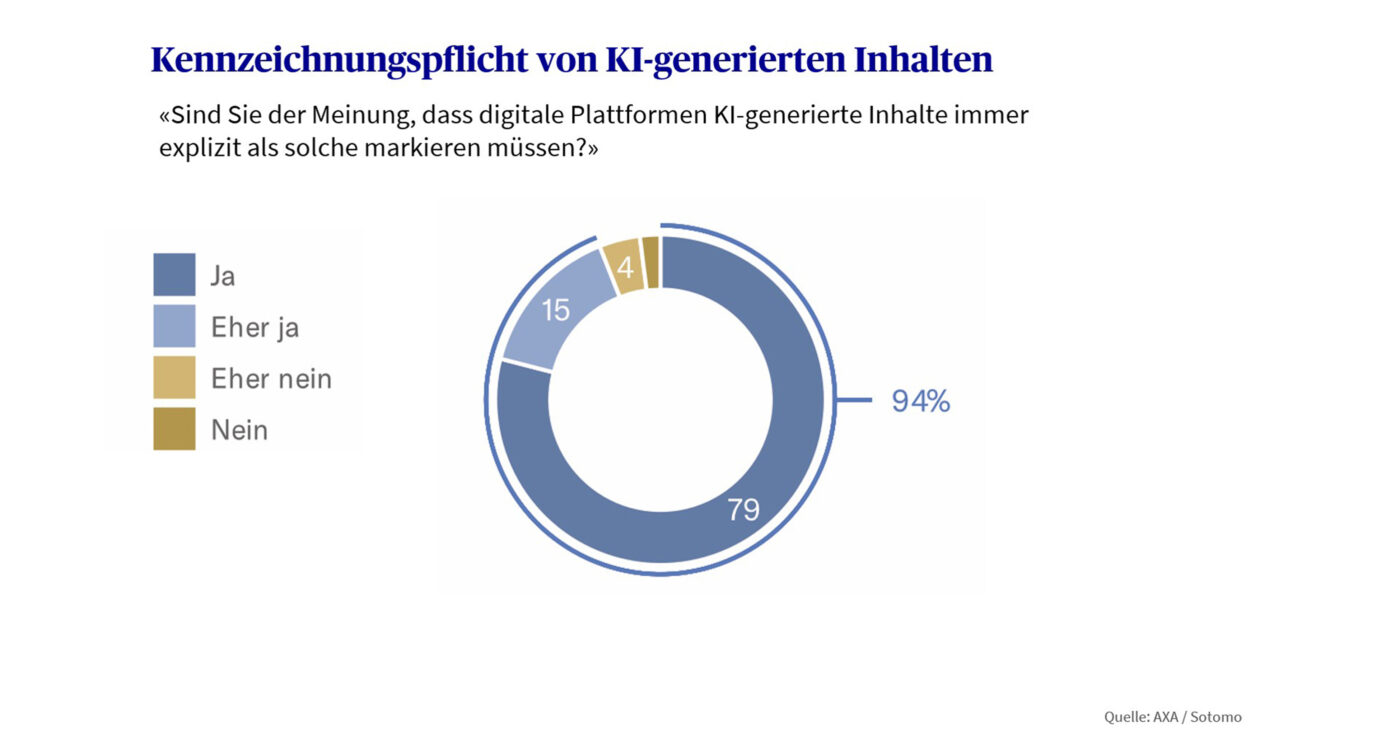
Swiss population calls for mandatory labeling of AI content. Source: zvg
AI content: Skepticism instead of enthusiasm
AI-generated media content meets with little enthusiasm among the Swiss population. Around 43% state that they do not specifically consume such content at all. Those who do use AI content do so primarily for learning (25 %) or out of curiosity (25 %). Only 15% and 17% respectively consciously use AI-generated content for entertainment or information on current topics.
There is a clear age gap in terms of usage behavior: While 29% of 18 to 35-year-olds state that they never specifically consume AI content, this figure is over half for the over 55s. In addition, around 40% of respondents believe that the growing presence of AI content is making social media less attractive - only a third see an increase. So-called AI slop - obviously AI-generated images or videos with visual distortions - is not popular with around two thirds.
The perceived threat to the credibility of information is particularly serious: 61% rate this as a major challenge (scale value 5). The formation of political opinion (51 %) and transparency in the creation of AI content (51 %) are also considered to be major problems by a majority. A considerable proportion of respondents also state that they have difficulty recognizing AI-generated texts (65 %), AI images (53 %) or AI audio content (49 %) as such.
«The technologies are constantly improving. Learning to recognize AI-generated content can therefore not be the goal,» says Sprenger. «We should always check the truthfulness of digital content before we trust it.»
Clear vote for mandatory labeling and platform responsibility
The demand for more regulation is clear: 94% of respondents are in favor of an obligation for digital platforms to explicitly label AI-generated content as such. From August 2026, the EU AI Act will oblige large platforms to take precisely this measure.
It is also clear who the population believes should bear responsibility: 70% see the operators of digital platforms - i.e. companies such as Google or Meta - as having the main responsibility for the safe handling of AI content. 55 percent also see the developers of AI models as having a duty, while 44 percent expect measures to be taken by national authorities and politicians. Michael Hermann, Head of Sotomo, comments: «People have moved away from the idea of dealing with digital platforms on their own responsibility.»
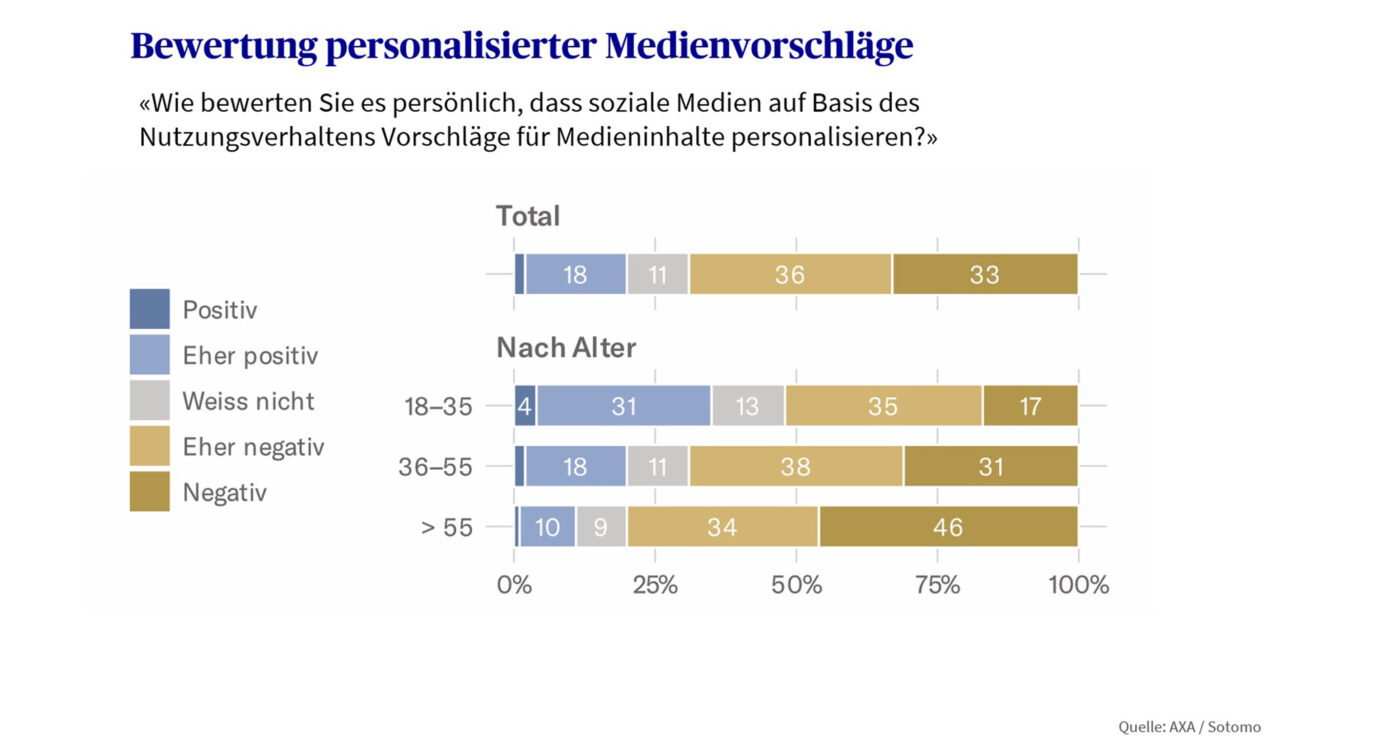
Swiss reject personalized media proposals by a large majority. Source: zvg
Personalized algorithms meet with rejection
Not only AI content itself, but also the algorithmic mechanisms behind it are met with disapproval. 69% of respondents have a negative opinion of social media personalizing content based on user behaviour. This disapproval is particularly pronounced among the over 55s, 80% of whom rate personalization as negative. «Many digital platforms are deliberately designed to capture our attention for as long as possible,» says Katrin Sprenger. «One example of this is personalized algorithms that analyse our usage behaviour and display content that matches our interests.»
Nevertheless, the adaptation of content does not lead to consistently positive user experiences: Just under a fifth (19 %) of respondents say they feel bad more often than good after using social media. 49 percent feel good and bad equally often. Only when streaming audio content such as music or podcasts do the positive feelings clearly outweigh the negative ones: 80% say they feel good more often afterwards.
Screen time: desire for reduction is growing
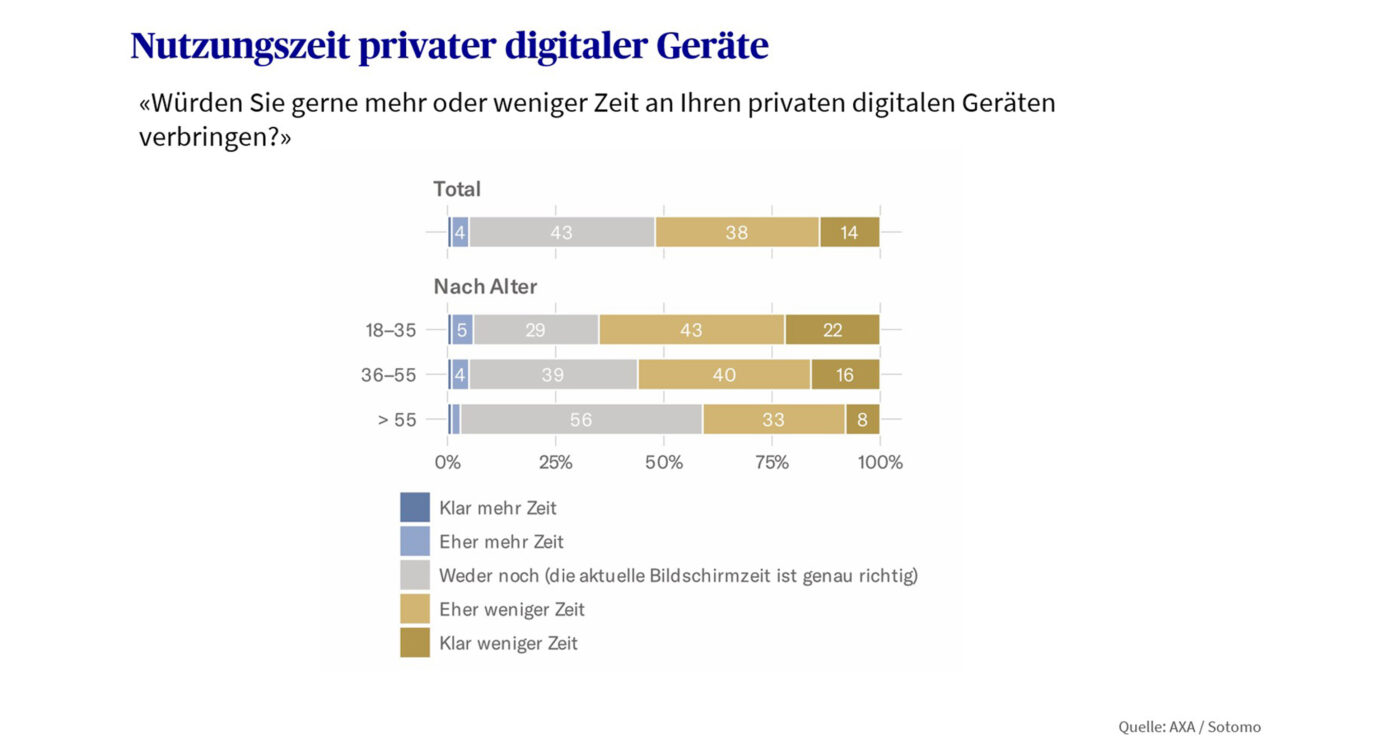
Swiss population wants less private screen time. Source: zvg
A good half of the Swiss population (52 %) would like to spend less time on private digital devices - six percentage points more than in the previous year (46 %). This desire is particularly clear among 18 to 35-year-olds: Two thirds of them would like to reduce their private screen time, and one in five young people even «clearly less». In contrast, only 5% of all respondents said they wanted to spend more time on their devices.
Two thirds of the population (68 %) frequently use their private cell phone without a specific reason - simply to pass the time or out of habit. Among the under-36s, the figure is as high as 84%. A large proportion actively take measures to regulate their own usage time: 46% consciously avoid certain apps or platforms, 27% limit notifications, 26% replace digital activities with analog ones.
However, not everyone finds it equally easy to implement these self-imposed rules: 34% say they have difficulties doing so. Among 18 to 35-year-olds, just under half (49 %) state that they find it difficult to stick to their own resolutions. This result is part of a consistent picture: The first generation of «digital natives» have significantly more trouble controlling their screen time than older people who grew up without a smartphone.
Speaking of AI content: This article was created by the editorial team with AI support.
Reto Joller becomes Chief Digital Officer of the Sabag Group
The Sabag Group is continuing to expand its organization in a targeted manner: Reto Joller is assuming overall responsibility for the company's digital transformation as Chief Digital Officer. At the same time, a new unit for central services, Sabag Service AG, is being established.
Editorial - April 20, 2026
Reto Joller becomes the new Chief Digital Officer at SABAG. Source: zvg
Reto Joller has been with the Sabag Group, a trading and production company for construction and interior design products, since summer 2025 and was previously responsible for the strategic and operational direction in the areas of digitalization and e-business. With his appointment as Chief Digital Officer, he is now assuming overarching responsibility for the transformation and further development of key topics relating to collaboration, processes, services, data and organization. Joller has been active in the digital business for over 30 years and has held various management positions at Swisscom, Swiss Life and in public administration at cantonal and federal level, among others. His work has won several awards, including the German Brand Award, Best of Swiss Web and the Digital Economy Award.
New organizational unit for the transformation
As part of the strategic realignment, the Sabag Group establishes Sabag Service, in which central services for the further development of the entire Group are bundled. Within the «Business Transformation» business unit, new competencies are being built up and gradually developed - including in the areas of Experience Management, Service Delivery & Operations and with the Sabag DataHaus as a competence center for company-wide data. This business unit is headed by Reto Joller.
The Sabag Group is thus setting an important course for the future and is gradually developing into an organization that functions even more simply - for employees and customers alike. At the same time, Sabag is creating the basis for implementing changes in the market environment more quickly and effectively.
Focus on concrete change instead of pure digitalization
The focus is not purely on the digitalization of existing processes. The decisive factor is how Sabag works together, improves processes in a targeted manner, makes joint decisions and implements projects. Digitalization forms the basis - the focus is on concrete change in everyday life and along the entire value chain.
With this focus, Sabag is also consciously breaking new ground in the trade of construction and interior design products. The company is making targeted investments in new roles and employees, including functions in the areas of customer experience, service design, communication, business and solution architecture as well as several roles for professional data management.
A new global study by Cloudera reveals a growing paradox: almost all companies rely on AI - but almost four out of five struggle with limited access to data. The so-called «AI readiness illusion» jeopardizes sustainable results.
Editorial - April 20, 2026
AI needs data, but access to it is often restricted. (Image: Depositphotos.com)
Globally, 96 percent of the companies surveyed are already integrating AI into their business processes. Nevertheless, almost four out of five report that restricted access to data is hindering their AI and data initiatives. This is shown by the new «Data Readiness Index» from Cloudera, which examines how well prepared companies are for the use of AI on a large scale.
The «AI readiness illusion»
85% of the companies surveyed worldwide have a clearly defined data strategy - in the EMEA region, this figure is as high as 92%. Despite this, 42 percent of respondents in Europe state that complicated access requirements make it difficult to use data effectively. This discrepancy describes what Cloudera calls the «AI readiness illusion»: the belief that companies are equipped to scale AI, even though fundamental data issues remain unresolved.
Sergio Gago, Chief Technology Officer at Cloudera, puts it in a nutshell: «Companies are not struggling with the introduction of AI. They are struggling to move beyond experimentation and into practice. AI is only as good as the data that feeds it. Without seamless access to all their data, companies are limiting the accuracy, confidence and business value that AI can deliver.»
ROI remains elusive
AI has arrived in most companies, but a sustainable return on investment is still difficult to achieve. When AI initiatives fail, respondents worldwide and in EMEA cite the same reasons: Data quality issues top the list at 22 percent globally and 18 percent in Europe, followed by cost overruns at 16 percent each and poor integration into existing workflows at 15 percent globally.
Infrastructural bottlenecks exacerbate the problem: almost three quarters of respondents worldwide (73%) and in EMEA (74%) report that performance bottlenecks hinder operational initiatives. 40 percent experience this frequently, 34 percent occasionally. In view of these bottlenecks, it is not surprising that EMEA organizations are investing particularly heavily in modern infrastructure: 90% are planning to increase their cloud spending, compared to just 65% globally.
Data gap: Access, governance and transparency
Globally, 84 percent of respondents said they trusted their company's data. But this optimism masks deeper problems: Data silos, inconsistent quality and limited accessibility. Globally and in EMEA, 34% of respondents cite isolated data pools as a serious obstacle to collaboration and data-driven decision-making.
The contrast in EMEA is particularly revealing: 89% of respondents state that they do not have a complete overview of where 100% of their data is stored. At the same time, 41% cite limited data transparency as a concrete obstacle to the effective use of their data. A similar picture emerges for data governance: globally, less than one in five respondents (18%) state that their data is fully managed. In Europe, this figure is higher at 26%, but here too, the majority of data remains insufficiently controlled.
Data readiness as a competitive factor
As AI moves from the experimental phase to widespread implementation, data readiness is becoming a decisive competitive factor. Organizations that can fully access and control their data, regardless of where it is stored, are much better positioned to use AI in a reliable and scalable way.
The willingness to change is fundamentally there: 96% of EMEA respondents are ready to introduce new governance frameworks and around 91% are confident that their data infrastructure can support the strategic priorities of the next two to three years. However, as long as governance gaps remain and data is not fully integrated, the full potential of AI will remain untapped. Those who close the gap between strategy and implementation will be best positioned to achieve sustainable impact with AI.
The complete report «The Data Readiness Index: Understanding the Foundations for Successful AI» has been published by Cloudera on its website. The study is based on a survey of 1,270 IT executives from the AMER, EMEA and APAC regions in companies with more than 1,000 employees, which was conducted from January 22 to March 3, 2026.
Equinix accelerates AI workloads with Fabric Intelligence
Equinix introduces Fabric Intelligence, an intelligent solution for managing network infrastructures. The AI-powered platform automates provisioning, optimization and maintenance of global infrastructures - and is designed to provide companies with a more resilient foundation for their AI workloads.
Editorial - April 20, 2026
Equinix Fabric Intelligence accelerates AI workloads with smart automation. Source: zvg
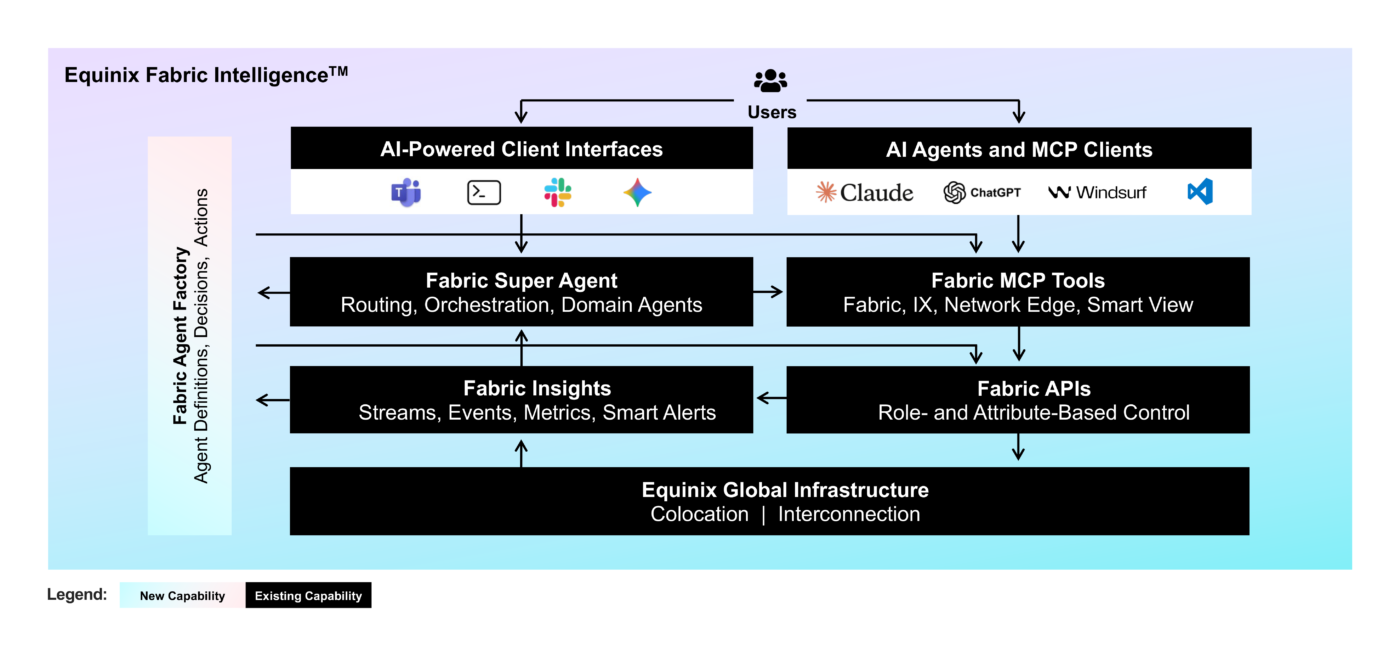
Equinix, the global digital infrastructure company, unveiled Equinix Fabric Intelligence, a new solution for AI-powered network infrastructure management, on April 15, 2026. At the heart of the Equinix Distributed AI Hub, the platform introduces smart automation for provisioning, optimizing and maintaining global infrastructures.
From rigid networks to dynamic AI infrastructure
Many companies still rely on slow, rigid network architectures that are not designed for the speed and complexity of modern intelligent systems. Manual workflows lead to bottlenecks, long deployment cycles slow down development, and a lack of visibility makes problem solving difficult. However, AI requires real-time networks that can adapt dynamically - a gap that is increasingly difficult to bridge with traditional software-defined network concepts.
Jim Frey, Principal Analyst at Omdia, underlines the urgency: «Our research shows that 93 % of organizations see network automation as essential for the future in order to keep pace with future changes. Furthermore, 88 % agree that AI itself will be required for effective network automation.»
Fabric Intelligence: Four core components
Fabric Intelligence automates the connection and operation of AI workloads across clouds, data centers and edge environments. The platform consists of four components: The Fabric Super Agent processes natural language requests via Slack, Microsoft Teams or the Equinix customer portal, reducing deployment times from weeks to minutes. The MCP Server provides a set of AI-ready management tools that simplifies the connection of AI systems to complex networks and enables integration with leading AI clients such as Claude Code, OpenAI Codex, VS Code Copilot and Cursor.
In addition, Fabric Application Connect provides a private, dedicated connectivity marketplace that allows organizations to access AI service providers for inference, training, storage and security without exposing sensitive data to the public internet. Finally, Fabric Insights delivers AI-powered network monitoring that analyzes telemetry data in real time, predicts anomalies and integrates directly with SIEM platforms such as Splunk and Datadog.
Infrastructure as a competitive advantage
«All companies want to use AI to transform their business. However, most lack the right infrastructure to deploy at scale for growth,» said Jon Lin, Chief Business Officer at Equinix. «Fabric Intelligence transforms infrastructure from a barrier to a competitive advantage. It enables our customers to spend less time on complex structures and more time investing in the success of their business.»
Combined with Equinix's global infrastructure - 280 data centers in 77 markets worldwide - and a fabric portfolio of more than 4,400 customers, Fabric Intelligence is designed to accelerate the adoption of AI tools and next-gen infrastructure. Equinix also joined the Agentic AI Foundation (AAIF) as a Gold member in early 2026 to help build an open, secure and infrastructure-ready foundation for the global autonomous economy.
Fabric Intelligence is now available as a preview. Demonstrations will be shown at the Equinix booth (7101) at Google Cloud Next 2026.
Future Summit TheNewNow: «When brands lose relevance, it's rarely due to the material»
TheNewNow Future Summit will take place in Zurich on April 22, 2026. The event focuses on dialog instead of frontal teaching and offers more than 100 sessions on topics such as AI, new luxury and leadership. The focus is on the question of what makes brands truly meaningful today, explains initiator Evelyn Gorgos in an exclusive interview with m&k.
Editorial - April 20, 2026
Evelyn Gorgos invites you to the Future Summit TheNewNow. Source: KO Photography
Luxury is in a phase of profound realignment. Technological acceleration, changing customer values and new generations are calling established assumptions into question. The Future Summit creates the space to think through these changes together - honestly, across industries and at eye level. As a further development of the Swiss Deluxe Hotels Media Summit, the format brings the entire Swiss luxury industry together for the first time: hospitality, watch brands, private banks, the healthcare sector and luxury retail. Around 350 decision-makers, creatives and innovators will organize their own day - with more than 100 sessions in the areas of media, business, AI and new work. Five keynote speeches will set the tone, supplemented by workshops, panels and open discussion formats. The venue reflects the concept: the headquarters network in Zurich offers not only infrastructure, but also atmosphere. What should remain are new connections - to people, ideas and concrete next steps. We asked initiator Evelyn Gorgos what's behind it all.
What distinguishes the Future Summit from traditional conferences in the field of business and innovation?
At the Future Summit, there is no master plan that we announce from the stage. Instead, we create a space in which real encounters are possible - with friction, a change of perspective and open dialog. The participants design their own day and choose from over 100 sessions what will really help them move forward. Less frontal teaching and more collective intelligence in action.
Why does the Future Summit focus on „relevance instead of status“?
Today, luxury is no longer defined by price but by meaning, authenticity and cultural connection. When brands lose relevance, it is rarely due to the material. It is because they have lost the emotional connection to people. This is precisely the question we want to ask together: What makes a brand truly meaningful today?
What specific role does AI play for luxury, brand management and communication?
AI is fundamentally changing creative processes. A good example is Oliver Rust, a former star photographer who now actively uses AI. And Sébastien Félix (Influence Society) analyzes how AI triggers creative disruption and what this means for the attitude and mindset of leaders. The key question is not: What can AI do? But rather: What remains deeply human and how can we protect this in the future?
How is the definition of luxury changing according to the experts at the Future Summit?
We are experiencing a phase of self-examination in the luxury segment. Relevance is created through authentic stories and genuine connection. To understand the term «new luxury», it is also worth looking to Asia - where this movement has been underway for some time - with a different dynamic and a native connection between technology, culture and consumption. We cannot ignore this.
Which sectors particularly benefit from interdisciplinary exchange?
Whether watch brand, private bank, mobility provider, healthcare sector or luxury retail, the strategic issues are the same and that is precisely why we bring them together. Solutions that would never have emerged within a single segment are created when different perspectives come together.
Why is the Future Summit deliberately focusing on dialog formats instead of pure lectures?
Because a lecture transfers knowledge, but a conversation changes thinking. We don't want people to go home with a notebook full of inputs and then return to their everyday lives. We want ideas and formats that provide space for what arises in human interaction. That's why we deliberately use the workshop format: with Claudio Del Principe, with a pasta workshop for a team-building experience, packaging artist Manuela Menzi, who shows what working with colors and collages can do, Gaudenz Looser, who starts an open Q&A session, and fitness coach Stefan Cerny. Craft, community, real action - this is also a form of dialog.
What concrete insights and „next steps“ can participants expect?
Participants get inspiration from other industries and from people who are already where many are just getting to. At the same time, they meet people with whom something can be created - a project, a collaboration, a new perspective on their own business. As Anil Varghese, CEO of Headsquarter, puts it in a nutshell: "It's about the right person at the right time. This is exactly what we want to make possible: concrete points of contact, initial approaches to solutions and the feeling that you have really taken something away with you.
How are new work and leadership dealt with in the context of technological change?
It's not about new work buzzwords, but about the question: What does leadership really need when technology accelerates everything and reliability has to be redefined? At the same time, we look at what culture means, how spaces and structures are created in which people can work really well.
What significance do personal encounters have in a digital world?
For me, TheNewNow is a statement: connection beats reach. In a fast-moving world of information, relevance comes from trust and trust comes from personal encounters.
For whom is the Future Summit particularly relevant - and who should not miss it?
All those who don't want to wait for others to formulate the answers for them and are open to perspectives beyond their own bubble.
Further information on the Future Summit TheNewNow can be found at www.thenewnow.ch.
Cando wins the «Master of Swiss Web 2026» with Swissgrid 24/7»
Best of Swiss Web has honored the best web projects in Switzerland for the 26th time. The «Swissgrid 24/7» project by Cando for Swissgrid was named «Master of Swiss Web 2026». A total of 11 gold winners and numerous silver and bronze awards were presented.
Editorial - April 20, 2026
The winners of the Best of Swiss Web Award in Zurich. Source: zvg
Best of Swiss Web honored the most outstanding web projects in Switzerland for the 26th time on April 16, 2026 at The Hall event location in Dübendorf. The industry celebrated a special evening with guests from the digital and communications industry.
The «Swissgrid 24/7» project by Cando for Swissgrid has won the race for the most prestigious award in the Swiss web industry. In a three-stage voting process, consisting of a jury of experts, readers' choice and live voting by the audience, the project prevailed against nine other high-caliber master candidates.
Transparency in the Swiss electricity grid
The jury justified its decision as follows: «Swissgrid 24/7 makes the processes in the Swiss electricity grid transparent and allows an almost real-time view of the current status of the electricity grid. The website visualizes the huge number of data points for employees with animations in a clear and concise way - a control center in your pocket. Despite the flood of data, it is easy to access different views and aspects quickly and intuitively. The challenging task has been solved very convincingly - the jury is impressed.»
Eleven categories awarded gold
This year, the specialist jury, consisting of over 100 experts, awarded a total of 11 gold buoys for technological, creative and economic excellence. The winner in the Brand Experience category was «Grittibänz im Benz» by ESE Agency for Migros Supermarket. In the Business category, the relaunch of the Switzerland Travel Center by Unic was the winner. Bold took gold in the Creativity category with acsono.com.
Bettybossi.ch by Unic, Convotis Switzerland and Digital Innovation Lab for Betty Bossi won in the Digital Commerce category. TI&M won in the Innovation category with Agridata.ch, the data room for the agricultural and food sector on behalf of the Federal Office for Agriculture. The Marketing category went to «Keep on Kicking» by Publicis Zurich and Mindshare for Axa.
Blueglass Interactive won the Performance Campaigns category with digital measures for the Swiss Transfusion SRC. Echo Charlie won in the Productivity category with its own project. The Public Value category went to «Plural - Plattform für demokratische Mitgestaltung» by Plural, Sitewerk and Dreipol. In addition to the Master prize, Cando also won gold in the Technology and User Experience categories with Swissgrid 24/7.
Goldbach Crossmedia Award presented
Another highlight of the evening was the presentation of the Goldbach Crossmedia Award. Victory went to the «Brack Super League - Unboxing Football» project for Brack Alltron by Brinkertlück and Mediaschneider. Silver went to the «100 Years of Migros» campaign by Migros Supermarkts. Bronze went to the project «The game of your life» by the Road Safety Fund. The Audience Award went to the project «Du bisch mir wichtig - Herzenssong über Geschwisterliebe» by the Förderverein für Kinder mit seltenen Krankheiten and Manuela Stier.
Best of Swiss Web was founded in 2001 and is now one of the most established and respected awards at international level. In the Swiss creative ranking, Best of Swiss Web has a multiplier of 2.
Further information on Best of Swiss Web and the complete list of all gold, silver and bronze winners can be found at www.bestofswissweb.swiss.