

Study: Many companies neglect their customers
The United Interim Business Report 2026 shows that many companies are barely aware of their customers' needs - and do not place them at the center of their work. A survey of 550 interim managers shows where the biggest weaknesses lie and how they can be remedied.






«All power comes from satisfied customers» - many companies have long since lost sight of this credo of market success. This is a key finding of the United Interim Business Report 2026, published by the United Interim management community. It is based on a survey of 550 interim managers who are brought in by companies as temporary managers to make companies fit for the future.
Wrong priorities instead of customer focus
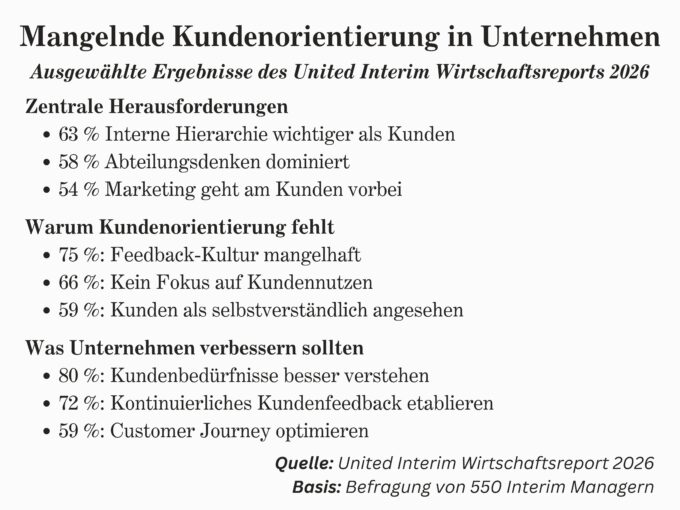
The study clearly shows that internal structures often slow down what needs to be solved quickly for customers. 63% of the interim managers surveyed observed that companies set the wrong priorities instead of focusing on their customers. Ulf Camehn, one of the authors of the study, puts it in a nutshell: «Too often, internal responsibilities and hierarchies slow down what needs to be solved quickly for the customer.»
58 percent of respondents note that «departmental thinking» dominates. 54 percent regularly find that their marketing activities bypass their customers. Internal operational processes are often considered more important than the customers themselves, reported 52%. And 46 percent complain of a «tool mania without customer focus». Eckhart Hilgenstock, one of the experts, explains: «Many companies have ERP, CRM, DMS, HRM, SCM, BI, ECM, chatbots and all the other IT tools that are important, but only if they are integrated and used with a focus on the customer. When introducing artificial intelligence in particular, the question of customer benefit should be given top priority.» Two thirds of respondents also warned against an «over-automation of sales, where AI replaces people to such an extent that customers suffer».
The «customer focus killers» at a glance
Other obstacles identified by the interim managers include a fixation on quarterly figures (46 percent), excessive cost management (36 percent), a mere product focus (35 percent), excessive political correctness (33 percent), over-observance of regulatory compliance (26 percent), a corporate philosophy that is distant from customers (23 percent) and misguided development departments that produce products that do not meet market needs (20 percent).
Christian Jung from the mechanical and plant engineering industry states: «In mechanical engineering, products are often perfected that the customer does not order and does not pay for. That's not a quality feature - it's a structural business risk.» Klaus-Peter Stöppler and Roland Streibich, both experts in the construction industry, add: «The construction industry is dominated by Processes, approval procedures, deadlines and cost calculations often so much that topics such as customer focus, communication or digital processes receive too little attention.» 72% of the interim managers surveyed recommend that the construction industry become more innovative, while 66% advise strengthening competitiveness.
Top management hardly knows the customers
What causes a lack of customer focus? The study shows: The problem often starts at the top. Three quarters of those surveyed rate the «feedback culture» - i.e. the willingness to actively receive market signals - as inadequate. Two thirds found that the claim «Value for the Customer» is often completely lacking. 62 percent believe that top management regularly underestimates the impact of technological developments on their own business model.
Jan Beutnagel names another cardinal error: «Customers are taken for granted.» 59 percent of respondents share this view. Ulvi Aydin adds: «Some top managers consider a time horizon of five years to be far-sighted and are therefore unable to anticipate long-term developments over ten or fifteen years.» 54% of respondents confirm that many managers are more focused on key financial figures than on customers. Paul Stricker also observes: «Many managers are simply so preoccupied with their own careers that they neglect the company they are supposed to lead and its customers» - almost half of those surveyed (49%) agree with him.
Measures for more customer focus
The most important measure for refocusing on customers is cited by 80 percent of interim managers: understanding customers« »Jobs To Be Done« (JTBD), i.e. knowing why customers choose a particular product. As Christian Florschütz puts it: »Only those who know the reasons for buying can take these into account in product development, service, marketing and sales.« Dr Andreas Vieweg adds: »Ultimately, it's about prioritizing customer benefits over internal operating processes or company goals" - three quarters of respondents agree with him.
Ongoing customer feedback contact is essential for 72% of temporary managers. Jane Enny van Lambalgen clarifies: «One-off feedback directly after the purchase is not nearly enough.» Dr. Andreas Vieweg adds: «Intensive data analysis, including with the help of AI, can often provide important insights into the level of satisfaction without constantly asking the customer.» Regular optimization of the customer journey is rated by 59% as the key to customer satisfaction.
54 percent consider constant comparison with the competition to be essential. And Friedhelm Best advocates a broader view: «Focusing on customers can also mean looking for new customer segments, for example in foreign markets.» A whopping 87% of respondents consider greater internationalization to be worth considering when acquiring new customers, while 62% advise targeting new markets more specifically - both at home and abroad. Ulrich Schmidt summarizes: «Most companies in practically all sectors would benefit from a transformation towards customer orientation - and so would their customers, of course.»
More information: www.unitedinterim.com






 Felix Graf, new Chairman of the Board of Directors of APG|SGA. (Image: Karin Hofer / NZZ)[/caption]