
Swiss IT departments between stability, automation and collaboration

New DACH report shows: Switzerland is ahead in IT resilience and automation - but there is still room for improvement in terms of collaboration.


Well positioned, but there is still room for improvement when it comes to collaboration: Swiss IT departments. (Symbolic image; source: Unsplash.com)

IT is the backbone of modern organizations - and is particularly stable in Switzerland. According to the new ITSM 2026 DACH report from TOPdesk, for which a total of 3,000 IT professionals from Germany, Austria and Switzerland were surveyed in August 2025 as part of a European online study, 43 % of respondents from Switzerland rate their IT department as «fully future-proof». This puts Switzerland just ahead of Austria (40%) and Germany (37%). This strong starting position forms the basis for further developments in the direction of automation and collaboration.

Workload and challenges in Swiss IT departments

At 27 %, the Swiss IT teams - together with Austria - have the lowest perceived overload not only in the DACH region, but also in Europe. However, this does not mean that they are free of disruptions: 20 % report that serious IT problems occur in their organization several times a week - the same figure as in Austria, but higher than in Germany (15 %). 17 % say that such incidents regularly lead to additional work in other departments. According to the report, 46 % even spend so much time on acute problems that there is hardly any room for preventive measures. And 54 % also report a lack of resources - the highest figure in the DACH region (Austria 50 %, Germany 46 %).

«Swiss IT departments work in a very structured and stable manner - but they are also under pressure,» says Steffen Groß, Director of International Consultancy at TOPdesk. «The high demand for quality and reliability means that many teams are working at full capacity. The next step is to automate routine activities to a greater extent in order to create more freedom for strategic tasks.»

Security as a foundation

Despite scarce resources, the level of security remains high: 35 % of respondents cite strong cybersecurity and data protection protocols as a key feature of future-proof IT - just behind Austria in the DACH comparison (36 %), while Germany is ahead with 41 %. When it comes to the integration of security processes in other business areas, however, the picture is reversed: Switzerland and Austria are on a par here with 41 % each, while Germany follows close behind with 40 %.

«Security is deeply rooted in IT structures in Switzerland,» continues Groß. «It is not seen as a brake, but as the basis for trust, efficiency and innovation. This sense of responsibility is one of the reasons why Swiss IT teams are so stable and resilient.»

Automation at a high level - AI on the rise

30 % of respondents say that AI is already fully implemented in their organization - the highest value in the DACH region. In a European comparison, Switzerland is also ahead, behind the UK (36 %) but well ahead of Austria and Belgium (26 % each), Germany (23 %) and the Netherlands (16 %). 42 % also state that AI is established in their company, i.e. AI is used in several areas but not yet company-wide. The trend is particularly strong in the area of support: according to 33 % respondents, first-line support is already fully automated in their company - in Austria it is mainly manual and in Germany it is hybrid (both 37 %). Nevertheless, 32 % of Swiss IT specialists see AI as a significant risk that requires additional resources.

«Switzerland shows that stability and innovation are not a contradiction in terms,» says Groß. «AI and automation are used here in a targeted manner to increase efficiency and quality - without losing sight of security and governance.»

Cooperation as development potential

80% of the IT professionals surveyed in Switzerland are convinced that IT disruptions would be resolved more quickly if departments worked better together. This puts Switzerland slightly ahead of Austria (79 %) and slightly more ahead of Germany (71 %). 59 % also see a direct correlation between functioning IT processes and the employee experience of their colleagues - a value that underlines the growing importance of IT in everyday working life.

«A strong technical basis is important, but without collaboration, potential remains untapped,» adds Groß. «Especially in mature IT organizations, cross-departmental coordination becomes a decisive factor.»

The key message for Switzerland remains: Reliable, forward-looking and open to automation - Swiss IT departments are among the most stable in the DACH region. If they combine their technical excellence even more closely with cross-divisional collaboration in the future, they can further expand their role as a strategic partner - and thus move from short-term disruption management to sustainable resilience.

Source: https://www.topdesk.com/de/

This article originally appeared on m-q.ch - https://www.m-q.ch/de/schweizer-it-abteilungen-zwischen-stabilitaet-automatisierung-und-zusammenarbeit/

Decline in the traditional advertising market - digital and radio up, print and cinema down

Trend Report by Media Focus: After two months of growth, the Swiss advertising market fell by 4.2% in September. Radio is the only media group to grow, while print and cinema are losing ground significantly. Only 8 out of 21 sectors are showing positive trends.


After two months of positive development, the «traditional» advertising market recorded a decline again in September. With gross advertising expenditure of CHF 376.7 million, the result is -4.2% down on the same month last year. The market is thus losing some of the upward momentum gained in July and August.

The traditional advertising market trend is at CHF 2,747.3 million gross YTD so far this year, representing a percentage decline of 2.5% compared to 2024.

Within the media groups, the picture in September is mixed. Radio was the only group to remain in positive territory with growth of +3.6%. All other media groups recorded declines: print was hit hardest with -7.2%, followed by cinema (-6.4%), out-of-home (-6.0%) and TV (-1.1%).

Digital advertising pressure in September was significantly higher than in the previous year. The driver is Search. The channel closed with a clearly positive result, while Display (-3.5%) and YouTube (-3.8%) recorded slight declines*.

Less than half of the sectors are convincing

Overall, only 8 out of 21 sectors were able to escape the negative trend in September. Although the retail trade is still in the lead in YTD, with growth of 14.4%, it is outperformed by the food industry (CHF 44.5 million) in terms of September spending (CHF 35.0 million). In percentage terms, the media sector recorded the most significant growth, although it is still in the bottom third of the ranking. Other winners included tobacco products (+35.2%), digital & household (+17.0%), services (+14.4%) and events (+7.8%).

Vehicle sector collapses

In September, 13 sectors recorded declining trends. The biggest losers include the automotive sector (-27.8%), transportation (-19.9%) and fashion & sports (-19.4%). Although the finance and telecommunications sectors also both recorded declines (-6.9% and -0.5% respectively), they are above the previous year's level in a cumulative year-on-year comparison. Initiatives & Campaigns (-1.4%) and Beverages (-0.9%) are also only just in negative territory.


The whole report on mediafocus.ch

by the way... creativity is no guarantee for clarity

In our «By the way...» column, Laura Colledani and Klaus Ammon from Management Tools take it in turns to ponder the issues of our time. This time it's about Denner's campaign with the stolen Lidl heart.

Denner stole the heart in its latest campaign in «20 Minuten» (m&k reported) - symbolically and literally at the same time. Denner booked the front page - all in Denner red - and shows a picture of a staged surveillance video of the red heart being stolen from the Lidl logo and taken to Denner. «The Swiss heart is now back where it belongs,» is the message. A clever idea that made the headlines and inspired the creative scene. But how does it actually go down with people?

Using the «Advertising Test» tool on management tools' market research platform deeptrue.com, we examined the impact of the campaign on two groups: Gen Z and people over 30. The results show an interesting tension between attention and understanding.

The story was well received by Gen Z - the heart, the theft, Switzerland - but without the prominent red front page of 20 Minuten, it remains unclear who is «actually» advertising here - the sender is often understood to be Lidl. Others found the idea „funny, but pointless“. Nonetheless, Gen Z likes the campaign more than the target group over 30 and the uniqueness is perceived more often:

Likeability of the Denner campaign by target group (source: «Advertising Test» tool, deeptrue.com from management tools)


Uniqueness of the Denner campaign by target group (source: «Advertising Test» tool, deeptrue.com from management tools)


The picture was also mixed among the older target group. The storyline was correctly identified more often than with Gen Z («The heart was stolen and taken to Denner»), but the wow effect did not materialize. Some found the ad appealing, others found it exaggerated or irrelevant. On the positive side, many liked the «Swiss heart» motif in principle - but without making a clear connection to the Denner brand.

Attention - but no assignment

In summary, the campaign has achieved what every brand wants: attention. But it did not achieve what brands need: Attribution. If people don't understand exactly who the message comes from, creative provocation quickly turns into communicative self-disconnection.

This does not mean that the idea was wrong. On the contrary: the playful approach to a strong symbol like the heart has great potential. But it needs more context and less staging. Brands can and should be provocative - but they should not lose sight of themselves in the process.

Content must be provided

Perhaps this is precisely Denner's opportunity: not only to steal the heart, but also to fill it with content. For example, with real stories about Swiss producers, employees, origins - in other words, what actually makes this heart beat.

By the way ... sometimes it's not enough just to have a heart - you also have to know what it beats for.


Laura Colledani and Klaus Ammon have more than 40 years of combined experience in consumer research and marketing research. Over the years, they have developed a keen sense of what moves people - even beyond the numbers. Both authors advocate a communication culture that listens before it broadcasts. With the new approach of consumer listening management tools, they want to support marketing managers in not only questioning consumers in the traditional way, but also entering into a genuine relationship with them.

Oniwa: Switzerland's first non-profit marketing agency launches in Zurich

Oniwa is the first non-profit marketing agency in Switzerland to launch in Zurich. The creative minds behind the project are Clement Obiegbu (formerly Heimat Berlin, TBWA\Zürich) and Lara Zanetti, former Marketing Manager at Zurich start-up Chimpy. Their goal: to rethink marketing and advertising ethically - regardless of profit expectations.

Oniwa does not see itself as a traditional agency, but as a non-profit association and collective movement for responsible communication. It works exclusively on a cost-covering or pro bono basis, for example for NGOs, NPOs, social initiatives and companies with an ecological or social purpose. „We want to show that professional marketing doesn't have to be a privilege of big budgets,“ says co-founder Obiegbu.

The range of services includes social media marketing, fundraising campaigns, brand communication, events and stunts. A network of experts in strategy, design and digital support the projects - many of them with experience from international agencies and brands.

Oniwa is financed through traditional commissions, donations and sponsorship contributions. In addition, industry professionals can donate voluntary working hours to support charitable projects. The long-term aim is to create a model that enables professional communication without being profit-oriented.

Initial talks with potential partner organizations are already underway. For co-founder Lara Zanetti, one thing is clear: «We want to bring attitude to the world of communication - with ideas that work, but don't have to sell.»


For more information www.oniwa.ch.


PLM users lead the way in AI adoption

Companies that use product lifecycle management (PLM) systems have a clear advantage when it comes to digital transformation. They demonstrate greater resilience, achieve sustainability goals faster and master regulatory challenges more confidently than companies that work with outdated stand-alone solutions.

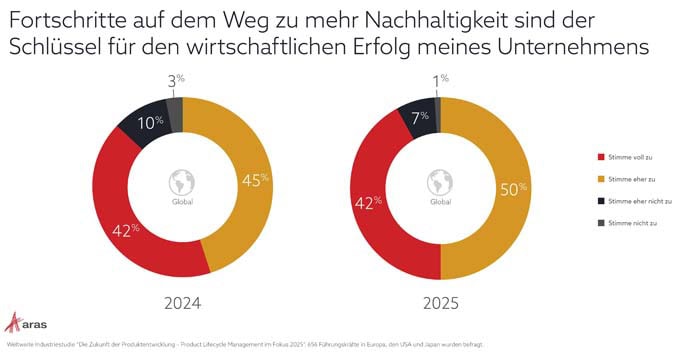
Sustainability makes companies successful. (Graphic: Aras)

Aras, a provider of product lifecycle management and digital thread solutions, conducted a study in January 2025 entitled „The future of product development - product lifecycle management in focus“. It concludes - in line with the client's wishes, of course - that companies that use PLM systems are ahead of the game when it comes to integrating AI. According to the study, they are 28 percentage points ahead of their competitors. „We are witnessing the establishment of a new industrial hierarchy,“ explains Jens Rollenmüller, Regional Vice President at Aras. „Companies that have built their processes around flexible, networked PLM platforms benefit from a ‚systemic advantage‘: they not only react to disruptions, but also turn them into competitive advantages.“

Some findings in detail

The survey data reveals remarkable differences in key business areas, for example:

  • Product development: While 87% of PLM users use AI in product development, this figure is only 59% for companies without PLM. PLM users benefit from optimized processes, predictive capabilities and accelerated innovation.
  • Regulatory readiness: In view of Europe's Corporate Sustainability Reporting Directive and the upcoming requirements for digital product passports, 88 percent of PLM users are ready for compliance - compared to only 70 percent of companies without a PLM infrastructure.
  • Digital thread competence: 59 percent of PLM users consider the digital thread to be business-critical, compared to only 35 percent of companies without a PLM infrastructure. This discrepancy reveals a significant gap in digital integration and future readiness.

More than software: part of the strategic architecture

Rollenmüller is convinced that companies gain organizational competence by implementing a PLM platform. „Those who seamlessly link design with the manufacturing process, dovetail supplier data with compliance requirements and connect market requirements with the product strategy are operating on a completely different level,“ he says. According to the industry expert, the more complex the regulatory landscape becomes, the more important this systematic integration becomes.

The survey results show: PLM users are significantly better at mastering both day-to-day business and future challenges. In important areas such as AI adoption, the implementation of digital threads and regulatory readiness, they have a continuously growing competitive advantage. Rollenmüller says: „They not only manage data, but also orchestrate decision-making processes, accelerate innovation cycles and create organizational intelligence that adapts to market changes in real time.“

Source: Aras

This article originally appeared on m-q.ch - https://www.m-q.ch/de/plm-nutzer-fuehren-bei-der-ki-adoption/

Bühler AG wins GFM Marketing Award

The gfm Marketing Prize was awarded at Kaufleuten on Tuesday. The winner for 2025 is Bühler AG. As is tradition, the event was hosted by Sandra Studer.

Marcus Schögel presents the prize to Stefan Scheiber

«With Bühler AG, the jury is recognizing a company that is a global leader in key areas of food and materials processing and whose technologies reach billions of people every day,» said Markus Schögel, president of the jury, in his laudatory speech. The CEO of Bühler AG, Stefan Scheiber, accepted the award on the Kaufleuten stage.

Prior to this, the members of the Board of Directors were confirmed at the Annual General Meeting. Reto Dahinden (Swica), Sunnie Groeneveld (Inspire 925 GmbH), Guido Stillhard (Schindler Management), Véronique Stephan (SBB) were re-elected. Gustav Baldinger (PwC AG), Muriel Mathis (Nestlé Suisse SA), Philipp Mischler (Die Mobiliar) were newly elected. Marcus Schögel (University of St. Gallen) is a new member of the Executive Committee.


Presenter Sandra Studer with the lucky winner Stefan Scheiber from Bühler.


Dentsu Report 2025: Consumers want less, but more consciously

A new study by Dentsu, the EMEA Consumer Navigator Report 2025, shows: Price is no longer everything for consumers - value, trust and simplicity count more than ever.

"We are seeing the emergence of a new type of consumer: financially prudent but emotionally involved," says Lara Jelinski, Chief Growth Officer Central Europe & CEO Media Switzerland at Dentsu. "The concept of value is being redefined. It's no longer about the lowest price, but about clarity, simplicity and shared values."

The marketing and transformation group Dentsu has published its EMEA Consumer Navigator Report 2025. The results show how consumer behavior and market structures are changing in Europe, the Middle East and Africa. The focus is on two topics: Mindset and Retail & Commerce. The conclusion: consumers are more financially cautious, but more emotionally demanding - and expect more from brands than just discounts.

The conclusion: consumers are more cautious financially, but more demanding emotionally - and expect more from brands than just discounts.

Conscious consumption despite uncertainty

64 percent of respondents say they are more conscious of their consumption today: They are postponing larger purchases, paying more attention to discounts and prioritizing basic needs. Economic uncertainty in countries such as France and the UK in particular has led to noticeably more cautious behavior.
Nevertheless, many remain optimistic - Gen Z and millennials in particular are open to new brands. Emotional factors such as trust, transparency and control are becoming the central currency in brand development.

Comparing generations

While older generations (boomers) are increasingly controlling their spending, younger people are investing more specifically in experiences. Vacation trips are at the top of the list of planned spending - especially in Spain. Brands that show empathy and give consumers guidance can score points in this environment.

Shein, Temu & Co. are changing retail

The Retail & Commerce Report shows how platforms such as Shein and Temu are shaking up the market: 45% of consumers in Spain and 33% in France already shop there at least once a month. For 55%, social media is the most important source for discovering new products - but 52% feel overwhelmed by the flood of advertising.
Dentsu sees this as a clear signal: brands must emphasize relevance and simplicity instead of flooding consumers with interchangeable messages.

More values, fewer price promotions

Although discounts have a short-term effect, price alone is no longer enough to build long-term loyalty. Younger target groups in particular are oriented towards shared values, sustainable action and transparent communication. Retailers and brands are challenged to create real experiences and meaningful benefits - both online and offline.

Pollutec 2025: Innovation driver for ecological transformation

According to the organizers, Pollutec 2025 has once again confirmed itself as the leading platform for environmental solutions. The international environmental trade fair took place in Lyon from October 7 to 10.

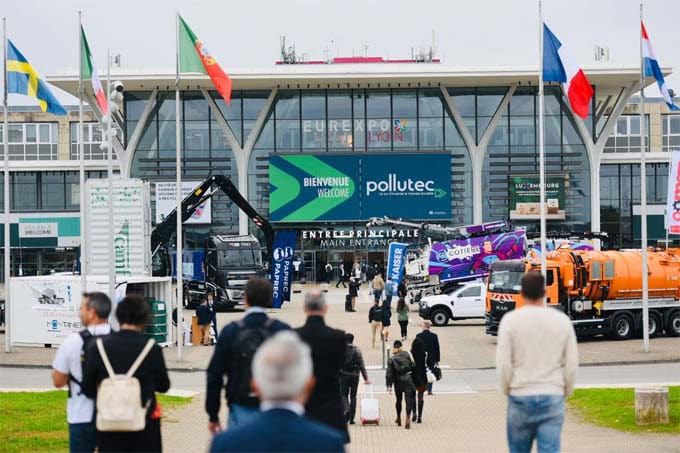
Pollutec 2025 looks back on a successful implementation. (Image: Pollutec / RX)

With 51,000 trade visitors and 2,000 exhibitors - including 500 new exhibitors and over 130 start-ups - the environmental trade fair Pollutec 2025 confirmed its role as the leading international forum for environmental, industrial and urban solutions. For four days, from October 7 to 10 in Lyon, everything revolved around innovations and collaborations for a sustainable future.

Focus on science, health and the circular economy

The thematic focus was on science, health, decarbonization and bioeconomy. Exhibition Director Anne-Manuèle Hébert emphasized: "Ecology is a science, not an opinion." Pollutec saw itself as a platform for fact-based solutions in the face of the rising costs of doing nothing, which, according to estimates, could reach up to 15 % of global GDP by 2050.

Industry forums on agriculture, textiles and mobility

A new feature was the Market Forum, which was dedicated to three key sectors. The "Textiles" sector focused on sustainable production and waste reduction. In the agriculture sector, the focus was on adapting to climate change and in the "mobility" sector, strategies for clean air and decarbonization were the main topics.

Innovations honored

Hardly any trade fair today can do without awards, and Pollutec is no exception. Three solutions were honored at the Pollutec Innovation Awards:

  • Pulse - Entent: Conversion of industrial waste heat into electricity,
  • Vortex 150 - Inddigo/Plastic Vortex: Captures up to 80 % of plastic waste in rivers,
  • Tamic - Tallano Technologies: Fine dust extraction during braking.
    The public also voted Arkeale's BioCapsule - a local, self-sufficient micromethanization system - as the most popular innovation.

The next event, STEP - The Ecological Transformation Show by Pollutec, will take place in Paris on December 1 and 2, 2026.

Source and further information

This article originally appeared on m-q.ch - https://www.m-q.ch/de/pollutec-2025-innovationstreiber-fuer-oekologische-transformation/

Creator Economy meets AI avant-garde: Insights from the Creator & Brand Convention

Our m&k multimedia coverage of the Creator & Brand Convention captures the energy of an afternoon where AI, creativity and community merge into a new creative force.

This year's Creator & Brand Convention was - unsurprisingly - all about artificial intelligence (AI). The event, which is considered Switzerland's largest business & entertainment event for creators, brands and communities, offered a rich program. The m&k video reviews the atmosphere of the afternoon - vibrant and inspiring. The convention was the prelude to a whole day dedicated to the creator industry, which ended in the evening in the large Smile Swiss Influence Award Night where the best creators in the country were honored.

AI in focus: visionaries and the new era of content creation

The dominance of AI was reflected in the launch of the AI Media Award 2025 reflected. Embedded in the platform of the SSIA Smile Swiss Influence Award, the award sees itself as a showcase and interface between the creative avant-garde and the advertising and media industry. The aim is to promote pioneering AI-generated content - with a focus on quality, responsibility and innovation.

The highlight of the afternoon was the presentation of Mark WachholzAI filmmaker and screenwriter, whose video essay "The Cinema That Never Was" won first prize in the Narrative category. His work was created entirely with AI - from images to music and voice to the script. Wachholz, who acquired the knowledge self-taught, described the process as AI CreationAI is actively involved in brainstorming and its independence is part of the creative experiment.

Production took around a week. Wachholz used numerous tools in a kind of "symphony", as no single tool could do everything. He used Midjourney (images), Klingen, Runway and Hun (video AI), 11 Labs (voice), ChatBT (script) and Judio (music). For him, AI is a way to bring ideas directly from the mind into the finished product - without gatekeepers. He sees limits in terms of controllability, as AI often contributes its own impulses - for Wachholz a characteristic of the AI Creation Space.

Content strategies and efficiency in the creator economy

Despite the AI hype, classic topics remain present - in particular Efficiency and Authenticity. One ongoing trend remains: real, personal content, even if the arc to artificial AI content is becoming increasingly visible.

Timo Wäschlemulti-award-winning storytelling expert, showed in his masterclass "From My First Sony to Storyworld Pioneer - Efficiency, Emotion & AI in Content"how storytelling, emotion and AI can be combined to form an efficient triad. His conclusion: if you want to increase visibility, you have to think emotion and technology together.

Timo Wäschle

Romina Menzel from TikTok emphasized that brands must become part of the community in the creator era - because TikTok thrives on the creativity of its users.

Brands and collaborations: Interaction, strategy and a bath

The convention served as a stage for new connections between brands and creators - supported by partners such as SMILE Insurance and Samsung.

Samsung demonstrated how technology can enhance creativity - from AI-powered editing to Nightography. Pekka BlancSenior Marketing Manager Switzerland, described the convention and the Smile Influencer Award as a strong platform for the brand, but noted that direct leads could hardly be generated with creators.

A strong practical example was provided by SPAR Switzerland (Schirin Fässler, Marketing) and Equipe One AG (Siria Berli, Co-Founder & CEO). Both explained that TikTok primarily brings them reach in younger target groups - not primarily sales, but brand awareness. The aim is to anchor SPAR as an integral part of the Swiss retail trade.

Siria Berli, co-founder and CEO of Equipe One AG (left) and Schirin Fässler from SPAR Switzerland spoke about social media measures with influencers

A sensation was caused by Weleda with an interactive campaign: the brand staged its new Booster Drops in a bathtub in which guests could take a seat. m&k editor Beat Hürlimann did not miss the opportunity to take an exciting dip in the influencer crowd and spontaneously conducted an interview with Elisabeth Acket from Weleda - straight from the tub. Weleda uses influencers strategically to increase awareness and has cooperated with, among others B from the Elevator Boys for the campaign for the new drops.

m&k editor Beat Hürlimann in an interview with Elisabeth Acket from Weleda

A deep insight into sustainable cooperation was provided by Tamara Glück (GLÜCK Influencer Management & Consulting) and Loris Zimmerli. They showed how real partnerships are created from a deal - through clear communication and a balance between market requirements and creative freedom.

Public institutions in the Creator Space

The public sector was also present at the convention - a sign that Creator Space has long been relevant to society as a whole. An unexpectedly exciting accent was set by Martin Kaiser, Staff Judge Advocate of the Swiss Armed Forces. The army not only showed its presence at the event, but also its equipment - including a drone, which attracted the interest of many guests.

In his input, Kaiser emphasized how formative the time of military service can be: The age at which young people do their service is crucial for personal development and a sense of responsibility. According to Kaiser, the 20 weeks of military service should not be seen as lost time - but as a lesson for life.

Summit of the Creator Economy: The Smile Swiss Influence Award Night

When the lights go out and the stage lights up, the grand finale begins: the Smile Swiss Influence Award Night - the Oscar night of the Creator Economy.

The show honored the best and most influential creators in the country and reflected the diversity of the Swiss influencer scene. Younes Saggaraknown for its finely observed lifestyle content, won the Smile Swiss Influence Award 2025 as Influencer of the Year. In the category Newcomer sat down Nathalie Schmid with its unmistakable mix of fashion, mindset and authenticity. The Entertainment Award fetched Zeki Bulgurcuwho reaches millions with humor and attitude.

The topics of sustainability and purpose also found their place: Nina Burri received the Social Impact Award for their commitment to mental health, while The Swiss Wanderer was honored for his content on conscious tourism.

By embedding the AI Media Award the Award Night also became a bridge between creator culture and AI art - a signal that the Swiss influencer landscape is not only entertaining, but also inspiring and thinking ahead.

Overall, the combination of convention and award night attracted over 3000 guests on. It confirmed the format's reputation as the most important stage in Switzerland, where the brightest minds and boldest ideas of the creator economy come together - from the first beats of the afternoon to the last moments of applause of the night.

Less waste, more added value: the benefits of upstream closed-loop solutions

"Reduce, reuse, recycle" is a widely recognized motto of the circular economy. But these terms have very different meanings for companies and investors. Recycling is only the last resort in a circular solution, while expanding to upstream solutions can lead to better outcomes for the environment and portfolios.

The circular economy is more than just recycling. That's why plants should also focus on upstream material cycles. (Image: Unsplash.com)

Although recycling is important, it should never be seen as a model for the circular economy. This is because it is insufficient and inefficient compared to upstream solutions that prevent waste generation in the first place. The EU Commission, a global leader in promoting the circular economy, underlined its preference for upstream solutions when it found that 80 % of environmental impacts are due to decisions made at the design stage of product development.[i]

Recycling - an inadequate solution

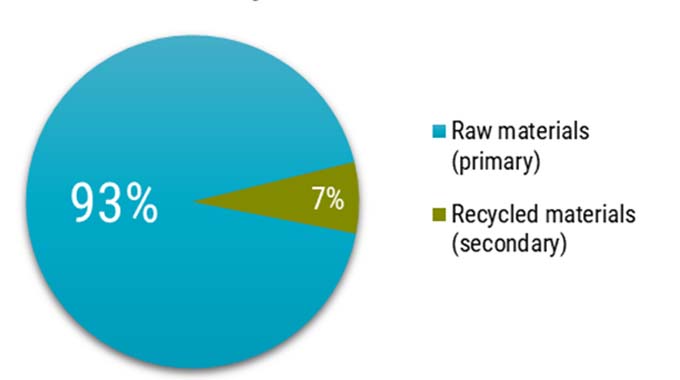
The proportion of recycled materials used in the global economy is currently around 7 % and continues to fall.[ii] This means that the majority of the material stock that is imported into the economy each year comes from new raw materials.

It is certain that legislative measures requiring a higher proportion of recycled material and industrial innovations in recycling technologies are increasing the impact of recycling and increasing its use in absolute terms. However, this is simply not enough to keep pace with rising production rates. Over the last five decades, the total amount of materials produced annually has almost tripled (270 %).[iii] Without a significant slump in demand, it is unlikely that recycling will ever catch up.

Figure 1 - New raw materials overshadow recycled material

Annual material consumption in the global economy. Raw materials that enter the economy from primary (new) sources far outweigh those that come from existing, recycled (secondary) materials.

Source: Circularity Gap Report, 2025.


Recycling is a costly, low-value solution. For many industries, the costs of recycling and recovery - collection, sorting, cleaning and processing - are too high. Recycled cullet or waste glass, for example, can be up to 20 % more expensive than virgin material.[iv] In the USA, the surcharge for recycled plastic compared to new polymers and resins is 25 %.[v] This is a decisive factor, as only 1 to 7 % of consumers are prepared to pay a premium for recycled materials.[vi]

And processing costs are rising as the material mixtures in the waste streams become increasingly complex. The limit value yield of multi-polymer plastics, textiles made from mixed fibers or multi-component electronics and machines is much lower than for simpler materials such as glass or aluminum. [vii]In addition, recycled materials are often inferior and less functional, further limiting their potential uses and commercial value.

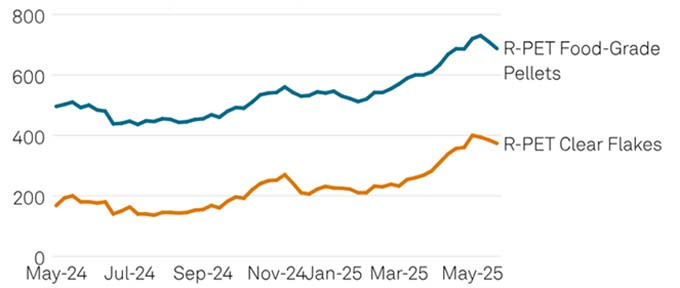
Figure 2 - Recycled plastic is more expensive than virgin material (Europe)

The chart shows the price differences between two types of recycled PET plastic (food-grade regranulate and transparent flakes) and new PET plastic in Europe. Recycled plastics are considerably more expensive. In May, the price for food-grade regranulate was EUR 700/tonne, EUR 400 higher than for virgin PET regranulate. Food-grade regranulate is processed according to stricter quality standards and can be used for food or medicine packaging, for example. Transparent flakes are used as a base material for industrial applications with less stringent quality criteria.

Source: S&P Global Commodity Insights, June 2025

The power of upstream thinking

According to circular economy experts, waste and pollution are caused by faulty design.[viii] In a perfect circular economy, recycling would only be used sparingly, if at all. Circular solutions are best applied upstream in the design of the product and not at the end of the product life cycle. This means that durable, repairable, modular and biodegradable products must be developed.[ix] This also applies to companies whose innovative technologies enable their customers to use resources more intelligently and achieve more with less.

Examples of wides Sector commitment

  • Technology and industry - Although Cloudflare and the Ashtead Group operate in very different industries, both promote the circular economy through shared platforms that replace on-site asset ownership with on-demand access. Cloudflare leases cloud computing and networking infrastructure to remote locations, eliminating the need for individual companies to build their own data centers.
    The Ashtead Group rents out industrial equipment, from scaffolding and work platforms to conveyor belts and power tools. Product sharing models increase asset utilization and product longevity through centralized maintenance. More importantly, they help an economy do more with fewer resources, reducing the need for physical assets across the economy.
  • Manufacturing and construction - Celestica and Cavco are two outstanding companies that offer joint manufacturing services for various industries. Cavco focuses on prefabricated homes, where scaled and optimized manufacturing and assembly in the factory significantly reduces the excess material of on-site construction.
    Celestica manufactures electrical components in joint production for customers in the aerospace, energy systems, medical devices and diagnostic equipment sectors. Strict manufacturing efficiency and tighter control of supply chain logistics help to reduce resource consumption. The modular design promotes the maintenance and repair of products, thereby extending their service life.
  • Consumer staples and basic materials - Sprouts Farmers and Sensient are good examples of circular solutions in the food and agricultural sector. Sprouts is a supermarket that focuses on fresh, organic and locally grown produce. Less packaging, chemical preservatives and transportation means less overall emissions and a smaller environmental footprint compared to processed food or meat alternatives.
    Sensient focuses on supplying customers in the food, cosmetics and pharmaceutical industries with colors, flavors and specialty ingredients that are naturally regenerative and derived from plants and organic sources.
  • Health and environmental services - Halma and Galenica are examples of how circular solutions are used in the health and environmental sector. Halma develops safety, health and environmental monitoring technologies - from pure water sensors to fire detection systems - that prevent risks and extend the useful life of facilities. With its own pharmacy network and logistics, Galenica improves access to medicines while eliminating inefficiencies and waste in the healthcare sector.

Wide-ranging commitment

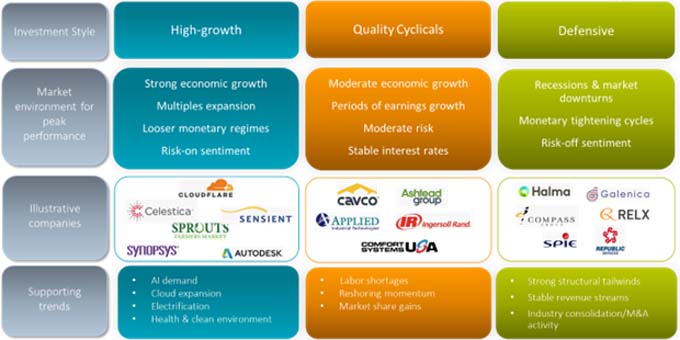
Too much focus on downstream recycling and waste management companies narrows the investment universe and limits the capture of attractive opportunities across the industry's value chains. Expanding the portfolio to include upstream solution providers not only increases the portfolio's return potential, but also diversifies the portfolio's exposure to various style factors, including high-growth innovation, high-quality cyclicals and defensive industry giants (see Figure 3).

Figure 3 - Balance between growth and stability

The focus on upstream solutions expands the investment universe across different sectors and growth cycles and increases the return potential and long-term robustness of the portfolio in different market environments.

Source: Robeco, as at September 2025.


By shifting away from recycling and towards upstream solutions, a broad range of industries and companies with compelling business models and growing market shares can be tapped into. This not only strengthens the portfolio's potential to generate sustainable returns, but also creates the opportunity to invest in companies that deliver greater value in terms of circularity and environmental impact.


Important noteThe companies shown are for illustrative purposes only and are indicative of the investment strategy as at the date shown. The companies are not necessarily part of the strategy and their future integration is not guaranteed. This is not a recommendation to buy, sell or hold, nor should any conclusions be drawn about the future performance of these companies.


Notes:

[i] EU Commission, State of the Union speech, Circular economy, retrieved in September 2025.

[ii] Proportion of recycled materials: 6.9 % compared to 9.1 %, Circularity Gap Reports 2025 respectively 2018.

[iii] Volume of material production: 27 billion (1970) compared to 106 billion tons (2025). Circularity Gap Report, 2025.

[iv] "Distributors are at the center of circular solutions." BCG, November 2022.

[v] "Impact on virgin vs recycled plastics." Briefing Note. Institute for Energy Economics and Financial Analysis, November 2024.

[vi] "Consumers are the key to taking green mainstream." BCG, September 2022.

[vii] US General Accountability Office (GAO), Textile Recycling Technologies. July 2024.

[viii] Ellen MacArthur Foundation, Eliminate waste and pollution webpage. Retrieved September 2025.

[ix] Ellen MacArthur Foundation, The technical cycle of the Butterfly Diagram. Retrieved September 2025.


Author: Natalie Falkman is a senior portfolio manager at the asset management company Robeco.

This article originally appeared on m-q.ch - https://www.m-q.ch/de/weniger-abfall-mehr-wertschoepfung-die-vorteile-vorgelagerter-kreislaufloesungen/

"Eva on Stage" makes female leaders visible - Interview with Annette Felicitas Häcki

Almost 70 percent of all speakers at conferences worldwide are male - sometimes women are even completely absent. The Executive Voices Academy "Eva on Stage" brings female voices to the stage.

Women are still significantly underrepresented at conferences and congresses. Almost 70 percent of speakers worldwide are male. At some events, there are no women on stage at all - and if there are, then as a moderator or on a group panel.

Competent and self-confident

The fact is that too few female experts are invited. After all, there are female thought leaders in every field. On the other hand, according to the event organizers themselves, it is often difficult to find a female speaker. Some decline when they are asked to give a keynote speech.

Eva on Stage is an excellence program that starts right here. It is aimed at female leaders who want to professionalize their performance skills. After all, time is short in the hectic world of day-to-day management and personal expectations are high. So it is better to turn down an invitation than not meet one's own expectations.

Visibility as a success factor

This is an untapped opportunity. Visibility is no longer a nice-to-have, but a strategic advantage. Those who impress on stage set the tone in the industry, gain reach and shape the perception of the employing company. For companies, this means measurable benefits for employer branding, reputation and network. If, on the other hand, women are underrepresented, this diminishes the competence attributed to them.

Renowned experts and live event

At Eva On Stage, experienced coaches accompany the female leaders in group and individual coaching sessions. They are trained by the experts with lots of practical exercises and video and vocal analysis in all aspects that are important for a professional performance on stage.

The well-known presenter and communications trainer Kiki Mäder combines stage practice with media experience and shows how performances can be authentic and effective. Inês Moura, international voice and breathing expert, provides practical advice on how voice and breathing can be used in a targeted manner on stage. Angélique Beldner, experienced TV and radio journalist, prepares you for the big stage. And storytelling expert Annette Felicitas Häcki will ensure that topics are sharpened, messages are conveyed clearly and content is remembered for a long time. The program also includes styling advice and interview training.

The highlight and conclusion of the Excellence Training is a live performance at an exclusive networking event. The first class will start in September 2026. Interested parties can register for the priority list via evaonstage.com. Places are limited to ten female leaders per class.

Interview with Annette Felicitas Häcki, initiator of "Eva on Stage"

m&k: Women are still clearly in the minority at conferences. Why is that a problem?It is a problem because important perspectives are lost as a result. Women in management positions bring expertise, responsibility and topics that enrich the discourse. If they are missing, debates remain one-sided. And there is also a lack of role models who inspire other women to take the next step. The visibility of female leaders is therefore not only an individual issue, but also a social one.

Annette Felicitas Häcki: Not all successful women take the opportunity when they are invited. Some turn them down. Why is that?

This is often not due to a lack of self-confidence, but to the general conditions. Leadership means busy schedules, little preparation time and prioritizing other tasks. At the same time, many women set themselves particularly high standards when they take to the stage: They want to show excellence, not just "get by somehow". And sometimes people underestimate the strategic difference that visibility actually makes - both for their own role and for the company.

What exactly is different about Eva On Stage compared to traditional performance training?

Eva On Stage is not a standard training course, but an excellence program. It combines all the relevant aspects of a strong performance: from voice, body language and storytelling to media presence, technique, outfit and stage routine. Each module is led by renowned female experts. In addition, an exclusive community of female leaders is created to support each other.

What role does the community play?

Eva on Stage is not just a program, but also a network. It is tailored to female leaders and limited to ten participants per class. In addition to individual performance skills, a circle of strong voices grows, helping each other to progress and enriching the discourse in the long term. Also in the hope that they will recommend each other as speakers if they themselves do not have time when invited or if the topic does not suit them.

Why is visibility a strategic success factor today - especially for managers?

Because the stage has an impact far beyond the individual appearance. Those who impress there shape the perception of an entire industry and strengthen the company they represent. Visibility is therefore a management tool. And especially in the age of AI, the human factor counts: attitude, credibility and presence cannot be automated.

What role does the DAY Partners agency play in this project?

Visibility is also a core value in our work as an agency. With Day Partners, we support companies in strengthening brands and empowering structures. This expertise flows into Eva on Stage, for example in the Storytelling module. For us, Eva on Stage is the logical continuation of our approach.

What do you wish for the future of Eva on Stage?

I hope that it will become a matter of course to hear a balanced mix of voices at every specialist conference. And that women do not see the stage as an additional burden, but as a strategic opportunity to make their expertise visible, help shape debates and act as role models. If we contribute to this, we will have achieved our goal.

Stadler Rail, Bühler, Dormakaba and Sensirion top the reputation ranking

The new media reputation study by swissreputation.group and pressrelations Switzerland shows which industrial and technology companies create the strongest brand images in the public perception. The analysis of over 118,000 reputation-relevant media statements from twelve months proves this: Stadler Rail, Bühler Group, Dormakaba and Sensirion lead the ranking in their respective presence categories.


Study shows: Swiss industrial and technology companies score with innovative strength, management and sustainability

Stadler Rail takes first place among the presence leaders. The eastern Swiss company impresses with top scores in almost all reputation dimensions - particularly in innovation, management and sustainability. It is followed by Holcim and ABB, which also have a strong presence in the media and receive positive feedback for their innovation and ESG activities.

With a reputation score of 99, the Bühler Group is the clear leader in the category of clock generators. The family-owned company from Uzwil achieved top marks in all six assessment dimensions: Products & Services, Innovation, Economic Performance, Management & Leadership, Workplace and ESG & Sustainability. Geberit, VAT, V-Zug and Hilti followed in second to fifth place.

Dormakaba takes the lead among the pioneers. The Zug-based company scores with its innovative strength and clear positioning in sustainable building technology. It is closely followed by Belimo, Temenos, SFS Group and Huber+Suhner.

Sensor manufacturer Sensirion secured first place in the group of hidden champions. The Stäfa-based company impressed with its high level of innovation and positive reporting on ESG and management issues. Schneider Electric, Garaventa, Mikron and Liebherr took the other places.

AI-supported analysis of over 65 companies

The study - the most comprehensive of its kind in Switzerland - examined the media reputation of 65 leading industrial and technology companies. The methodology is based on artificial intelligence: articles from all Swiss online and print media were analyzed according to thematic and tonal aspects. The reputation model differentiates between six dimensions that shape a company's reputation: Product and service quality, innovative ability, economic performance, leadership, employer attractiveness and sustainability.

The division into four presence groups - from omnipresent brands to specialized hidden champions - enables realistic benchmarking. This allows companies to compare themselves within their visibility level and optimize their communication strategy in a targeted manner.

Visibility alone is not enough

"Media visibility is the basis for perception, but the tone is crucial," explains Lukas Zihlmann, Managing Director of Swissreputation.group. "Positive reporting shapes a good reputation - and this is increasingly linked to innovation, sustainability and leadership.

Katrin Frei, Managing Director of Pressrelations Switzerland, also emphasizes the social relevance: "Many industrial companies are B2B-oriented. The media are often the only channel through which the public can get an idea of their services."

A clear trend

The 2025 ranking shows a clear trend: companies with a consistent communication strategy and a clear innovation agenda are gaining trust. Stadler Rail, Bühler, Dormakaba and Sensirion demonstrate how technological expertise and social responsibility can be combined to create a strong media profile - and thus become the most important currency for reputation.

get_footer();