Swiss insurers leading the way digitally, but with gaps in hybrid sales
Swiss insurers are maintaining their leading position in the DACH region and have achieved a maturity level of 61% in digital sales. However, Wavestone's Hybrid Sales Index 2025 shows that media disruptions often occur as soon as customers switch channels. AXA Switzerland and Zurich lead the ranking, but no provider achieves a fully customer-centric omnichannel approach.
Editorial - February 11, 2026
Source: zvg
With an overall score of 61%, Switzerland improved its maturity level from the previous year by 6 percentage points and maintained its leading position in the DACH comparison. Insurers have made further gains, particularly in the early phase of the customer journey - in terms of visibility, landing pages and digital information offerings. The market has a digital presence, is easy to find and is increasingly anchored in digital ecosystems. In comparison with Germany, Switzerland still has considerable potential for consistent end-to-end integration of all channels.
Clear differences in benefits between Swiss insurers
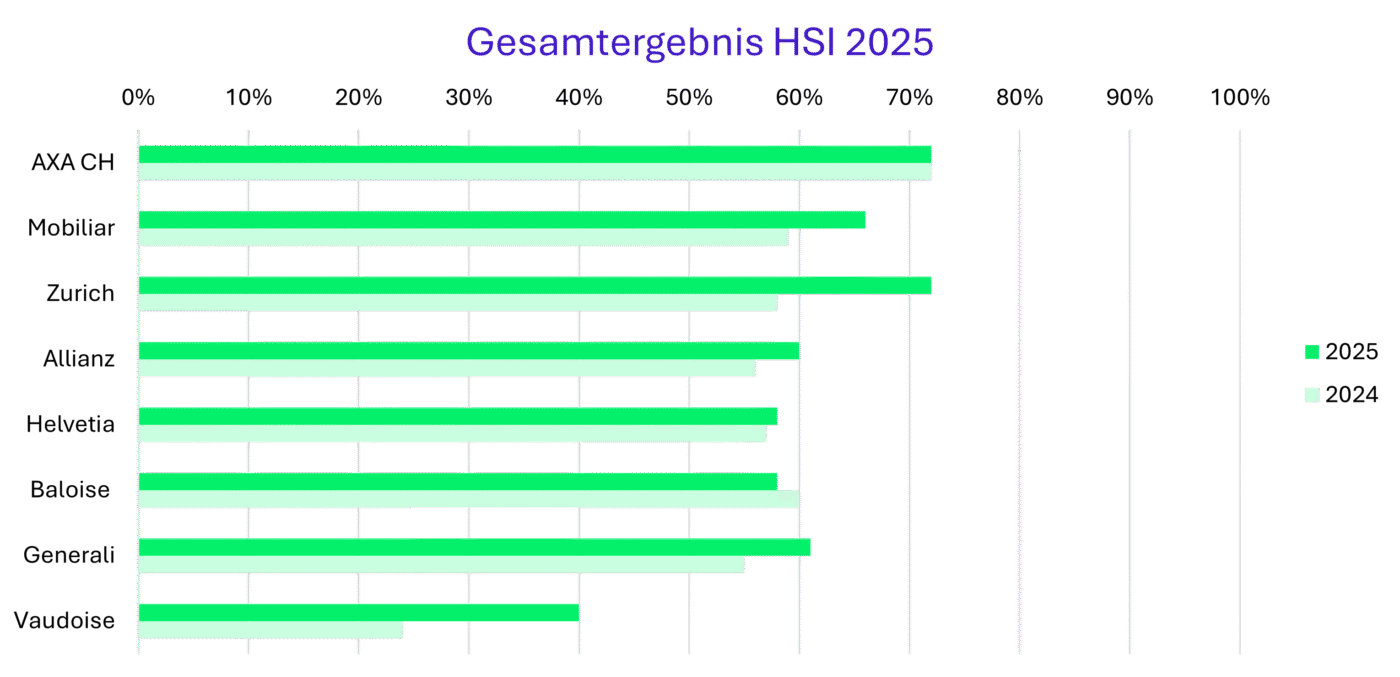
The Hybrid Sales Index 2025 reveals clear differences within the Swiss insurance market. The results are based on a comparative analysis of defined criteria along the hybrid sales journey and sales potential. AXA Switzerland and Zurich are at the top of the list, each achieving the highest level of maturity in hybrid sales with around 72% and are therefore clearly positioned in the advanced omnichannel approach. Mobiliar follows with 66% and also confirms a high, but not yet fully integrated level.
Allianz and Generali are in the midfield, followed by Helvetia and Baloise. These providers have solid digital entry points and functioning individual channels, but continue to show weaknesses in the cross-channel continuation of offers, lead recognition and seamless transfer to personal advice.
Vaudoise is at the lower end of the Swiss insurers surveyed with a maturity level of 40%, which means that it remains in the area of an established but only partially networked multi-channel approach. Overall, it can be seen that none of the insurers surveyed will reach the highest maturity level of customer-centric omnichannel management above 75% by 2025.
The bottleneck lies in linking the channels
Despite this progress, one key weakness remains: The end-to-end hybrid sales journey. As soon as interested parties switch from online offers to a personal consultation or want to process an offer further, there are often media disruptions. Data is not transferred, processes start again, deals are delayed or not closed.
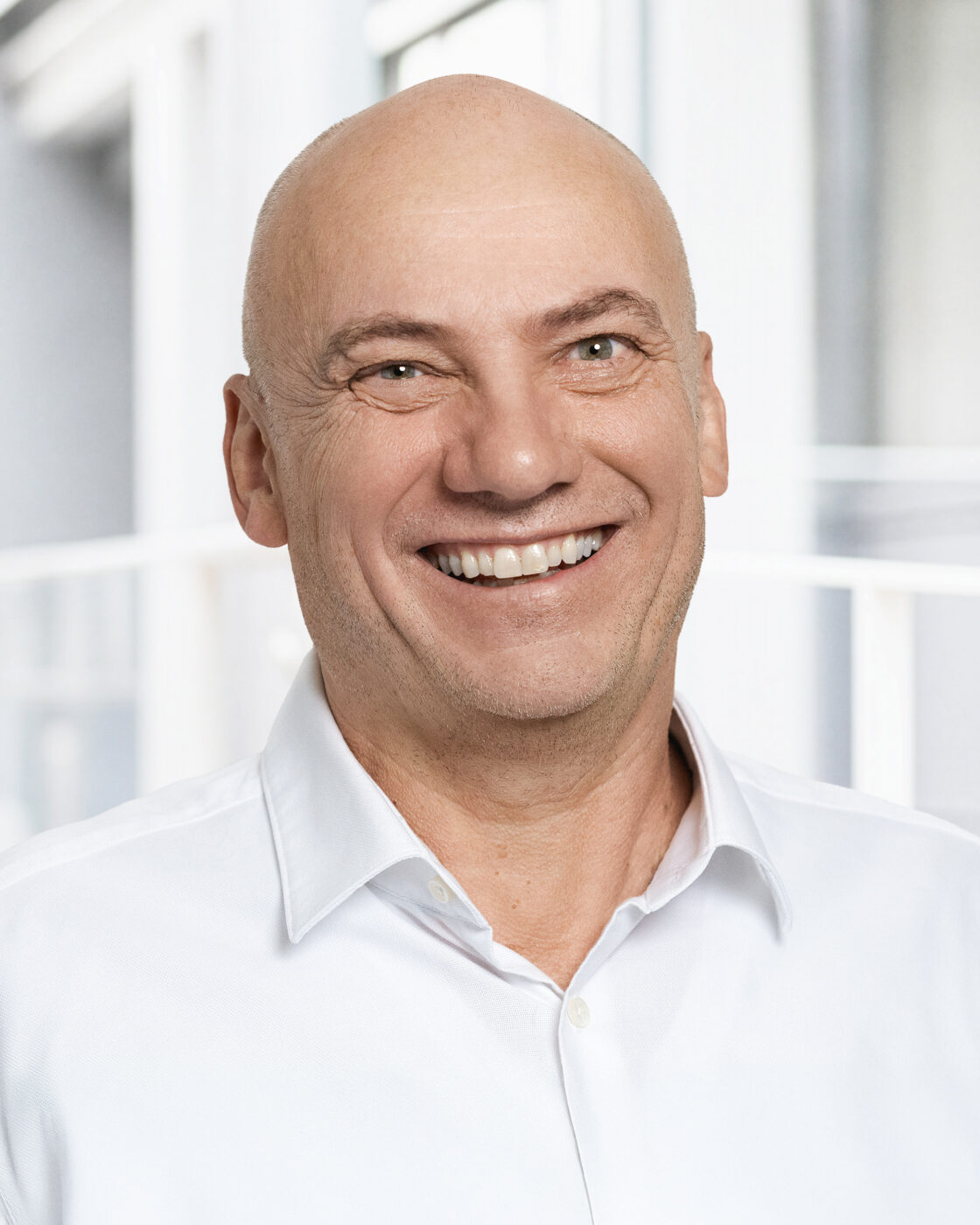
«Switzerland is digitally visible and well positioned, but true hybrid sales only emerge when online and personal advice are seamlessly integrated,» says Dominik Simmen, Associate Partner at Wavestone Switzerland. «Insurers are not characterized by the highest possible number of digital touchpoints, but by the ability to consistently orchestrate customer data, advice and processes along the customer journey and this as an organizational management task, not as a pure IT initiative.»
More visibility - but hardly any progress in lead utilization
Compared to the previous year, Swiss insurers have further professionalized their digital presence. Comparison portals, thematic landing pages and partnerships with digital platforms are playing a growing role in early customer contact. At the same time, the index shows that data-based lead recognition and further processing remain underdeveloped. Only a few providers recognize customers across channels or make it possible to continue a journey that has already begun without friction losses.
Digital consulting and AI remain the exception
Even in 2025, Swiss insurers will only partially exploit the potential of digital advice. Interactive decision support, AI-supported advice and intelligent chatbots have only been used sporadically to date. Yet it is precisely these solutions that could help to relieve the burden on sales and service while improving the customer experience.
Conclusion: The next level of maturity is organizational, not technological
The Hybrid Sales Index 2025 clearly shows that the technical foundations are in place. The decisive factor now is how consistently insurers design hybrid journeys from the customer's perspective. Those who use data intelligently, design transitions cleanly and rethink advice will differentiate themselves in an increasingly comparable market.
Wavestone's Hybrid Sales Index analyzes the sales strategies of leading insurers in the DACH region every year. The study assesses the level of digital maturity and shows how well companies design hybrid sales journeys. You can download the entire index download here for free.
Bechtle bundles public expertise in a Switzerland-wide cluster
The IT service provider Bechtle is pooling the expertise of its three Swiss companies in the public sector in a new, Switzerland-wide cluster. The bundling creates a clearer point of contact for over 1800 public institutions from administration, education and healthcare and strengthens cooperation across all regions.
Editorial - February 11, 2026
Martin Kull, Vice President Bechtle Switzerland. Source: zvg
Bechtle is further expanding its strong position in the public sector and combining the many years of experience of all three Swiss companies - Bechtle Switzerland, Bechtle direct and Bechtle Suisse - in a new, Switzerland-wide Public Cluster. The bundling strengthens cooperation across all regions and creates an even clearer, more integrated point of contact for public institutions for their digital projects.
Over 1800 customers in the public sector
The public sector has been one of Bechtle's most important markets for years. Today, the company serves more than 1,800 customers from administration, education, healthcare and other public sectors and generates revenues of around 225 million Swiss francs in this segment with all three companies. With the new structure, these customers will benefit even more from standardized processes, closely interlinked competence teams and a nationwide network of specialists.
Oliver Sieber takes over technical management
Oliver Sieber, who reports directly to Martin Kull, Vice President Bechtle Switzerland, will take over the technical management of the Public Cluster. This will further strengthen the public sector at a strategic level. The further development will be accompanied by a steering committee. The disciplinary structures in the companies will remain unchanged, as will the sales and customer support models. Key account managers and account managers will continue to look after their customers as before, while at the same time having access to specialized experts throughout Switzerland.
Focus on healthcare
Bechtle pays particular attention to the healthcare sector. Since January, a cross-divisional virtual health team has been active, pooling know-how and developing solutions for hospitals, clinics and other healthcare institutions in a targeted manner. In this way, Bechtle is responding to the increasing demands in the healthcare market and creating additional added value for one of the fastest-growing public sub-sectors.
Advantages for public customers
With the Public Cluster, Bechtle is pursuing the goal of further expanding its role as a central digitalization partner to the public sector. The uniform organization strengthens tendering capabilities, simplifies cooperation between all service units and makes it possible to offer integrated solutions even more effectively from a single source. This creates a clear advantage for public sector customers: more orientation, more efficiency and a more bundled competence profile.
«The public sector is facing challenging digital tasks. With the nationwide Public Cluster, we are ensuring that our customers can access Bechtle's bundled expertise anywhere in Switzerland - for security, digital sovereignty and a sustainable ability to act,» says Martin Kull, Vice President Bechtle Switzerland.
Bechtle Switzerland combines Bechtle Switzerland, Bechtle direct and Bechtle Suisse and is a leading IT service provider in Switzerland. The range of services covers the entire IT life cycle, from consulting to implementation and operation. The Bechtle companies in Switzerland are part of the Bechtle Group, which operates at over 120 locations in 14 European countries.
LIS integrates AI language assistants into warehouse management system
The software company LIS is expanding its warehouse management system LWM with an AI-supported assistance function. In future, users will be able to query stock information, article movements and order data directly in natural language - via text or voice control. The new function will be available from the second quarter of 2026.
Editorial - February 11, 2026
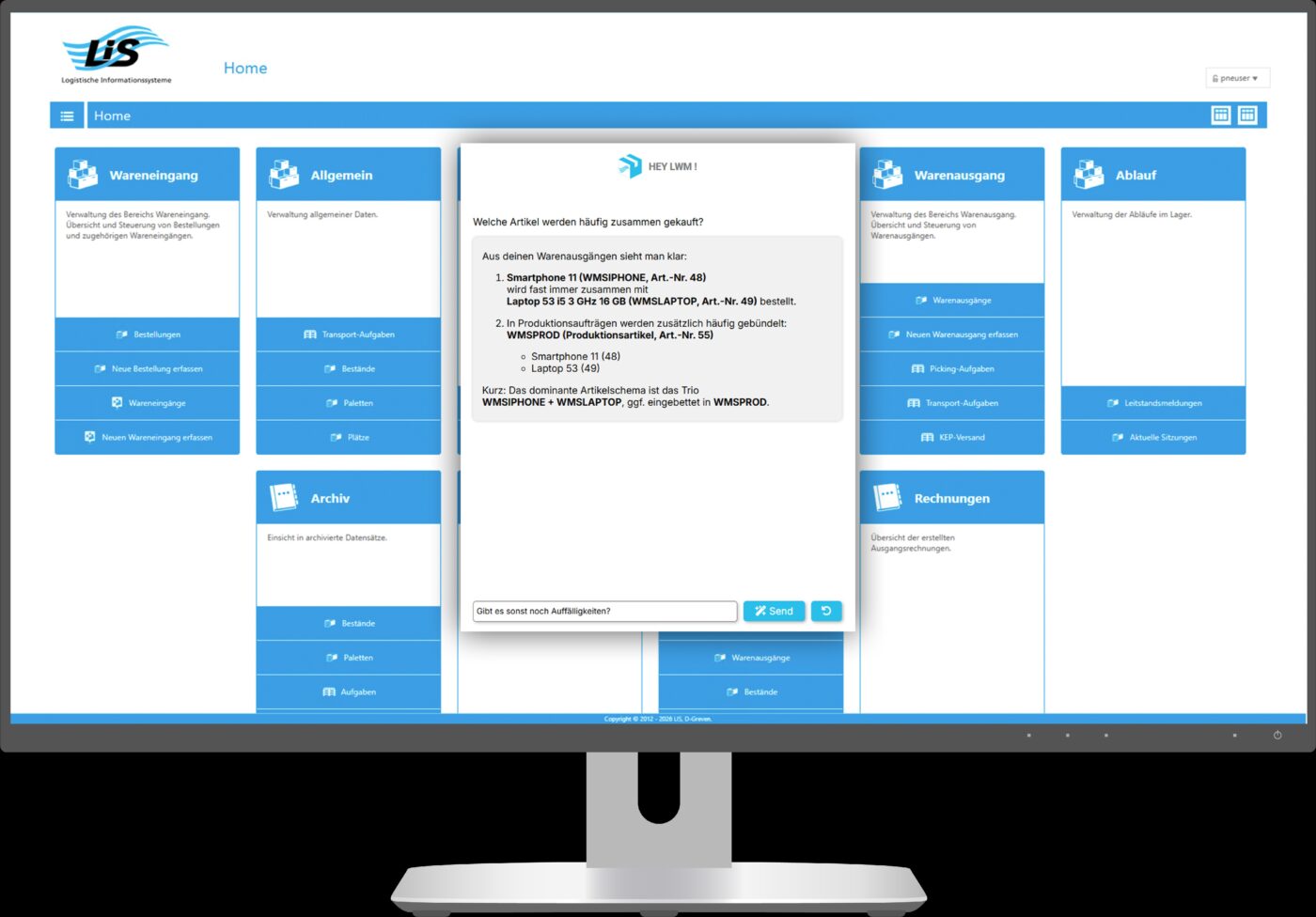
The AI assistant recognizes items that are frequently purchased together and provides context-related evaluations without having to navigate through complex menus. Source: LIS
LIS Logistische Informationssysteme is expanding its LIS Warehouse Management System (LWM) with an AI-supported assistance function that fundamentally simplifies access to warehouse data. In future, users will be able to query stock information, article movements, order data and evaluations directly in natural language, via text input or voice control. Instead of navigating through complex menu structures, users receive context-related answers in real time. This supports faster, well-founded and reliable decision-making in day-to-day warehouse operations. The new function will be available from the second quarter of 2026.
No more lengthy training required
«Access to warehouse data must be quick and uncomplicated in day-to-day operations,» says Philipp Neuser, Head of WMS at LIS. «With the AI integration in LWM, we are significantly reducing this hurdle. The AI itself does not need to be trained and can be used in multiple languages. Employees can use the system like a digital assistant and immediately receive the information they need for their work, without long training periods or in-depth system knowledge.»
The new assistance function directly accesses live data and existing documentation in the system. In addition to classic queries on stock levels or orders, simple data analyses and evaluations can also be created ad hoc. In this way, the AI supports control stations, warehouse management and operational employees in particular when making daily decisions. The aim is expressly not to control processes autonomously or replace employees, but rather to relieve them in their day-to-day work in a targeted manner.
Advantage in the event of a skills shortage
Further added value can be seen during system changes and when onboarding new employees. «Companies lose a lot of time, especially during start-up phases or staff changes, because new users first have to familiarize themselves with interfaces and process logic,» explains Neuser. «Voice-based interaction makes it possible to work productively right from the start. This is a real advantage in times of skills shortages and increasing cost pressure.»
The AI integration fits seamlessly into LIS's existing product strategy of consistently developing LWM in the direction of intuitive operation, greater transparency and faster decision-making processes. «We don't see AI as an end in itself,» emphasizes Neuser. «It has to be used where it solves real problems. That's exactly what this function does in day-to-day warehouse operations.»
ComImpact elects Valerio Stallone and Adrian Wenzl to the Board of Directors
At the general meeting on February 10, Valerio Stallone (HWZ) and Adrian Wenzl (Webrepublic) were elected to the board of the ComImpact association. The association for best-practice insights into CommTech and AI will celebrate its fifth anniversary in 2026 and has already organized 48 events for the marketing and communications community.
Editorial - February 11, 2026
Valerio Stallone, Head of the Department of Marketing & Digital at the HWZ. Source: zvg
Cyril Meier, Chairman of the ComImpact Association, hosted the members« meeting on February 10, which took place at Farner's new location in Sihlcity in Zurich. »It gives me great pleasure to ring in ComImpact's 5th anniversary year today," said Meier. Since its foundation in February 2021, the association and its members have already held 48 events for the marketing and communications community. At least one event per month is also on the program for 2026.
Unanimous election of the new Board members
At the general meeting, Adrian Wenzl (Webrepublic) and Valerio Stallone (Head of Marketing & Digital HWZ) stood for election to the board, which was unanimous. According to Valerio Stallone, ComImpact «addresses precisely those interfaces in its association activities that require a high level of communication skills - technology, methodology and measurable success. In other words, exactly what the HWZ prioritizes in education, training and research.»
Adrian Wenzl, Senior Client Director, Webrepublic. Source: zvg
Tobias Zehnder, Co-Founder and Managing Director of Webrepublic and member of the ComImpact Executive Board, is now handing over to his long-time Webrepublic colleague Adrian Wenzl, Senior Client Director. According to Wenzl, he is very much looking forward to contributing his many years of experience in digital marketing to ComImpact and strengthening the practical exchange of knowledge in today's complex industry environment.
Appreciation of the outgoing member of the Executive Board
Cyril Meier paid tribute to the special role played by outgoing board member Tobias Zehnder, who was not only involved in the founding of ComImpact, but has also been committed to its continuous development as an uncomplicated exchange platform for the industry ever since.
Sonja Kingsley-Curry (UBS), Irene Fischbach (Mobiliar), Andreas Jäggi (Managing Director), Daniel Jörg (Farner), Cyril Meier (President) and Ueli Weber (Media Focus) were confirmed as members of the Board of Directors by the General Meeting.
The ComImpact association was founded in February 2021 and is a network for the promotion of CommTech skills in the communications industry in Switzerland in particular. Its members regularly organize events to exchange know-how. The initiators are Farner Consulting, the HWZ University of Applied Sciences in Business Administration Zurich, Media Focus, Mobiliar, UBS and Webrepublic. Other members include Aclevion, BKW, Digitas (Publicis Groupe), Dreifive, the University of Applied Sciences Northwestern Switzerland, myconvento, OMD, Swiss Post, Swisscom, Swiss Re, Pressrelations, Sonova, Swiss Reputation Group and the ZHAW. The associations IAB, LSA Leading Swiss Agencies, Page Society, PR Suisse and the SWA Swiss Advertising Client Association have issued patronages.
Current information on the association's activities can be found on the website www.comimpact.ch
HR FESTIVAL europe 2026: Focus on speed meetings and input presentations
The HR FESTIVAL europe will take place on March 24 and 25, 2026 at Messe Zürich and is expecting over 6,000 visitors and more than 170 exhibitors. Tickets for the leading event for the Swiss HR community are available now. The program highlights include speed meetings with industry experts and around 75 input presentations on five topic-specific content stages.
Editorial - February 11, 2026
The HR FESTIVAL europe is the leading meeting place for HR professionals in Switzerland. Source: zvg
The HR FESTIVAL europe is establishing itself as the central meeting place for HR professionals in Switzerland. On March 24 and 25, 2026, Messe Zürich will open its doors to over 6,000 visitors and more than 170 innovative exhibitors. The event is aimed at the entire HR community and offers a varied program with first-class speakers.
Speed meetings: compact expert exchange
The Speed Meetings have already established themselves as one of the most popular program items in the past year. The free format offers quick, concise insights into the latest products and solutions from leading companies in the HR sector. In small groups with a maximum of 25 people, participants receive exclusive insights directly from industry experts and concrete solutions for their HR challenges.
Prior registration is required for the speed meetings. Interested parties must first book a ticket for festival entry before they can reserve their speed meeting.
Input presentations on current HR topics
Visitors can look forward to around 75 input presentations on current HR topics at five topic-specific content stages. The focus will be on corporate health, talent management, corporate learning, the future of work and artificial intelligence. All input presentations are free of charge and do not require registration. In the «Meet the Speaker Corner», participants will have the opportunity to talk directly to the speakers after each presentation.
Important innovations in 2026
All content stages will now be held as silent stages. To attend the presentations, visitors will receive headphones directly at the respective stage, which must also be returned there. Participation is only possible with these headphones, own headphones cannot be used.
All keynotes and panels on the Main Stage will be simultaneously translated. The translation will be available in German, French and English. The organizers recommend downloading the «Syntax Translations» app in advance from the App Store or Google Play Store. Participants will receive further information on simultaneous translation directly at the event.
Another highlight is the start-up area with pitches. The start-up presentations take place daily at 11.00 am and 2.00 pm and offer innovative ideas and fresh impulses for the HR sector. HR Today members benefit from free admission and other benefits.
«Bambi Boss»: How women strengthen their self-management
Ute Zischinsky has written a book about female leadership that is aimed at women who shape and take responsibility. «Bambi Boss» shows that self-doubt is not a weakness, but an expression of the ability to reflect. With personal stories and practical exercises, the book accompanies female readers on their way to becoming confident leaders.
Editorial - February 10, 2026
Ute Zischinsky and her book «Bambi Boss». (Image: zVg)
«Bambi Boss» is a book about female leadership that goes beyond traditional role models and leadership models. Ute Zischinsky has written it for women who shape and take responsibility - whether as managers, entrepreneurs, project managers or experts. In addition to leading others, the focus is primarily on self-leadership.
Self-doubt as a sign of the ability to reflect
Ute Zischinsky sheds light on a reality that is rarely talked about: Self-doubt. Because even successful women question themselves more than their male colleagues. «Bambi Boss» shows that doubt is not a sign of weakness, but an expression of the ability to reflect and a sense of responsibility.
With her deep understanding of female characteristics and potential, the author provides a structured overview of key issues in modern leadership. Based on personal experiences and practical exercises, the book invites readers to develop an individual leadership style, gain inner clarity and effectively shape their own influence - both professionally and personally.
Guide and workbook in one
With authentic stories from her coaching practice, Ute Zischinsky illustrates how inhibiting patterns can be sustainably transformed through inner realignment. Designed as a mixture of guidebook and workbook, «Bambi Boss» accompanies readers step by step on the path to becoming a confident leader. A recommendation for all women who want to realize their visions and rethink leadership.
Ute Zischinsky accompanies managers on their way to becoming coherent, authentic leaders. She is particularly interested in supporting women who want to learn to overcome self-doubt and courageously achieve their goals. Born in 1975, she started her career in hotel management. Today, she works with the clear aim of strengthening confident and empathetic leadership and bringing female potential into the world.
The book «Bambi Boss - Female Leadership transforming, authentic, confident - what else!» is published by Businessvillage and has 256 pages. Further information is available at https://www.businessvillage.de/1224.html and https://utezischinsky.eu available.
Management mistakes lead to corporate crises more often than politics
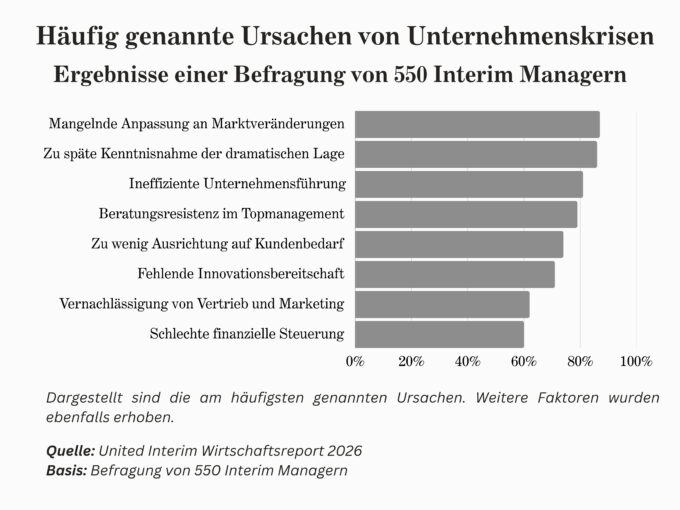
The United Interim Economic Report 2026 shows: When companies get into difficulties, it is usually due to serious management mistakes - not political conditions. A survey of 550 interim managers reveals the most common causes and shows ways out of the crisis.
Editorial - February 10, 2026
Crises in companies: Politics is often not to blame... (Image: Depositphotos.com)
When companies get into difficulties, it is usually less due to unfavorable political conditions than to serious mistakes at management level. This is the conclusion of the 2026 Business Report by the management community United Interim. The study was compiled by 15 experienced interim management specialists and is based on a survey of 550 interim managers.
Lack of adaptation and late reaction as the main reasons
According to the report, the most common reasons for the decline are a lack of adaptation to market changes (87 percent), too late recognition of the dramatic situation (86 percent), inefficient company management (81 percent), resistance to advice from top management (79 percent), too little focus on actual customer needs (74 percent), a lack of willingness to innovate (71 percent), neglect of sales and marketing (62 percent) and poor financial management (60 percent).
«Sometimes the management mistakes are really hair-raising,» marvels Jan Beutnagel. «In many cases, I wish I had been called in to help a year or at least six months earlier,» adds his colleague Klaus-Peter Stöppler. «We are so busy putting out fires that we don't have time to eliminate the causes of fires,» says Dr. Andreas Vieweg, describing the prevailing company mentality that leads to permanent inefficiency in companies.
Ulrich Schmidt adds: «So as not to be misunderstood: Many companies are very well managed and rely on interim managers for specific transformation projects. But there are also many other cases where you ask yourself how things got this far before you call in external help.»
Source: United Interim Economic Report 2026
Data waste, cluster risks and a lack of future technologies
The survey revealed further reasons: inadequate risk management (57 percent), poor HR policy and loss of key personnel (55 percent), lack of communication between management and other stakeholders (54 percent), taking excessive cluster risks (54 percent), exclusive focus on costs (52 percent), failure to adapt to new regulations (51 percent), insufficient focus on the core business (51 percent) and lack of cost control (47 percent).
Dr Andreas Vieweg reports: «Many companies neglect their master data for many years: a lack of maintenance and structure costs efficiency in processes, prevents evaluability and inhibits standardization. The data waste requires more controllers - the course to a crisis is basically pre-programmed.»
Christian Jung points to another example: «Many automotive suppliers have been hit so hard by the automotive crisis because they have only focused on this sector - a classic cluster risk. The risk has been visible at least since the massive political intervention in the issue of electric versus combustion engines, but has all too often been suppressed.»
Christian Florschütz adds: «The neglect of customers is just as common. Companies do all sorts of things, from cost-cutting measures to management overhauls and restructuring, but rarely do they address the core issue of how to focus more on customer needs.»
Eckhart Hilgenstock has observed: «Many companies are so deep in crisis mode that they cannot find the strength to leverage the potential of new technologies such as artificial intelligence.»
Personnel policy as a key factor
Paul Stricker has identified a misguided HR policy as a frequent cause of company downfall: «Incorrect appointments, a lack of management development and a failure to adapt to new working environments lead to top performers leaving a company and only the administrators remaining.»
His colleague Ulf Camehn knows from experience: «As a rule, the first management level needs to be replaced, as well as at least fifty percent of the second management level, which is often THE »paralyzing layer' for change." In practice, a targeted realignment of the HR strategy is needed to get a company in difficulties back on track.
Ulvi Aydin sees light at the end of the tunnel: «The number of insolvencies in Germany in 2025 has risen significantly less than in the previous year.» He refers to the latest figures from Creditreform, according to which around 285,000 employees were affected by their employer's insolvency last year - 6,000 fewer than in 2024.
Jane Enny van Lambalgen counters: «In addition to the immediate damage caused by unemployment with the corresponding burden on social systems and bad debts, which ripple through the economy like waves and drag other companies into the maelstrom, know-how, innovative strength and industrial skills are lost in the long term.»
Asia as a strategic sales market
Roland Streibich names the causes of the economic slump: «The EU's unspeakable anti-economic course, reinforced by German politicians over the years, has ultimately led to the current situation. This historical blame clearly lies with the politicians. But it is up to companies to focus on their core competence in this situation - to take action - and not to rely on politics.»
«Blaming politics is no substitute for a corporate strategy,» explains Dr. Harald Schönfeld. Friedhelm Best recommends «looking to Asia». He analyzes: «In view of Europe's weakness and global uncertainties, companies should focus more on Asia as a stable, strategically important sales market for sustainable growth and innovation.»
«In view of the serious weaknesses of Germany as a business location, relocation is actually the best way forward from a business perspective in many cases,» says Dr. Sven Mues. This is particularly true for industrial companies that have to contend with excessively high energy costs and excessive German bureaucracy. «Instead of expanding a plant in Germany, relocating production abroad is often quicker, more cost-effective and more future-proof,» says Dr. Sven Mues, who is familiar with specific projects of this kind.
Trust and change management as success factors
The 550 interim managers surveyed reported what is most important when they take the helm in a crisis: establishing trust in the management and its decision-making power (89 percent), change management appropriate to the situation (88 percent) and crisis experience (84 percent).
«Turnaround management is above all strong leadership coupled with experience, swift action and clear communication with all stakeholders,» Klaus-Peter Stöppler knows from numerous projects. «Leadership skills with a team player mentality» is what more than two thirds (68 percent) of the interim managers contacted call it.
Other important factors are analytical skills (70 percent), strategic planning (69 percent), high resilience and negotiation and communication skills (64 percent). Reliable business and liquidity planning (58%) and a focus on eliminating reasons for insolvency (49%) are also important.
Why turnaround attempts fail
Turnarounds are not always successful. Creditreform counted around 24,000 company insolvencies in 2025 - a ten-year high. ’Many companies don't even think about bringing in an interim manager to avert the worst, or take this step so late that nothing can be saved,« wonders Dr. Harald Schönfeld, founder and managing director of the personnel consultancy Butterflymanager, which specializes in the placement of interim managers.
In fact, «acting too late» is the most common reason for the failure of turnaround projects, according to 86 percent of the temporary managers surveyed. In second place comes resistance to advice and a lack of consequences (80 percent).
The other causes of failure: lack of trust in those responsible for the turnaround (61 percent), poor stakeholder management (58 percent), exclusive focus on cost reduction and lack of confidence in the rescue concept (57 percent), loss of key personnel (41 percent), too many individual measures (34 percent) and incomplete performance programs (25 percent).
Insights from the survivors
What do companies learn that succeed in crossing the valley of tears and sailing back to success? The answers from interim managers: Maintain transparent communication (84 percent), act closer to the market (83 percent), focus more on the customer (79 percent), streamline processes and be willing to change quickly (75 percent), focus on cash flow instead of fixating on sales (61 percent), improve company culture (58 percent), exercise financial discipline (57 percent), streamline the portfolio and focus on the core business (55 percent), report more accurately (52 percent), increase the rate of digitalization (49 percent) and place greater emphasis on business development (48 percent).
«Restructuring is often only possible with a change of management in order to implement these findings,» Ulf Camehn knows from practical experience. «Many companies only learn to focus on their customers and their needs again during restructuring,» explain Christian Florschütz and Eckhart Hilgenstock in unison.
It is important to Jane Enny van Lambalgen to emphasize «that despite all the sometimes serious management weaknesses, the deterioration in the political framework conditions over many years has contributed significantly to the current imbalance of the entire business location». Her colleague Jan Beutnagel puts it in a nutshell: «Good managers also get their companies through bad times. These times are the result of anti-business policies - exacerbated by a lack of self-criticism and responsibility in parts of the economy.»
United Interim is the leading digital platform and the only ecosystem for interim management in Germany, Austria and Switzerland. As an open online community and curated pool, United Interim reaches well over 12,000 interim managers in the DACH region. Over 550 selected interim managers took part in the survey for the 2026 Business Report.
Renaissance becomes majority shareholder of Asic Robotics
Renaissance has repositioned itself as the majority shareholder in the Asic Robotics Group. The move marks another milestone in the long-term partnership that began back in 2013. The management is also acquiring a stake in the company and is thus relying on a stable, Swiss shareholder base.
Editorial - February 10, 2026
Asic Robotics focuses on automation solutions as well as test and assembly lines for industrial applications. Source: zvg
The Swiss investment foundation Renaissance has announced that it is now the majority shareholder of the Asic Robotics Group. This step marks a further milestone in a long-term partnership, according to the statement. This partnership began in 2013 when Renaissance acquired a stake in Asic Robotics. The management of Asic Robotics shares Renaissance's vision and has also acquired a stake in the company.
Asic Robotics, based in Burgdorf (BE), unites several companies in the field of modern mechanical and plant engineering. The focus is particularly on automation solutions as well as test and assembly lines for industrial applications.
Stability and long-term investment philosophy
The new ownership structure strengthens a stable, Swiss shareholder base that is closely aligned with the management. It is also in line with Renaissance's evergreen model and its long-term investment philosophy. At the same time, the coordination between shareholders, the Board of Directors and management will be further strengthened.
«Renaissance is looking forward to accompanying Asic Robotics in the long term and supporting sustainable growth based on stability, corporate responsibility and strong roots in Switzerland, while preserving the company's industrial DNA and strategic independence,» said Martin Herceg, Investment Director at Renaissance.
New management structure
In this context, Milo Gasser, former CEO of Asic Robotics with over 20 years of experience within the Group, has been appointed Chairman of the Board of Directors. Micha Kühne, CEO of Asic Robotics, adds: «Thanks to the new shareholder structure, Asic Robotics is ideally positioned to continue its growth strategy in the long term and to further expand and strengthen its role as a reliable Swiss industrial partner.» For employees, customers and partners, everything will remain the same operationally: activities at the Burgdorf and Radolfzell sites will continue unchanged.
This development reflects Renaissance's DNA: to accompany Swiss industrial SMEs over the long term, while preserving their identity and independence and with a clear vision of sustainable value creation, together with a management team that is fully committed to the company.
Smart Monday: Staying healthy in your job until retirement
On March 16, 2026, experts from occupational health management, HR and science will discuss how employees can make their working day healthy at Smart Monday. Moderator Kathrin Hönegger will lead the panel discussion with Beat Hunziker (Helsana), Eva Keller-Hunkeler (Forum BGM Zurich) and Prof. Dr. Georg Bauer (UZH).
Editorial - February 9, 2026
The Zurich Commercial Association invites you to the «Smart Monday» event series. (Image: zvg)
Increasing demands, a fast pace and changes in everyday working life pose major challenges for employees. A healthy way of working is essential if you want to stay healthy in your job until you retire. The Zurich Commercial Association invites you to Smart Monday on March 16, 2026 to discuss precisely this question: How can everyday working life be organized in such a way that employees remain motivated and productive?
Top-class panel guests
The event brings together three proven experts from different areas. Beat Hunziker, Head of Human Resources at Helsana, will contribute the HR perspective. Eva Keller-Hunkeler, Head of Forum BGM Zurich, represents the perspective of occupational health management. Prof. Dr. Georg Bauer, Head of the Department of Public & Organizational Health at the EBPI of the University of Zurich, provides the scientific background.
Kathrin Hönegger moderates
The panel discussion will be hosted by Kathrin Hönegger, known as a presenter on SRF3 radio and the SRF knowledge program «Einstein». Her curiosity and thirst for knowledge, as well as her talent for communicating with everyone about everything, make her the ideal presenter for this format.
Further events in the program
Smart Monday on March 16 is part of a series of events organized by the Kaufmännischer Verband Zürich. On May 18, another Smart Monday will take place in the Kaufleuten Klubsaal on the topic «Where do I want to go? Gaining professional clarity». This will be followed on August 31 by a Digital Smart Monday on the topic of «Confidently entering salary negotiations», which will be held online via Zoom.
Feldschlösschen celebrates 150 years with a ceremony
The traditional brewery Feldschlösschen celebrated its 150th anniversary with a ceremony in Rheinfelden. Around 250 guests, including Federal Councillor Albert Rösti, paid tribute to the anniversary on February 8, 2026 and toasted to a shared future.
Editorial - February 9, 2026
Around 250 guests celebrated Feldschlösschen's 150th birthday. Source: zvg
Feldschlösschen celebrated its 150th anniversary with a festive ceremony on Sunday, February 8, 2026. Around 250 guests came together in the heart of the brewery in Rheinfelden to celebrate the anniversary of the traditional company. Among those present was Federal Councillor Albert Rösti, who accepted the brewery's invitation.
The ceremony was characterized by solidarity and togetherness. In an informal setting, the guests toasted the shared future and paid tribute to the 150-year history of the brewery, which has been cultivating the Swiss brewing tradition since 1876.
The celebrations took place in the heart of the brewery in Rheinfelden. Source: zvg
With this anniversary, Feldschlösschen underlines its long-standing importance for the Swiss beverage industry and looks to the future with optimism. The brewery from Rheinfelden is one of the best-known brands in the country and combines tradition with innovation.
SMG Swiss Marketplace Group focuses on joint prevention of cybercrime
The SMG Swiss Marketplace Group hosted the first Cybersecurity Day and brought together representatives from the authorities, business and prevention. The focus was on concrete approaches against fraud, identity misuse and phishing. It became clear that cybersecurity is a matter for the boss and prevention must start earlier.
Editorial - February 9, 2026
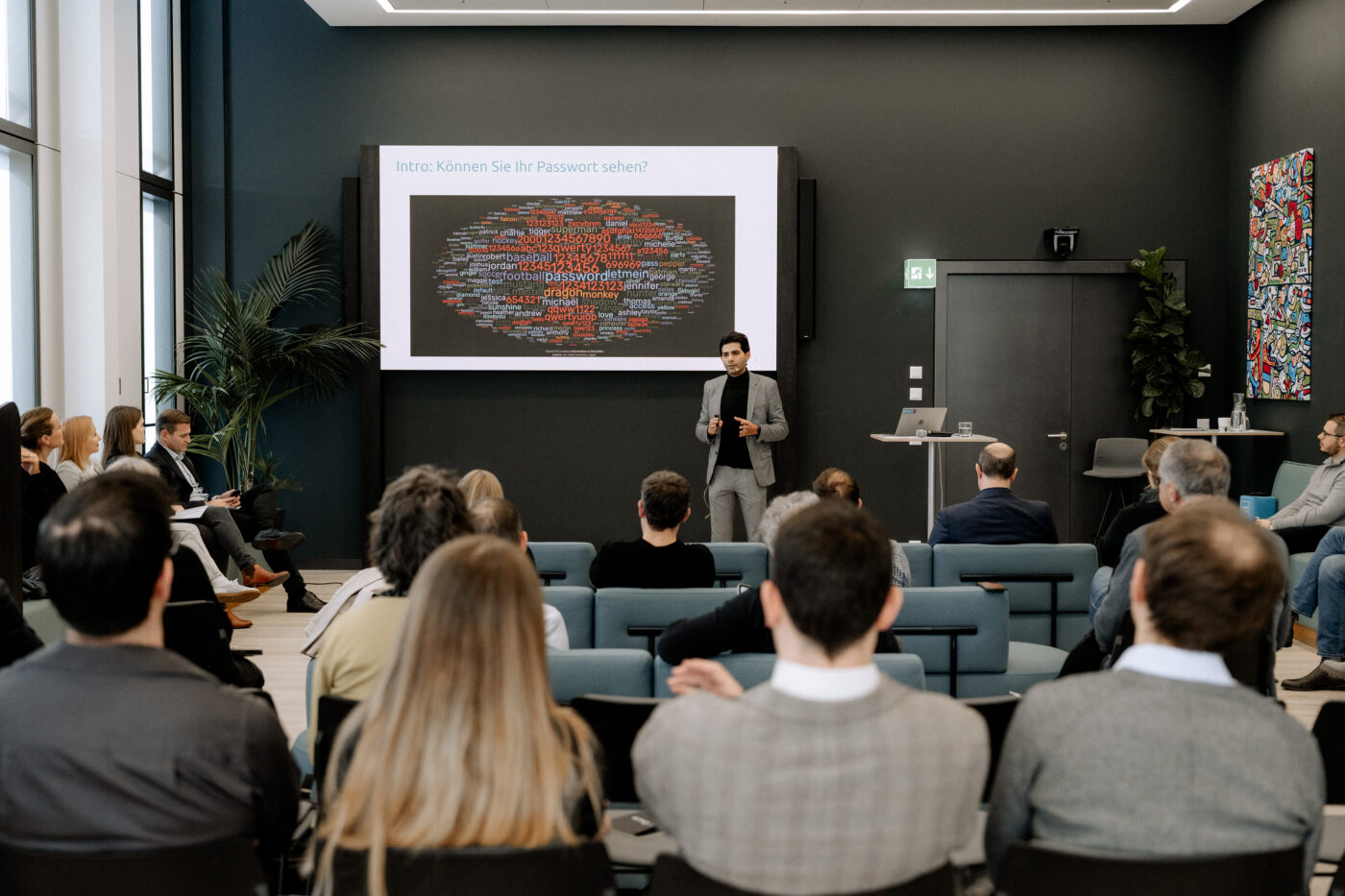
Mostafa Hassanin (Group CISO/CSO SMG) at the first SMG Cybersecurity Day. Source: zvg
Cybercrime continues to increase in Switzerland and shapes the everyday digital lives of millions of users. The SMG Swiss Marketplace Group invited representatives from authorities, prevention, business and specialist organizations to the first SMG Cybersecurity Day to discuss specific approaches to combat fraud, identity misuse and phishing. The aim: to share insights, openly discuss challenges and jointly develop measures against cybercrime.
Trust as the basis of digital marketplaces
Christoph Tonini, CEO of SMG, kicked things off. He emphasized that trust is the foundation of digital marketplaces and that security must be continuously strengthened to achieve this. Cybersecurity is also a prerequisite for innovation because it creates the basis for implementing new solutions responsibly and sustainably.
Protective effect instead of high investments
The SMG Group Security, Safety and Trust team gave an insight into the interplay between technology, processes and prevention in protecting online marketplaces. Group CISO/CSO Mostafa Hassanin made it clear that cyber security is a matter for the boss. The decisive factor is not the level of investment, but maximum, risk-based and clearly prioritized protection in the right places. No matter how much is invested, there is no end state. Attackers are constantly evolving and you have to continuously improve.
The dual role of artificial intelligence was also discussed. Attacks are becoming more scalable; at the same time, AI can relieve the burden on security teams and support detection, provided it is embedded responsibly in processes. A second presentation focused on digital identity. Examples were used to show how identities and access on SMG's platforms can be protected in a more phishing-proof and context-dependent manner in order to reduce account takeovers and attempted fraud - for example through passwordless logins and registrations.
Cybersecurity as a task for society as a whole
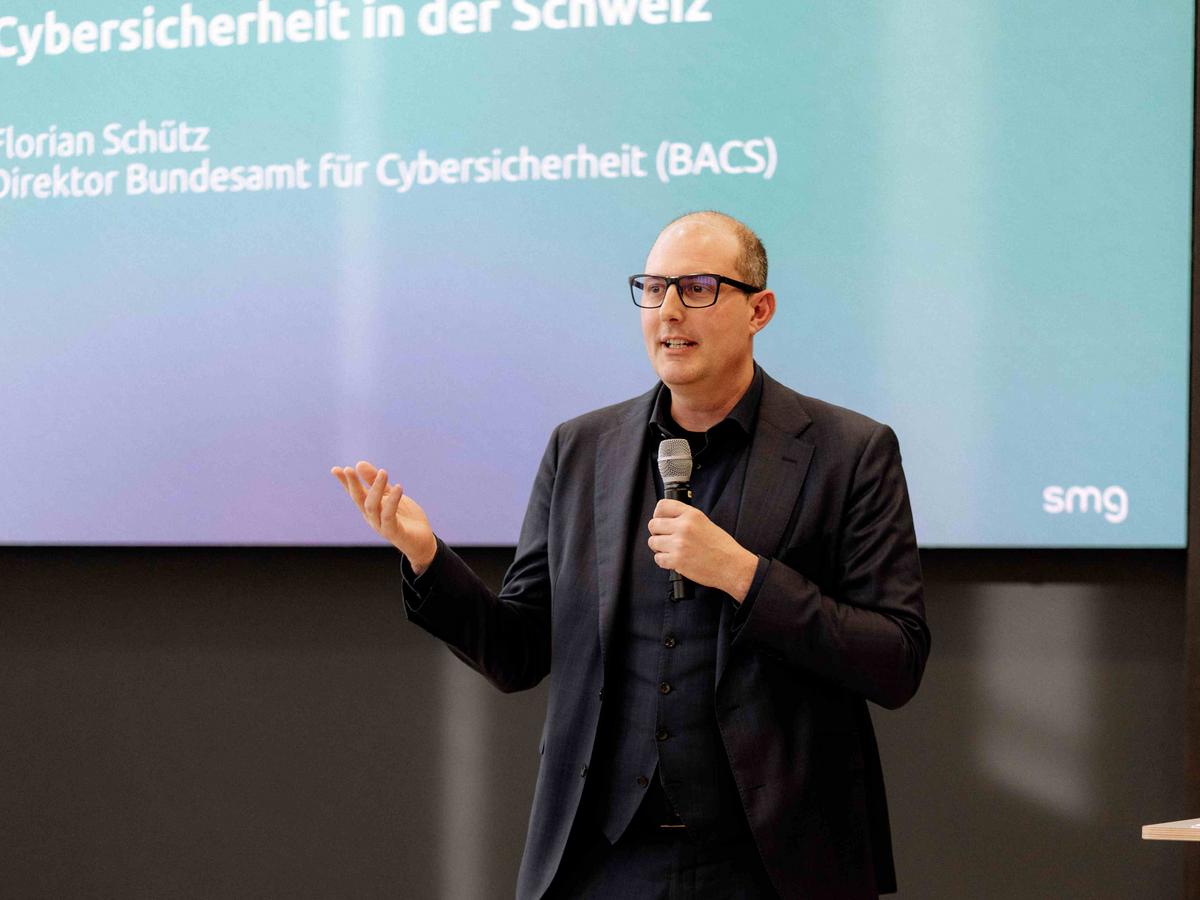
Florian Schütz, Director of the Federal Office for Cybersecurity (BACS), categorized cybersecurity as a task for society as a whole. Source: zvg
Florian Schütz, Director of the Federal Office for Cybersecurity (BACS), provided an overview of the current threat situation. He categorized cyber security as a task for society as a whole. With increasing digitalization, crime is also shifting into the digital space. Attacks, dependencies on infrastructures and rising security costs not only affect individual organizations, but also the resilience of the economy and society as a whole. This makes cooperation between the state, business and local institutions all the more important. Schütz cited investment in product security and high minimum standards as further levers.
Prevention must start earlier
In the panel discussion that followed, Florian Schütz, Fabian Ilg (Managing Director of Swiss Crime Prevention), Mostafa Hassanin and Jessica List (Chief Corporate Officer SMG) discussed key issues relating to cyber security and the roles that business, authorities, prevention actors and the media can play in this. A common denominator was found: Reaction alone is not enough - prevention must start earlier. At the same time, criminal prosecution and professional management of incidents remain crucial.
Education and comprehensibility were also emphasized: cyberattacks are often successful not because they are technically particularly complex, but because risks are misjudged in everyday digital life, reinforced by increasing AI-supported social engineering methods. The media was named as an important multiplier for classification, everyday protection tips and reliable expert voices. At the same time, it became clear that cybersecurity requires continuous work. The protection of digital platforms is an ongoing process and requires a balance between user experience, data protection and security measures.
Mostafa Hassanin summarizes: «Cybercrime is a lucrative business model as long as the return is high and the risk is low. Prevention is therefore crucial. We need to detect attacks earlier, make monetization more difficult and raise people's awareness so that they recognize warning signals more quickly and react correctly. This is exactly what we work on every day at SMG.»
SMG is further expanding the protection mechanisms on its online marketplaces through improvements in technology, processes and education. At the same time, cooperation with authorities and prevention partners is to be intensified in order to contain cyber risks even more effectively.
EY Entrepreneur Of The Year 2026: Registration started
EY is looking for innovative entrepreneurial personalities from Switzerland for the 29th time. Interested parties have until March 27, 2026 to apply in the categories Scale-up Leaders, Visionary Entrepreneurs and Entrepreneurs in Family Business. The award ceremony will take place on October 23, 2026 at the Kongresshaus Zurich.
Editorial - February 9, 2026
Frédéric Tissot, Head of EY Entrepreneur Of The Year Switzerland. Source: zvg
With the EY Entrepreneur Of The Year Award 2026, the audit and advisory firm EY is once again looking for innovative and committed entrepreneurs from all over Switzerland. The award is part of a year-round program that offers exchange, networking and increased visibility within a strong network of entrepreneurs. This is the 29th time the company has held the program in this country.
Three categories to choose from
The registration phase started on February 4 and runs until March 27, 2026. Interested parties can participate in the categories Scale-up Leaders, Visionary Entrepreneurs and Entrepreneurs in Family Business. The prerequisite is that both the entrepreneurial role of the nominee and the basic criteria of the company are fulfilled. Specific requirements apply for each category. The complete conditions of participation are available on the application platform.
An independent jury of ten members evaluates all candidates, selects the finalists and decides on the winners. The award will then be presented at a gala ceremony on October 23, 2026 at the Kongresshaus Zurich.
Platform for visibility and exchange
«We want to encourage entrepreneurs across Switzerland to actively register for the program. The EY Entrepreneur Of The Year offers a unique platform to create visibility, reflect on one's own work and recognize the achievements of the teams behind the companies. At the same time, we promote an open and diverse network in which the focus is on exchange at eye level. Participation opens up new perspectives and makes it possible to experience entrepreneurial success throughout Switzerland,» says Frédéric Tissot, Head of EY Entrepreneur Of The Year Switzerland.
Global network with over 50,000 companies
The presentation of the award is the highlight of a year-round program for all candidate entrepreneurs. However, the award is more than just the «Oscar of Entrepreneurship»: it is a close and established network for entrepreneurial personalities that enables and promotes contact and exchange - among all candidates who have participated in the competition worldwide. Today, the global network comprises 60 programs in more than 94 countries and regions and connects over 50,000 entrepreneurs worldwide.
Top-class jury
The jury for the award in Switzerland consists of ten independent members. The committee includes the following personalities from the Swiss economy: Adrienne Corboud Fumagalli (Board Chair Unyversal Technologies, Board Member Swiss Life), Marco Gadola (Board Chair DKSH and Medartis, Board Vice Chair Straumann Group), Thomas Hanan (Founder & CEO Webrepublic, EY Entrepreneur Of The Year 2017), Jan Lichtenberg (CEO & Co-Founder InSphero, EY Entrepreneur Of The Year 2015), Didier Maus (Board Chair Maus Frères), Michael Mueller (Group CEO Valora & Head Europe FEMSA Proximity & Health), Piero Poli (Board Chair & CEO Rivopharm), Jean-Marc Probst (Board Chair Probst Group Holding), Franziska Tschudi Sauber (Board Chair Weidmann Holding, EY Entrepreneur Of The Year 2022) and Pascale Vonmont (CEO/Director Gebert Rüf Stiftung).
EY Switzerland is supported by Julius Baer as program partner and Girard-Perregaux, HDI Global, SWISS and Volvo Cars as sponsors.